Hip fracture discharge checklist template for families
A family-caregiver discharge checklist for a parent recovering from hip fracture surgery: equipment, medication reconciliation, follow-up appointments, home safety, who to call for what, the PT schedule, and red flags to watch. Built for the two real pathways — fracture to SNF to home, and fracture straight home.
Get the free printable hip fracture discharge checklist ↓No account required.By Rachel Moore, Founder, Sagebeam · Published July 2026 · How we research and review our guides
Part of: Medical transitions for aging parents – before/after plan
If you are reading this, you are probably the person organizing your parent's return from a hip fracture — not the patient. That distinction is the whole point of this checklist. Almost everything you will find when you search "hip fracture discharge" is written for the person who had the surgery. But the person who actually manages the discharge is usually an adult child juggling the equipment order, the ride to the follow-up, the new blood thinner, and a parent who cannot yet get to the bathroom alone. You need a different tool.
A hip fracture discharge is one of the higher-stakes handoffs in family caregiving. The surgery fixes the bone, but the weeks afterward are where outcomes are actually won or lost: whether the medications get taken correctly, whether the home is safe enough to prevent a second fall, whether physical therapy actually happens, and whether a clot or an infection gets caught early. The discharge team hands you a stack of paper on a busy day, and the details that matter most are easy to lose in it. This checklist is designed to make sure nothing critical falls through.
This article is educational and is not medical advice. Always follow the instructions you receive from your parent's surgeon, hospital or facility discharge team, and physical therapists. If anything here conflicts with their guidance, follow their instructions — they know your parent's specific fracture, repair, and weight-bearing status.
Two pathways, one checklist
Before you use the checklist, know which pathway your parent is on, because the timing changes.
Fracture → skilled nursing facility (SNF) or inpatient rehab → home. This is very common for older adults. Your parent leaves the hospital not for home but for a facility that provides daily therapy, because they cannot yet transfer, walk, or manage self-care safely. You will do this discharge process twice: once from the hospital to the SNF (lighter — the facility takes over most tasks) and again, the bigger one, from the SNF to home a few weeks later. Medicare's rules for who pays for that facility stay are specific and worth understanding early; see what Medicare covers at a skilled nursing facility and what a skilled nursing facility actually is. If the team is still deciding between home and a facility, understanding the home-vs-SNF discharge recommendation walks through how that decision gets made.
Fracture → home. Some parents go straight home from the hospital with home health services, usually because they were stronger before the fall and have enough in-home support. Here the full home setup has to be ready fast — often within a day or two of surgery.
The checklist below works for both. The equipment, medication, appointment, safety, and red-flag sections apply to whichever discharge is sending your parent home; the pathway-specific notes flag what changes.
What this checklist covers — and what it does not
It covers: the equipment that must be in the home and working, medication reconciliation (with special attention to the blood thinner nearly every hip fracture patient goes home on), scheduling and getting to follow-up appointments, a home safety pass focused on second-fall prevention, a "who to call for what" contact sheet, the physical therapy plan, and the warning signs to monitor.
It does not cover: your parent's specific weight-bearing status, incision care technique, or medication doses — those come from the surgeon and discharge team and must be filled in from their written instructions. This checklist is the scaffold; their instructions are the content. It is also not a substitute for the discharge conversation. Use it during that conversation to make sure every box gets a real answer before your parent leaves.
The hip fracture discharge checklist
Copy this into a note or print it. Work through it in the days before discharge, not on discharge day. An empty box the morning of discharge is a problem to raise with the team, not a task to figure out alone in the parking lot.
1. Equipment — in the home and working before arrival
| Item | Needed? | In place? | Notes |
|---|---|---|---|
| Front-wheeled walker (correct height) | Confirm PT set the height | ||
| Raised toilet seat or commode | Standard toilets are too low after hip surgery | ||
| Shower chair or tub bench | Never let a recovering parent stand to shower | ||
| Grab bars (bathroom, by toilet) | Suction bars are not enough — mounted if possible | ||
| Long-handled reacher / grabber | Avoids bending past hip precautions | ||
| Sock aid / long-handled shoehorn | For dressing without bending | ||
| Firm chair with armrests | Low, soft couches are hard to rise from | ||
| Hospital bed or wedge (if ordered) | Only if the team ordered it | ||
| Ice packs / prescribed cold therapy | For swelling per instructions |
Pathway note: For a SNF-to-home discharge, ask the facility's therapy team what equipment your parent actually uses there so home matches it. For fracture-straight-home, this list has to be ready within a day or two — start ordering before discharge day.
2. Medication reconciliation
| Task | Done? | Notes |
|---|---|---|
| Get the reconciled discharge med list (not the pre-fall list) | Ask which meds were stopped, changed, or added | |
| Confirm the blood thinner (anticoagulant) and its stop date | Almost universal after hip fracture to prevent clots | |
| Confirm pain medication plan and taper | Ask how to step down without under-treating pain | |
| Confirm stool softener / laxative | Opioids + reduced movement cause constipation | |
| Confirm any bone-health or supplement changes | Calcium, vitamin D, osteoporosis meds | |
| Fill every prescription before discharge day | Avoid a gap in the blood thinner | |
| Build a written daily medication schedule | Times, doses, with-food notes |
The blood thinner is the single most important line here. Missing doses raises clot risk; taking it past its stop date raises bleeding risk. Write the exact stop date somewhere everyone can see it. For the day-to-day side — a dose-taken checkbox per day, the prescriber's missed-dose instruction, and a bleeding-and-bruising observation log — use the blood thinner tracker alongside this checklist.
3. Follow-up appointments — scheduled and transported
| Appointment | Date/time | Ride confirmed? |
|---|---|---|
| Surgeon / orthopedic follow-up (often ~2 weeks) | ||
| Staple/suture removal (if separate) | ||
| Primary care follow-up | ||
| Outpatient physical therapy start | ||
| Any imaging (X-ray) ordered |
An appointment with no ride is not scheduled. A parent recovering from hip surgery usually cannot drive and often cannot get into a standard car easily — sort transportation for each visit now.
4. Home safety — second-fall prevention
A second fall is the outcome this whole checklist exists to prevent. The CDC's older adult fall prevention resources are good background; the priorities for a hip-surgery home are:
| Task | Done? |
|---|---|
| Clear walker-width paths through the whole route your parent uses | |
| Remove throw rugs and secure cords | |
| Add night lights on the path to the bathroom | |
| Set up a main-floor living space if bedrooms are upstairs | |
| Keep phone, water, glasses, tissues within reach of the chair/bed | |
| Non-slip mats in the bathroom | |
| Confirm the bathroom is reachable without stairs | |
| Remove or rearrange low, soft, or wheeled furniture |
5. Who to call for what
| Situation | Who to call | Number |
|---|---|---|
| Emergency (chest pain, severe shortness of breath, hard fall) | 911 | 911 |
| Surgical / wound question | Surgeon's office | |
| Medication question | Pharmacy / prescriber | |
| Therapy question | Home health or outpatient PT | |
| General decline / new symptom | Primary care | |
| Home health scheduling | Home health agency | |
| Equipment problem | DME supplier |
Fill in every number before discharge. In the moment, no one should have to figure out whether a symptom is a surgeon question or a 911 call — the sheet decides.
6. Physical therapy plan
| Item | Answer |
|---|---|
| Weight-bearing status (as tolerated / partial / non-weight-bearing) | |
| Home health PT starting? How many visits/week? | |
| Outpatient PT starting? When? | |
| Prescribed home exercises | |
| Hip precautions (movements to avoid) |
Therapy is not optional recovery — for hip fracture it is the recovery. Missed early PT is one of the strongest predictors of a worse functional outcome.
7. Red flags to monitor
| Warning sign | Action |
|---|---|
| New calf pain, swelling, warmth, or redness | Call surgeon/PCP — possible clot |
| Sudden shortness of breath or chest pain | Call 911 — possible pulmonary embolism |
| Wound redness, drainage, opening, or fever | Call surgeon's office |
| Sudden confusion or big behavior change | Call PCP; 911 if severe |
| Pain not controlled by the plan | Call prescriber |
| A fall (even without obvious injury) | Call surgeon's office; call 911 if your parent hit their head, is on a blood thinner, is newly confused, cannot move, or has severe pain |
Blood clots are the warning sign families most often miss because early symptoms look minor. MedlinePlus explains how deep vein thrombosis can develop after surgery and why sudden shortness of breath is an emergency. For a fuller walkthrough of every post-surgery warning sign and its threshold, keep warning signs after hip surgery: when to call the doctor next to this checklist.
How to adapt it
For the SNF-to-home discharge, treat the facility's therapy and nursing staff as your best source. Ask them what equipment your parent uses, how they transfer, how much help they still need for the toilet and shower, and how far they can walk. Match the home to that reality, not to how your parent was before the fall. Ask for the facility's discharge summary and reconciled medication list in writing — do not reconstruct it from memory. For a deeper look at the emotional and financial arc of this pathway, see recovery after hip fracture surgery: what family caregivers need to know.
For the direct-to-home discharge, compress the equipment and safety sections into the day or two you have. If the home cannot be made safe that fast, raise it with the discharge planner before your parent leaves — that is exactly the kind of information the team needs to adjust the plan, not a complaint.
If your parent has dementia or memory loss, the medication schedule, hip precautions, and "don't get up alone" instructions cannot rely on your parent remembering them. Plan for supervision, not reminders. When a parent with dementia has a fall or hip fracture covers what changes.
If you're still upstream of the surgery — planning a scheduled repair or preparing the home before your parent comes back — what to prepare before a parent's hip or knee replacement covers the pre-surgery setup, and what to do when a parent breaks a hip covers the crisis window from the fall through the hospital stay.
Common mistakes and what to do when it breaks down
Treating discharge day as the day to start. The equipment order, the medication fills, the ride to the follow-up — these take days. Start the checklist the moment discharge is on the table.
Accepting "they'll be fine at home" without specifics. If the plan assumes more help than your family can actually provide overnight or during work hours, say so plainly. Naming the gap is giving the team the information they need to build a safe plan together — not being difficult.
Losing the blood thinner in the paperwork. Because it stops on a specific date and sits among many other medications, the anticoagulant is the one families most often mis-manage. Write its name and stop date at the top of the medication schedule.
Skipping early PT because your parent is tired or in pain. Managed pain and early movement are how hip fracture recovery works; talk to the team about pain control so that therapy can happen, rather than letting pain postpone it.
No plan for a second fall. Some parents will try to get up alone before they are ready. Decide in advance who is supervising, how your parent will call for help, and where the walker lives — and confirm Medicare coverage for the therapy and facility care that supports safe recovery via the Medicare skilled nursing facility coverage page.
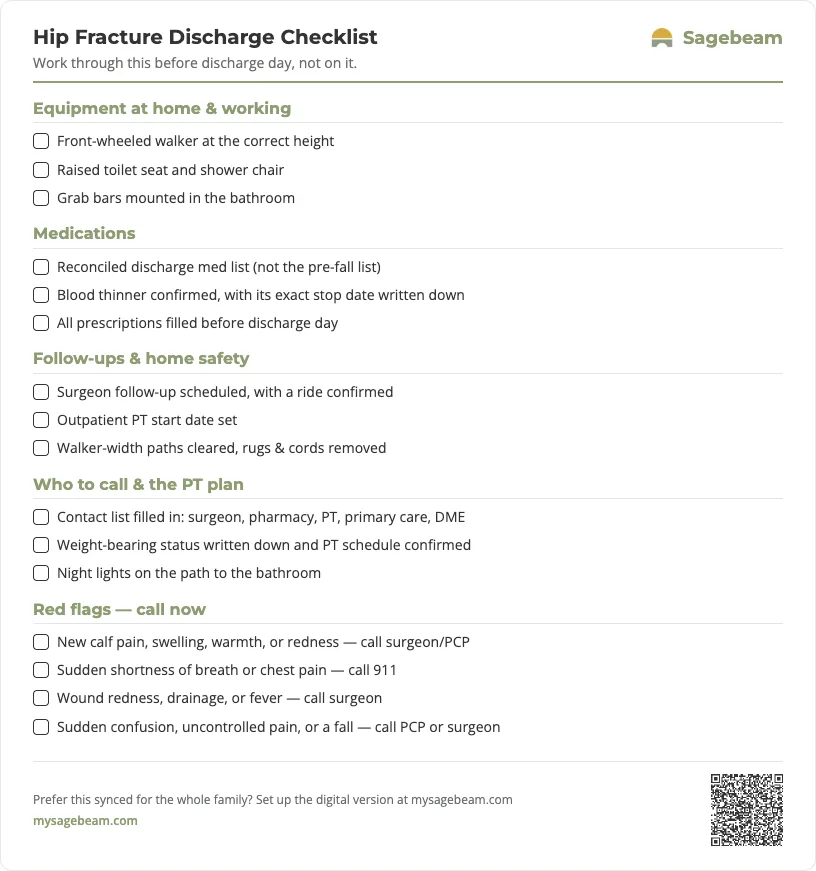
Print your hip fracture discharge checklist
A ready-to-use one-page sheet. Print it and check off each item, or keep it digitally so the whole family can see what still needs doing.
 Sagebeam
Just got home from the hospital? Get a free text-message helper for the first week.
By signing up, you agree to the Terms and Privacy Policy.
Related planning steps
- Warning signs after hip surgery: when to call the doctor — the full red-flag reference to keep alongside this checklist
- What to do when a parent breaks a hip — the crisis window from the fall through the hospital stay
- Recovery after hip fracture surgery: what family caregivers need to know — realistic timeline and the SNF-to-home arc
- Understanding the home-vs-SNF discharge recommendation — how the discharge destination gets decidedPlanning the weeks after the fracture? Build your parent's discharge plan with the free Post-Discharge Schedule Builder — answer 4 questions and get a condition-informed 30-day task list and warning-sign checklist.