Hip replacement recovery daily log template for families
A daily log template for the family member helping a parent recover from hip replacement: track pain, medications given, exercises completed, mobility, and wound observations so you have a clear record to bring to physical therapy and follow-up appointments.
Get the free printable hip replacement recovery log ↓No account required.By Rachel Moore, Founder, Sagebeam · Published July 2026 · How we research and review our guides
Part of: Medical transitions for aging parents – before/after plan
If you are the son or daughter helping a parent recover from hip replacement, most of what you will find online is written for the patient: how you will feel after surgery, what you should do. This log is written for you, the person doing the supporting. You are the one who fills the pill organizer, drives to physical therapy, notices that Mom winced getting out of the chair, and answers the surgeon's questions at the follow-up. That role comes with a quiet problem: recovery unfolds over weeks of small daily details, and by the time you are sitting in the appointment, those details have blurred together.
A daily log solves that. It gives you one place to write down what actually happened each day, so that when the physical therapist asks "how has her pain been?" or the surgeon asks "any drainage from the incision?", you are answering from a record instead of a hazy memory. It also matters when caregiving is shared. If you handle mornings and your sibling covers evenings, a single log means no one double-doses the pain medication and everyone can see how the day really went.
This article is educational and is not medical advice. Always follow the instructions your parent's surgeon and physical therapist give you, including their specific weight-bearing rules, medication schedule, and wound-care directions. If anything here conflicts with their guidance, follow their instructions. The log is a tool to help you participate in the recovery conversation, not a substitute for the care team's plan.
What this log covers and what it does not
This template is designed to capture the five things families are most often asked about at physical therapy and surgeon follow-ups, and the five things that most often signal a problem worth a phone call:
- Pain, reported by your parent in their own words and on a simple 0–10 scale
- Medications given, with the time, so doses are spaced correctly and nothing is missed or repeated
- Exercises completed, so the physical therapist can see whether the home program is actually happening
- Mobility, such as how far your parent walked, what equipment they used, and how transfers went
- Wound observations, so changes at the incision are caught early rather than at the next scheduled visit
What this log does not do: it does not replace your parent's formal medical record, and it does not diagnose anything. It also is not a warning-sign reference. If you are looking for the specific symptoms that mean "call the doctor now" versus "mention it at the next visit," pair this log with warning signs after hip surgery: when to call the doctor. The log helps you notice trends; that article helps you interpret them.
The daily recovery log template
Print one copy per day, or set up a shared note or spreadsheet with these columns so multiple family members can update it. Fill in what you can; a partly-completed log is far better than none.
Daily header
| Field | Entry |
|---|---|
| Date | |
| Days since surgery | |
| Who filled this in | |
| Weight-bearing status today (per surgeon/PT) |
Pain
| Time | Pain 0–10 | Parent's own words | Where the pain is |
|---|---|---|---|
| Morning | |||
| Afternoon | |||
| Evening | |||
| Worst point today |
Note whether pain is improving, the same, or worse compared to yesterday. Recovery pain should trend down over time.
Medications given
| Time | Medication | Dose | Given by | For (pain / blood thinner / other) |
|---|---|---|---|---|
Blood-thinning medication is often prescribed after hip replacement to reduce clot risk, so record it even though it is not for pain. Never adjust a dose on your own; note questions for the care team instead.
Exercises and physical therapy
| Exercise / activity | Prescribed reps or time | Completed? | How it went |
|---|---|---|---|
The home exercise program is the engine of recovery. MedlinePlus notes that following the prescribed exercise routine is central to regaining strength and movement after a hip replacement. Logging what was actually done, not just what was assigned, gives the therapist a true picture.
Mobility and daily function
| Item | Today's entry |
|---|---|
| Distance walked (feet, laps, or "to the mailbox") | |
| Equipment used (walker / cane / crutches) | |
| Transfers (bed, chair, toilet, car): easy / with help / difficult | |
| Stairs attempted? How did it go? | |
| Time spent up and moving vs. resting |
Wound and general observations
| Check | Today's entry |
|---|---|
| Incision: redness? | |
| Incision: drainage? (color, amount) | |
| Incision: warmth or increasing swelling? | |
| Calf pain, swelling, or tenderness in either leg | |
| Fever or chills? Temperature if taken | |
| Appetite, sleep, mood, confusion | |
| Anything new or different today |
Watching the incision and both legs matters because swelling, warmth, and calf tenderness can be early signs of a blood clot, or deep vein thrombosis, which is a known risk after major leg surgery. You are not diagnosing anything; you are collecting the observations the care team needs to.
End-of-day note
One or two lines: Better than yesterday? Harder than yesterday? What do we want to ask the PT or surgeon about?
How to adapt the log to your situation
Match your parent's actual restrictions. Your surgeon and physical therapist set the weight-bearing rules and any movement precautions, and those can differ from one patient to the next. Write the current status in the daily header so whoever is on duty knows what is allowed today. For the broader home routine this log supports, see caring for a parent at home after hip replacement: a family caregiver guide.
If a paid caregiver or home health aide helps. Keep one shared log rather than parallel ones. Ask the aide to fill in the same fields for their shift. The "given by" column on the medication table becomes especially important so it is always clear who administered the last dose.
If your parent had a hip fracture rather than an elective replacement. The log still works, but recovery is often slower and may begin in a skilled nursing facility before home. Start the log the day they come home and read recovery after hip fracture surgery: what family caregivers need to know for why the timeline and priorities differ.
If your parent has memory loss. The "parent's own words" pain column may be less reliable, so lean more on observed behavior: grimacing, guarding the leg, reluctance to move, restlessness. Note what you see, not only what they say. If this hip replacement was the result of a fall rather than a planned surgery, when a parent with dementia has a fall or hip fracture covers the hospital, delirium, and rehab questions specific to that situation.
Adjust the frequency over time. Daily entries make sense through the first four to six weeks while pain medication is tapering and the wound is healing. After that, many families move to logging on physical therapy days or when something changes. Your care team can tell you when detailed tracking is no longer needed.
Common mistakes and how to avoid them
Logging feelings instead of facts. "Rough day" is hard to act on. "Pain 7/10 in the afternoon, up from 4/10 yesterday, worse when transferring from the chair" is something the physical therapist can respond to. Aim for specifics.
Only writing things down when they go wrong. A log that is blank on the good days makes it impossible to see the trend. The whole value is the comparison, so capture ordinary days too.
Not bringing it to appointments. The single most common miss is keeping a careful log and then leaving it at home. Put it in the bag with your parent's medication list and insurance card. Following the prescribed exercise program and being able to walk without stairs are often milestones the care team will check on, and your log is the fastest way to show where things stand. Medicare covers medically necessary physical therapy services as part of recovery, and a clear record helps the therapist make the most of each visit.
Assuming the surgeon can see what you see at home. They cannot. A twenty-minute follow-up shows a snapshot; your log shows the movie. Highlight anything you flagged in the "anything new" row so it does not get lost.
Keeping five different logs across five family members. Fragmented notes defeat the purpose. Decide on one place, whether it is a printed binder page or a shared note, and route everyone through it.
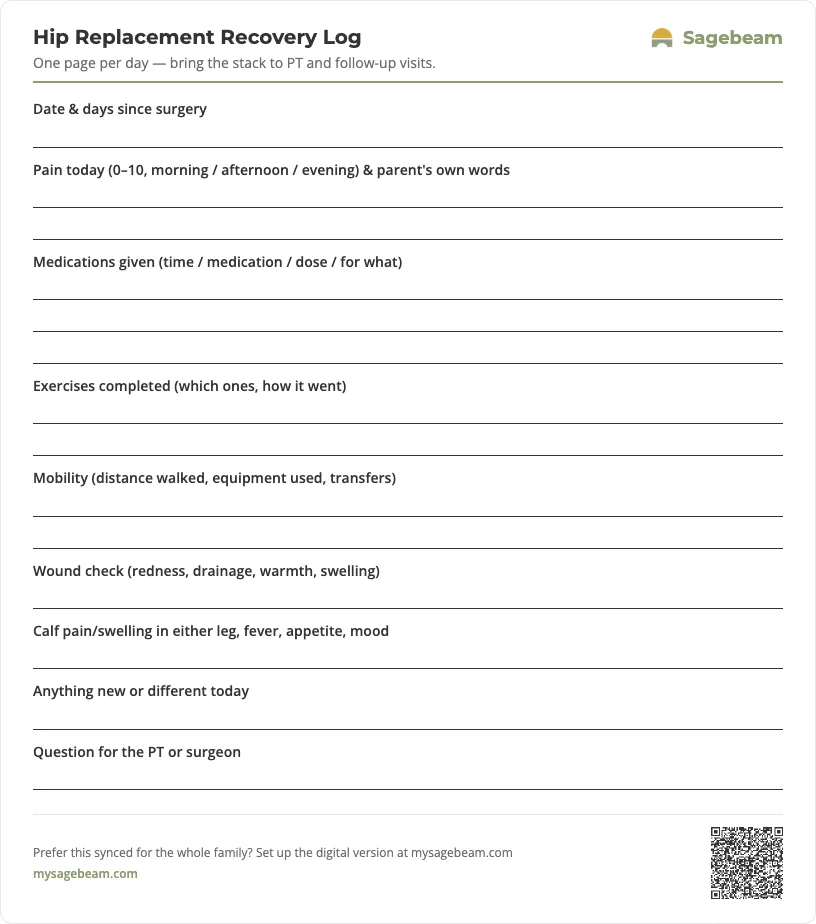
Print your hip replacement recovery log
A ready-to-use one-page sheet. Print it and fill it in by hand, or keep the same log digitally so the whole family stays in sync.
 Sagebeam
Just got home from the hospital? Get a free text-message helper for the first week.
By signing up, you agree to the Terms and Privacy Policy.
Related planning steps
- Caring for a parent at home after hip replacement: a family caregiver guide — the full home-recovery routine this log supports
- Warning signs after hip surgery: when to call the doctor — how to interpret the observations you record
- What to prepare before a parent's hip or knee replacement — home setup and supplies to have ready before surgery day
- Recovery after hip fracture surgery: what family caregivers need to know — if this was a fracture rather than an elective replacement
- Knee replacement recovery daily log template — the knee-specific version of this log, if your parent had a knee replacement instead