Long-term care insurance prep and call notes worksheet (template)
Every call with your parent’s long-term care insurance company can change thousands of dollars of benefits and months of elimination-period time — but most families are stuck with scribbled notes on envelopes. This worksheet gives you a clean, repeatable way to prep for each call and capture answers about benefits, elimination periods, providers, and next steps in one place.
Get the free printable LTCI call notes worksheet ↓No account required.By Rachel Moore, Founder, Sagebeam · Published May 2026 · How we research and review our guides
Once you discover your parent has an active long-term care insurance (LTCI) policy, there is usually a long stretch of phone calls and portal messages before benefits start paying — especially if you are trying to use it for home care instead of a facility. The Administration for Community Living's long-term care planning hub is a good federal reference point for how long-term care benefits generally work alongside your parent's specific policy.
In those conversations, you learn:
- How benefits work for home care vs facilities,
- Exactly how the elimination period will be counted, and
- What documentation they need from you and your parent’s clinicians.
But most of those details end up scattered across sticky notes and half-remembered phone calls.
This guide gives you a long-term care insurance prep and call notes worksheet template you can use for every conversation, so you:
- Walk into each call with the right information in front of you,
- Capture the answers you get about benefits, elimination-period rules, and providers, and
- Leave with clear next steps and a timeline for follow-up instead of vague “we’ll be in touch.”
That is especially true if you are calling during or right after a hospital stay or rehab stay, when discharge planners, therapists, and the LTCI company may all be asking questions at once. Having one worksheet per call makes it much easier to connect what the insurer says with what the hospital team is planning for the hospital‑to‑home transition.
It is educational and is not legal or financial advice. Use it alongside your parent’s actual policy documents and professional legal or financial guidance.
If you are still confirming whether a policy exists, start with Does my parent have long-term care insurance? Quick checklist. Before your calls, use how to read your parent's long-term care insurance policy in plain language to understand what the contract says, and keep a LTCI policy and benefits summary sheet alongside this worksheet so you aren't hunting through the full policy on every call. To plan your questions and overall strategy, pair this worksheet with Questions to ask your long-term care insurance company before starting home care, How to activate a long-term care insurance policy for home care, and How to avoid adding months to the long-term care insurance elimination period. When you are ready to file, see What documentation you need before filing a long-term care insurance home-care claim for a full documentation checklist.
On this page:
- Quick answer – what your LTCI prep and call notes worksheet should include
- How this worksheet fits with your other LTCI tools
- Long-term care insurance prep and call notes worksheet (copy and adapt)
- Step-by-step: using this worksheet for every LTCI call
- Common mistakes families make with LTCI call notes
- How this supports activation, elimination-period tracking, and appeals
Jump to template: Long-term care insurance prep and call notes worksheet
Quick answer: what your LTCI prep and call notes worksheet should include
Policies and carriers vary, but a useful long term care insurance call notes template almost always helps you capture:
-
Policy snapshot
- Parent’s name and policy number.
- Insurer name and key contact numbers.
- Daily or monthly benefit amount and benefit period (in years or total pool).
- Elimination-period length (number of days).
-
Today’s goal for the call
- A short sentence or two about what you hope to learn or decide (for example, “Confirm whether home care is covered and what counts as an elimination-period day”).
-
Answers about benefit triggers and covered settings
- How many activities of daily living (ADLs) your parent must need help with and whether cognitive impairment can also trigger benefits.
- Whether home care is covered and, if so, which settings and provider types count.
-
Elimination-period rules
- What counts as an elimination-period day (hours, provider type, setting).
- Whether days must be consecutive or can be cumulative.
- Any exclusions (for example, days in certain facilities or unpaid family-only care).
-
Documentation and process details
- Forms, doctor statements, and assessments they expect.
- How to submit documents (mail, fax, portal) and typical review timelines.
-
Case / claim details and follow-up
- Case or claim number, if created.
- Representative’s name and role.
- What the insurer says will happen next and when, plus your to-do list after the call.
The template below brings all of this into a single printable or digital worksheet you can reuse for each conversation.
How this worksheet fits with your other LTCI tools
Think of this worksheet as the operational bridge between your LTCI guides and your real-world phone calls:
- ”Does my parent have long-term care insurance? Quick checklist” helps you discover and confirm the policy.
- How to read your parent's long-term care insurance policy in plain language shows you where to find the key sections before you call.
- The LTCI policy and benefits summary sheet is the plain-language snapshot you keep open during every call.
- ”Questions to ask your long-term care insurance company before starting home care” gives you the wording and sequence of questions.
- This worksheet is where you prep for each call and capture the answers you receive in a consistent format.
- ”How to activate a long-term care insurance policy for home care” and ”How to avoid adding months to the elimination period” show you how to turn those answers into an actual plan, care schedule, and documentation system.
- What documentation you need before filing a long-term care insurance home-care claim tells you what to assemble when you are ready to submit.
You can keep one worksheet per call in a binder, a shared folder, or a Sagebeam workspace so that every sibling can see what was said, what has already been tried, and what still needs to happen.
Long-term care insurance prep and call notes worksheet – long term care insurance call notes template (copy and adapt)
You can copy and paste this LTCI prep and call notes worksheet template into your own document, spreadsheet, or caregiver workspace, or print it and fill it out by hand. Before relying on it, compare it to any forms or guidance from your parent’s insurer and adjust sections or wording as needed.
LONG-TERM CARE INSURANCE (LTCI) PREP AND CALL NOTES WORKSHEET

Parent name: ________________________________________________
Policy number: ______________________________________________
Insurer name: _______________________________________________
Insurer phone number(s): _____________________________________

Today’s date: ___________________
Call number for this issue (1, 2, 3…): _______________________ (helps track long-running problems)

Representative name: ________________________________________
Representative role / department: ____________________________

SECTION 1 – POLICY SNAPSHOT (KEEP THIS THE SAME ACROSS CALLS)

Daily or monthly benefit amount: _____________________________
Benefit period (years or total pool): ________________________

Elimination period length (in days): _________________________
Elimination period type (circle one): consecutive / cumulative / unsure (ask the representative if you’re not sure)

Home care covered? (circle one): yes / no / unsure

Notes about any limits you already know (facility-only, agency-only, etc.):
_____________________________________________________________________
_____________________________________________________________________

SECTION 2 – TODAY’S GOAL FOR THIS CALL

What do we want to learn or decide on this call?
_____________________________________________________________________
_____________________________________________________________________

Key questions we plan to ask:
- _________________________________________________________________
- _________________________________________________________________
- _________________________________________________________________

SECTION 3 – ANSWERS FROM THIS CALL

Benefit triggers (ADLs, cognitive impairment, other requirements):
- _________________________________________________________________
- _________________________________________________________________

Elimination-period rules for HOME CARE days
- What counts as an elimination-period day?
  _________________________________________________________________
- Minimum hours per day (if mentioned):
  _________________________________________________________________
- Do days have to be consecutive or can they be cumulative?
  _________________________________________________________________
- Any settings or provider types that do NOT count:
  _________________________________________________________________

Covered settings and providers for home care
- Home care covered? Details:
  _________________________________________________________________
- Agency vs independent caregivers:
  _________________________________________________________________
- Any network or location limits mentioned:
  _________________________________________________________________

Documentation and process
- Forms we need to complete:
  _________________________________________________________________
- Doctor statements / assessments required:
  _________________________________________________________________
- How to submit documents (mail / fax / portal):
  _________________________________________________________________
- Typical review timeline they quoted:
  _________________________________________________________________

Other important notes from this call:
_____________________________________________________________________
_____________________________________________________________________

SECTION 4 – CASE / CLAIM DETAILS AND FOLLOW-UP

Case / claim number (if created): ____________________________

What the insurer said THEY will do next:
- _________________________________________________________________
- _________________________________________________________________

What WE need to do next:
- _________________________________________________________________
- _________________________________________________________________

Date we should follow up if we have not heard anything:
_______________________________________________________________

Best number / method to follow up:
_______________________________________________________________

SECTION 5 – SUMMARY FOR OUR FAMILY / CARE TEAM

In plain language, what we learned on this call:
_____________________________________________________________________
_____________________________________________________________________

Impact on our care plan or schedule (if any):
_____________________________________________________________________
_____________________________________________________________________

Where these notes are stored (binder, shared folder, Sagebeam workspace):
_____________________________________________________________________
You can print several blank copies of this worksheet, save it as a reusable digital template, or adapt it into a simple table in your preferred tool.
Step-by-step: using this worksheet for every LTCI call
To keep this manageable and useful over months of back-and-forth, treat the worksheet as part of your routine:
-
Before the call
- Fill in the policy snapshot once, or update it if you have learned something new.
- Write a one-sentence goal and list 2–4 questions you want to cover.
-
During the call
- Ask the representative to spell their name, role, and any case or claim number.
- As they answer your questions, write in short, concrete phrases – especially around elimination-period rules and covered home-care providers.
-
Right after the call
- Add a brief summary in the “family / care team” section in your own words.
- Capture what you and the insurer each agreed to do next, and when to follow up.
-
Store and share
- Keep completed worksheets together (for example, in a binder tab, a shared drive, or a Sagebeam workspace) so siblings and future you can see the full history.
- When you notice repeated questions, update your policy snapshot or your LTCI policy and benefits summary sheet so you do not have to dig through every page.
This small system adds a few minutes to each call but can save hours of confusion later.
Common mistakes families make with LTCI call notes
Families are often doing the hard work of calling but still run into friction because key details never make it into their notes. This worksheet is designed to help you avoid mistakes like:
-
Not writing down the representative’s name, role, or case number
Makes it harder to reference prior conversations or escalate when information conflicts. -
Mixing up elimination-period rules across calls
Without a single place to track what counts as a day and which settings or providers qualify, families can accidentally design a home-care plan that does not move the elimination period forward. -
Skipping documentation details
It is easy to focus on “Will this be covered?” and miss “What forms and visit records will you need from us?” Capturing both keeps activation and claims from stalling later. -
Letting tasks drift without a follow-up date
If no one writes down when to check back and what should have happened by then, weeks can slip by between calls.
Using a structured call notes template does not guarantee faster approval or payment, but it does make it much easier to spot gaps, follow through on what you agreed to, and tell a coherent story if something needs to be escalated.
How this supports activation, elimination-period tracking, and appeals
Over time, a stack of completed LTCI call notes worksheets becomes part of your evidence and paper trail:
- For activation, you can show when you first reported certain functional changes or diagnoses and what the insurer told you to do next.
- For elimination-period tracking, your notes on what counts as a day and which providers are allowed can be lined up against your actual care logs and schedules.
- For appeals or second opinions, you have a clear record of who said what and when, instead of trying to reconstruct everything from memory.
You can keep this worksheet alongside tools like an LTCI policy summary sheet, an elimination-period day tracker, and your regular care logs (in Sagebeam or another system) so that benefits, documentation, and day-to-day care all point in the same direction.
Exact rules and timelines vary by insurer, policy, and state. Use this worksheet as a planning checklist and conversation helper, and always rely on your parent’s actual policy documents and qualified legal or financial advice for decisions about coverage or appeals.
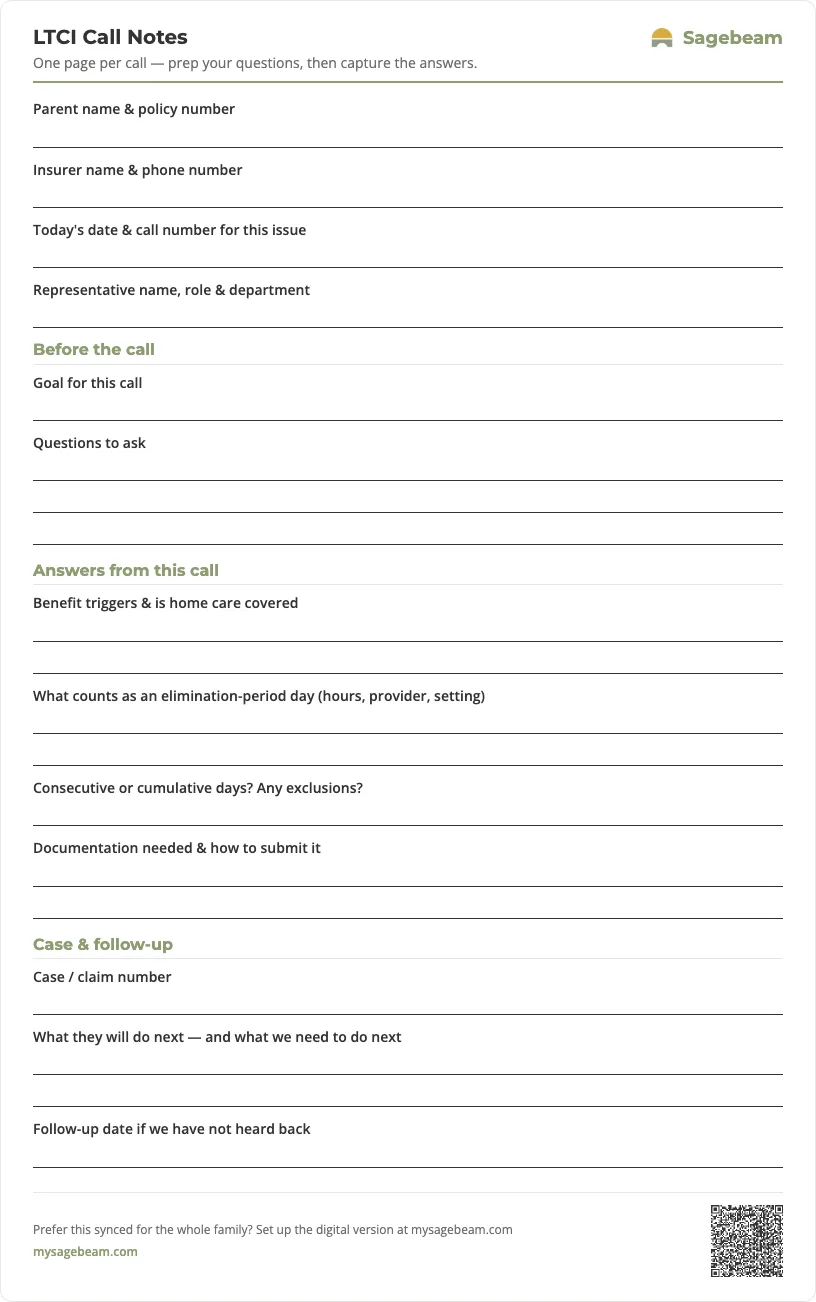
Print your LTCI call notes worksheet
A ready-to-use one-page sheet for every long-term care insurance call. Print a stack and fill one in per call, or keep the same notes digitally so the whole family can see what was said.
 Sagebeam
- How LTCI, Medicaid, and private pay fit together for home care
- How to read your parent’s long-term care insurance policy in plain language
- Long-term care insurance policy and benefits summary sheet (template)
- What documentation you need before filing a long-term care insurance home-care claim
You don't need more tabs. You need one place to run your parent's care.
By signing up, you agree to the Terms and Privacy Policy.