New dementia diagnosis family action checklist
A printable 4-section checklist for the first 60 days after a parent's dementia or Alzheimer's diagnosis — covering the medical, legal, safety, and care logistics steps that matter most while things are still early. Use it as a working document, not a test to pass.
Get the free printable diagnosis action checklist ↓No account required.By Rachel Moore, Founder, Sagebeam · Published June 2026 · How we research and review our guides
Part of: Medical transitions for aging parents – before/after plan
A parent's dementia or Alzheimer's diagnosis is one of the more disorienting moments in a family's life. You may have suspected something was wrong for months, or the diagnosis may have come as a shock. Either way, the next few weeks ask a lot of you: absorb an enormous amount of information, make decisions you've never had to make before, and keep your parent's day-to-day life stable while doing it.
This checklist is for the first 60 days — the window that matters most for getting the foundational pieces in place. It is organized into four sections: Medical, Legal, Safety, and Care Logistics. Not everything needs to happen in week one. But some of it does, and this list tells you which. Use it as a working document: print it, add notes, check items off, and share it with whoever else is helping coordinate.
This is educational and is not medical, legal, or financial advice. Work through these steps alongside your parent's care team and, for the legal section, with a qualified elder law attorney.
Section 1 — Medical
These steps help your family understand the diagnosis clearly and build the right clinical team around your parent.
- Confirm the diagnosing provider — Who made the diagnosis (primary care physician, neurologist, geriatrician)? Write down their name, practice, and contact information.
- Request written diagnostic summary — Ask for a written summary of what was found, including the type of dementia diagnosed (Alzheimer's, Lewy body, vascular, mixed, or still being determined) and the current stage or severity.
- Schedule neurologist follow-up — If a neurologist was not involved in the diagnosis, ask for a referral. Neurologists specialize in distinguishing dementia types and managing medications. If one was involved, confirm next appointment.
- Ask about neuropsychological testing — If your parent has not had formal neuropsychological testing (a detailed cognitive assessment administered by a neuropsychologist), ask the care team whether it would add useful information for staging and care planning.
- Discuss current medications — Ask the prescribing provider to review all current medications, including over-the-counter supplements. Some medications can worsen cognition or interact with dementia treatments.
- Ask about dementia-specific treatment options — Ask the care team what, if any, medications or non-medication approaches are appropriate at this stage, and what the goals are.
- Get a second opinion if needed — Dementia diagnosis is complex. If you or your parent are uncertain about the diagnosis, seeking a second opinion from a geriatric psychiatrist, behavioral neurologist, or an academic memory center is reasonable and does not mean distrust of the current provider.
- Clarify follow-up schedule — How often should your parent be seen, by whom, and for what? Get a concrete answer, not just "come back if something changes."
Section 2 — Legal
This section is the most time-sensitive on this entire checklist. Legal documents that authorize family members to help with financial and medical decisions must be signed while your parent has the legal capacity to do so. Dementia affects capacity over time. Do not assume you have months to get to this.
- Consult an elder law attorney — This is the single most important action on this list. An elder law attorney can assess your parent's current capacity, prepare the right documents, and flag anything unusual in your state. Look for someone who specializes in elder law or estate planning.
- Execute durable power of attorney — financial — Authorizes a named person (often called an "agent") to manage financial matters. "Durable" means it remains valid if your parent later loses capacity. Must be signed while your parent has capacity.
- Execute durable power of attorney — healthcare (also called a healthcare proxy or medical POA) — Authorizes a named person to make medical decisions if your parent cannot. Must be signed while your parent has capacity.
- Execute a living will or advance directive — Documents your parent's wishes about life-sustaining treatment, resuscitation, artificial nutrition, and related decisions. Works alongside the healthcare POA.
- Ask about POLST (or MOLST/MOST depending on your state) — A POLST (Physician Orders for Life-Sustaining Treatment) is a medical order, not just a preference document. Ask the care team whether it is appropriate now or at a later stage. Not right for every family at diagnosis, but worth understanding.
- Confirm existing documents — Does your parent already have a will, trust, or any of the above documents in place? Locate them, review them for currency, and confirm they still reflect your parent's wishes.
- Review beneficiary designations — This is a good moment to ensure retirement accounts, life insurance, and similar assets have current, correct beneficiaries named.
If your parent resists legal planning, involve the care team. A social worker or the diagnosing physician can sometimes help explain why this is part of good medical planning, not a power grab.
Section 3 — Safety
Safety changes with dementia over time. Your goal right now is to understand your parent's current risk level honestly — not to over-correct for a stage they haven't reached yet.
- Do a home safety walk-through — Walk the path from bed to bathroom, kitchen to front door. Look for: loose rugs, poor lighting, stair hazards, cluttered walkways, unsecured cleaning products or medications.
- Review medication safety — Is your parent managing their own medications? Can they reliably take the right dose at the right time? Consider a weekly pill organizer, blister packaging from the pharmacy, or a medication management system. Medication errors are a serious safety risk in dementia.
- Have the driving conversation — This is one of the hardest conversations in an ADRD diagnosis and one of the most important. A new dementia diagnosis does not automatically end driving, but it does require an honest assessment. Ask the care team about a formal driving evaluation by an occupational therapist with driving rehabilitation training. Document your observations about any recent close calls, getting lost, or new hesitation.
- Assess living-alone risk honestly — If your parent lives alone, list the specific scenarios that concern you most: not eating, leaving the stove on, not taking medications, not being able to call for help if they fall. Bring that specific list to the care team rather than a general "is it safe for them to live alone?" question.
- Identify emergency response plan — Does your parent have a medical alert device or phone they can use? Do neighbors know to check in? Is there a clear protocol for who gets called and in what order if something happens?
- Secure hazards — Depending on your parent's current stage, consider: locking up medications and cleaning products, removing or securing firearms, and checking that the stove has an automatic shutoff or that you've had a conversation about cooking safety.
Section 4 — Care Logistics
Getting the logistics of coordination right early reduces the chaos later. This section is about who is doing what and how the family is staying connected.
- Identify the primary family coordinator — One person needs to be the hub for medical information, appointment scheduling, and updates. This doesn't mean they do everything. It means they know everything and communicate it to others. Name this person explicitly.
- Map who else is involved — Siblings, spouses, other relatives, close friends, paid caregivers. What can each person realistically contribute right now? A brief honest conversation is more useful than assumptions.
- Schedule a family meeting — Even a 30-minute call to share what you know, surface questions, and divide near-term tasks. Bring the diagnostic summary if you have it. The goal is alignment, not resolution of everything.
- Establish one communication channel — Group text, email thread, or a shared workspace like Sagebeam. The channel matters less than the consistency. Decide what counts as "send to everyone immediately" versus "share in the weekly update."
- Make a respite plan — Who is the primary caregiver right now, and what does that person need to not burn out? Even in early stages, naming a respite plan — even a simple one — is part of sustainable caregiving. What would allow the primary coordinator to take a day off?
- Find your local Area Agency on Aging — Area Agencies on Aging (AAAs) offer free care consultations, information about local services, and referrals to resources including support groups, home care, and legal assistance. Find yours at eldercare.acl.gov.
- Connect with the Alzheimer's Association — The Alzheimer's Association (alz.org) has a 24/7 helpline (800-272-3900) and local chapters with caregiver support groups, care consultations, and educational programs. You don't need to have all the answers to use these resources.
Using this checklist
Not everything on this list needs to happen in week one. A new diagnosis is overwhelming, and trying to complete every item in the first few days is neither realistic nor helpful. The most important thing in week one is to start — pick two or three actions and move on them.
The legal section is genuinely time-sensitive — treat it that way. Everything else on this list can be phased in over 60 days. The legal documents in Section 2 depend on your parent having capacity at the time of signing. Capacity can change. Put the elder law attorney consultation at the top of your list.
This checklist is a tool for working with the care team, not around them. Sagebeam's editorial approach is that families do their best work when they're informed enough to ask good questions, understand the answers, and make decisions in partnership with the professionals involved in their parent's care. Bring the questions this checklist surfaces to appointments. The care team is your ally in this.
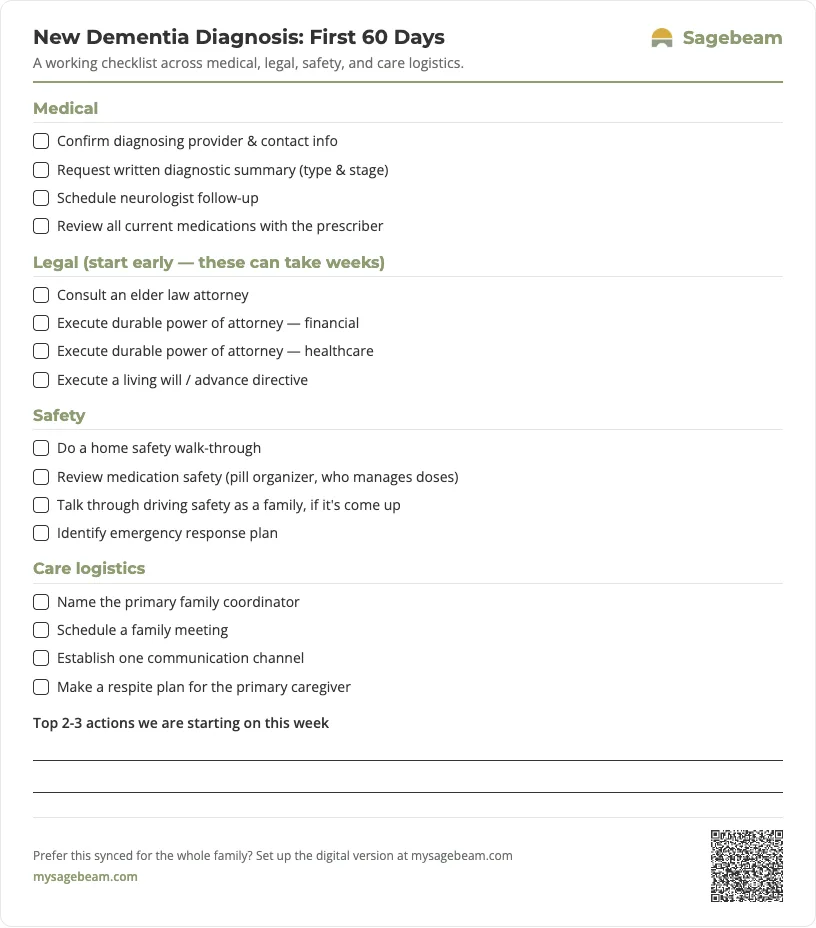
Print your new diagnosis action checklist
A ready-to-use one-page sheet. Print it and check things off as you go, or keep the same checklist digitally so everyone helping can see progress.
 Sagebeam
Just got home from the hospital? Get a free text-message helper for the first week.
By signing up, you agree to the Terms and Privacy Policy.
Related planning steps
- The first 30 days after a parent's Alzheimer's or dementia diagnosis — the action sequence for the first month
- Alzheimer's Association caregiver center — caregiver resources, support groups, and helpline (24/7)
- Legal and financial steps after a parent's dementia diagnosis — POA, advance directives, financial accounts — why timing matters
- Becoming a caregiver for a parent checklist — the broader starter checklist for new caregivers
- Signs an aging parent should stop driving — how to assess driving safety and have the conversation