Family meeting agenda template after a parent's dementia diagnosis
A structured agenda for the first family meeting after an Alzheimer's or dementia diagnosis. Covers who should attend, what decisions must happen in the first 30–60 days, how to divide responsibilities, and how to keep your parent involved in decisions about their own care.
Get the free printable family meeting agenda ↓No account required.By Rachel Moore, Founder, Sagebeam · Published June 2026 · How we research and review our guides
Part of: Medical transitions for aging parents – before/after plan
After a parent's dementia diagnosis, every family conversation can feel urgent and impossible at the same time. A structured agenda helps because this meeting has a different job than most family conversations: you are not just exchanging information, you are making decisions together — some of which have real deadlines. Without a clear frame, these meetings tend to either spiral into grief and overwhelm or get bogged down in details before the important questions get asked.
This template is a starting point. Adapt it for your family. The goal is to leave with a shared understanding of what you know, what you need to find out, who is handling what, and when you are meeting again.
This article is educational and is not medical advice. Every situation is different, so always follow the guidance you get from your parent's doctors, nurses, and other clinicians. If anything here conflicts with what their care team says, follow the care team — they know your parent's specific health and history.
Before the Meeting
Date: _______________
Who's joining:
- [Parent's name] (include them if they are willing and it feels appropriate — see FAQ below)
- _______________
- _______________
- _______________
- _______________
Where / how: _______________ (in person, video call, phone)
Who is facilitating: _______________ (one person keeps time and moves through the agenda)
Who is taking notes: _______________ (one person writes down decisions and action items)
Opening (5–10 minutes)
Start by stating why you are meeting and what you are trying to accomplish. Keeping this explicit helps everyone focus.
Why we're here: We received [parent's name]'s diagnosis of [Alzheimer's / [type] dementia] on [date]. We are meeting to make sure we understand what we know, figure out what decisions need to happen soon, and agree on how we are going to work together as a family.
What this meeting is not: This is not the time to plan the next five years or make every decision. We are focusing on the next 30–60 days.
Ground rule: We are working together — with [parent's name] when possible — not making decisions for them.
Section 1: Understanding the Diagnosis (15 minutes)
The goal here is to get everyone on the same page, and to identify what questions need to go back to the care team.
What we know:
- Diagnosis: _______________
- Who made the diagnosis and when: _______________
- What the doctor has told us about what to expect: _______________
- Any medications or treatments currently in place: _______________
What we don't know yet: (Write down every question as it comes up — assign one person to bring these to the next appointment with the doctor or specialist.)
- _______________
- _______________
- _______________
Who is taking clinical questions back to the care team: _______________
Section 2: Immediate Decisions (20 minutes)
Some decisions can't wait. Others can. Be explicit about which is which.
Must happen in the next 30–60 days
Legal documents: Does [parent's name] have a durable power of attorney (financial) and a healthcare proxy (medical) in place?
- Yes, both are in place. Location: _______________
- Partially — what's missing: _______________
- No — we need to arrange this. Who is taking point: _______________
Note: These documents should be signed while your parent still has the legal capacity to do so. An elder law attorney can help.
Driving: Is driving currently safe?
- Yes, no concerns right now
- Uncertain — a driving evaluation is needed. Who is scheduling: _______________
- Already a concern — action needed: _______________
Living arrangements: Is the current living situation safe right now?
- Yes
- There are concerns — what they are: _______________ Next step: _______________
Can wait — but needs a plan
(List decisions that don't need to be made today but should have an owner and a rough timeline.)
Section 3: Dividing Responsibilities (15 minutes)
Someone needs to be the primary point of contact for the care team. Others can take on specific areas. Being explicit now prevents confusion and resentment later.
Primary care coordinator (single point of contact for doctors, specialists, and providers):
Who handles what:
| Area | Owner | Notes |
|---|---|---|
| Medical appointments and care team communication | ||
| Legal and financial documents | ||
| Day-to-day check-ins with [parent's name] | ||
| Home safety and practical logistics | ||
| Research (care options, local resources, etc.) | ||
| Family updates — keeping everyone informed |
How we share updates:
- Method: _______________ (group text, shared doc, app, weekly call)
- Frequency: _______________
Section 4: Including [Parent's Name] (10 minutes)
This section is especially important if your parent is present for the meeting. If they are not, it still matters — and their preferences should shape the decisions you make.
What [parent's name] has told us they want: (If they're in the meeting, ask them directly. If not, what have they expressed in the past?)
Questions to ask them, now or soon:
- What matters most to you about where you live?
- Are there things you want to keep doing as long as possible? What are they?
- Who do you want involved in decisions about your care?
- Is there anything you don't want to happen?
How we will involve them going forward: (How decisions get made, how preferences get checked, how we make sure their voice stays in the room as things change.)
Next Steps
| Action | Owner | By when |
|---|---|---|
Next check-in: Date: _______________ | Format: _______________ | Who schedules it: _______________
A Few Notes on Facilitating This Meeting
This is not the last conversation. The first family meeting after a dementia diagnosis will not resolve everything — and it shouldn't try to. The goal is to make the decisions that genuinely need to happen now, surface the open questions, and agree on how you will keep communicating. Treating it as a starting point reduces pressure and makes it easier to actually complete.
Aim for decisions, not just discussion. It is easy for these meetings to become emotional in ways that feel productive but don't produce action. The facilitator's job is to gently redirect: "It sounds like we need to talk more about that — can we note it as an open item and keep moving?" Every section should end with a clear owner and a next step.
Keep it short. Ninety minutes is usually enough for a first meeting. If you run over, it is often a sign that the conversation has shifted from agenda items to processing grief or relitigating old family dynamics — both real and valid, but neither will be resolved in this meeting. It is okay to say: "I think we need a different kind of conversation for that. Can we set a separate time?"
The Alzheimer's Association caregiver center has additional resources for families navigating the early phase of a diagnosis, including guidance on family communication, legal planning, and finding local support groups.
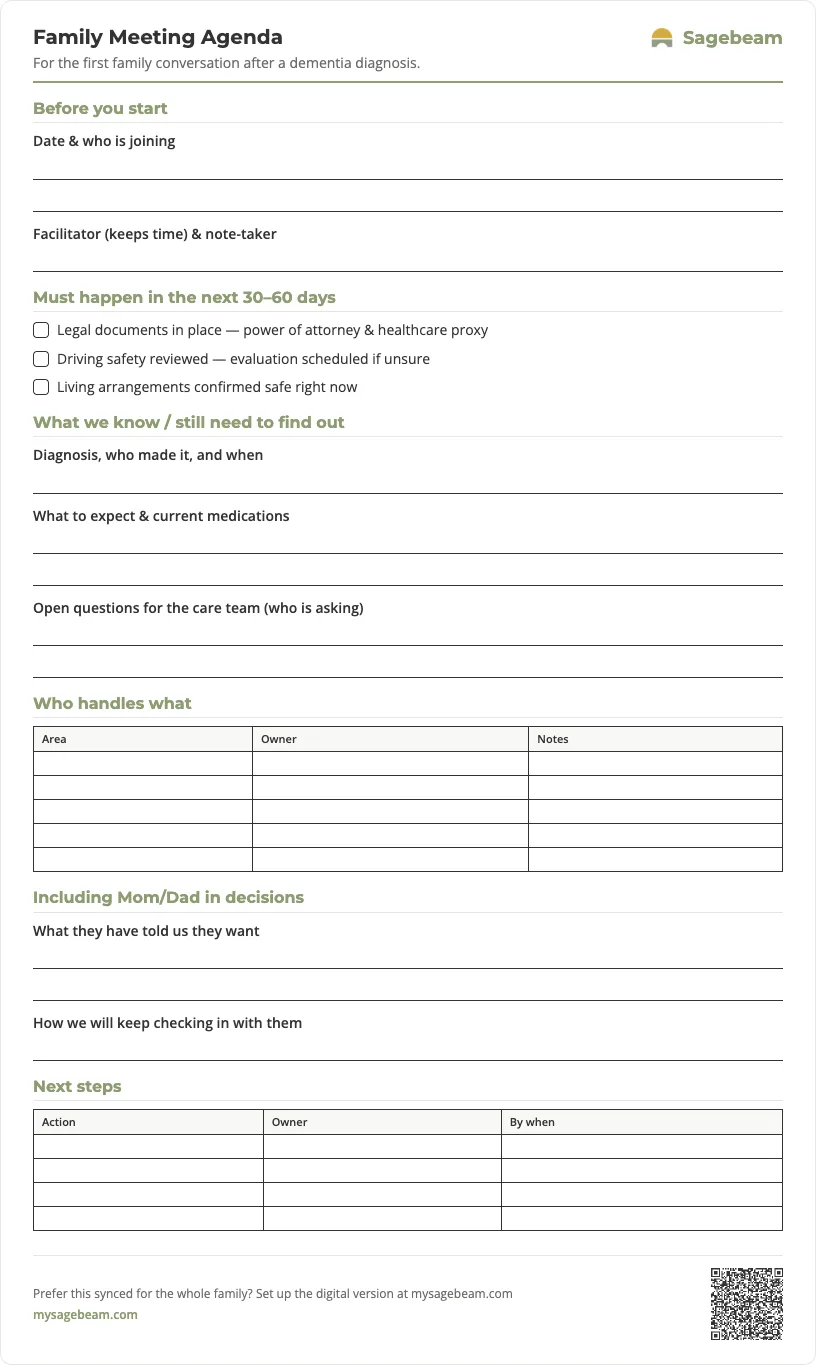
Print your family meeting agenda
A ready-to-use one-page agenda for your first family meeting. Print it and fill it in together, or keep the same agenda digitally so everyone can see what was decided.
 Sagebeam
| Area | Owner | Notes |
|---|---|---|
| Action | Owner | By when |
|---|---|---|
Just got home from the hospital? Get a free text-message helper for the first week.
By signing up, you agree to the Terms and Privacy Policy.
Related Planning Steps
- The first 30 days after a parent's dementia diagnosis — the priority actions this meeting should be organized around.
- New dementia diagnosis family action checklist — the shared task list to bring to the meeting.
- How to talk to a parent about their dementia diagnosis — for the conversation with your parent that runs alongside the family one.
- Family caregiving roles and responsibilities guide — a framework for dividing the work that comes out of the meeting.