Hospital discharge planning worksheet template for families
Discharge decisions move fast and it's easy to miss key details. This hospital discharge planning worksheet template helps families capture diagnoses, medications, equipment needs, follow-up appointments, and red-flag symptoms in one place — before the discharge conversation is over.
Get the free printable hospital discharge worksheet ↓No account required.By Rachel Moore, Founder, Sagebeam · Published June 2026 · How we research and review our guides
Part of: Medical transitions for aging parents – before/after plan
Free tool · no sign-up
Turn the discharge instructions into a day-by-day plan
Answer a few quick questions about the condition and how much help your parent needs, and you'll get a 30-day task list, a daily schedule, and the warning signs to watch for — grounded in AHRQ and CMS discharge guidance.
Hospital discharge meetings compress a lot of information into a few minutes. You might hear about diagnoses, new medications, home‑health services, equipment, red‑flag symptoms, and follow‑up appointments – all while trying to get your parent safely home.
Without a simple way to organize that information, it is easy to end up with:
- A pile of discharge papers no one can decipher later,
- Unclear instructions about who to call when something seems off, and
- Confusion among siblings about what was actually decided.
This guide gives you a hospital discharge planning worksheet template – a one‑page form families can fill out during the hospital stay to capture:
- What happened during the stay and what changed,
- The plan for medications, services, and equipment,
- The red‑flag symptoms and “call vs. go to ER” guidance they were given, and
- Who to call for what once your parent leaves the hospital.
It is educational and is not medical advice. Always follow the instructions you receive from your parent’s clinicians and discharge team. Use this worksheet to make sure you understand and can follow that plan safely at home or in rehab.
For a fuller hospital‑to‑home toolkit, you can pair this worksheet with:
- What to track during a parent’s hospital stay – a simple log you can use during the stay.
- Questions to ask before your parent is discharged from the hospital – a role‑based question list for doctors, nurses, and the discharge planner.
- Hospital discharge checklist for an elderly parent coming home – a task‑oriented checklist for the day of discharge.
- First 72 hours after hospital discharge – simple game plan for family caregivers – what to focus on once your parent is home.
- How to help a parent transition home after a hospital stay – a broader “before/during/after” transition guide.
After discharge, the worksheet also works well alongside:
- Caregiver observation log template for tracking health changes – for watching symptoms and function at home.
- Doctor visit summary template for aging parents – for the first follow‑up visit after the hospital stay.
On this page:
- Quick answer – what a hospital discharge planning worksheet for families should include
- How this worksheet fits with your other hospital‑to‑home tools
- Hospital discharge planning worksheet template (copy and adapt)
- Step‑by‑step: using the worksheet during the hospital stay
- Tips to keep it to one page and actually use it
Quick answer: what a hospital discharge planning worksheet for families should include
A simple hospital discharge planning worksheet for families usually captures:
-
Basic details about your parent and this hospital stay
- Name, date of birth, medical record or account number (if needed) and the hospital or unit.
- Reason for admission and, in simple language, what changed during the stay.
-
Diagnoses, procedures, and key findings
- Main diagnoses or problems the team is treating.
- Any procedures or tests that are especially important for the plan going forward.
-
How your parent is doing functionally now
- What your parent can and cannot safely do at discharge (walking, stairs, bathing, dressing, bathroom, meals, medications).
- Whether someone needs to be with them overnight or for specific tasks.
-
Medications at discharge
- Which medications are new, changed, or stopped.
- When and how to give them, and any red‑flag reactions that should trigger a call or urgent care.
-
Services and equipment ordered
- Home‑health nursing, PT/OT, other therapies, or personal care services ordered for home or rehab.
- Any equipment ordered (walker, commode, oxygen, hospital bed, etc.) and how/when it will arrive.
-
Red‑flag symptoms and “what to do if…”
- The team’s own words for which symptoms mean “call the office,” which mean “urgent care or ER,” and what to do after hours.
- Space to note what a normal recovery should look like in the first few days.
-
Follow‑up appointments and key contacts
- Which follow‑ups are already scheduled and which you need to schedule.
- Names and numbers for who to call with questions: main clinic, on‑call line, home‑health agency, and any case manager or social worker.
-
Home setup and special instructions
- Notes about the home environment (stairs, bathroom setup, equipment placement).
- Any special instructions (for example, lifting restrictions, wound‑care steps, diet, or fluid limits).
-
Benefits and paperwork notes (optional)
- Space to jot down anything the team mentions about Medicare days, rehab coverage, home‑health limits, or how this stay might affect long‑term care insurance or Medicaid planning. Medicare requires hospitals to provide written discharge notices and families have the right to appeal a discharge — the NCOA's guide on hospital transition and discharge planning explains what those rights look like in practice.
The template below turns these elements into a reusable hospital discharge planning worksheet template you can print or keep in a shared digital workspace.
How this worksheet fits with your other hospital‑to‑home tools
You do not need a separate form for everything. Think of your tools this way:
- Use “What to track during a parent’s hospital stay” to log day‑to‑day changes and questions.
- Use “Questions to ask before your parent is discharged” to guide conversations with the team.
- Use the hospital discharge checklist to track tasks and to‑dos on the day of discharge.
Use this hospital discharge planning worksheet when you want:
- A single, at‑a‑glance summary of the plan that you can bring home, to rehab, and to early follow‑up visits.
- A place to pull together diagnoses, functional status, meds, services, equipment, and red‑flag guidance without flipping through multiple pages.
After discharge:
- Use your observation log to track how things are going at home.
- Use the doctor visit summary template to capture what is decided at follow‑up appointments.
The discharge planning worksheet sits in the middle: it bridges what happened in the hospital and the first days and weeks at home or rehab. It is about capturing the plan in writing, while the discharge checklist is about carrying out the tasks, and it gives you a clean reference when you are coordinating care or filling out later paperwork.
Hospital discharge planning worksheet template for families (copy and adapt)
You can copy and paste this hospital discharge planning worksheet template for families into a document, spreadsheet, shared note, or caregiving workspace, and adjust sections as needed. The goal is to keep it to one page so it is easy to carry, copy, or upload.
HOSPITAL DISCHARGE PLANNING WORKSHEET – FOR FAMILIES

Parent name: ________________________________   Date of birth: ________________

Hospital / unit: ____________________________   Date of discharge: ____________

Reason for hospital stay (in your own words):
_____________________________________________________________________
_____________________________________________________________________

WHAT HAPPENED & WHAT CHANGED

Main diagnoses / problems the team is treating:
_____________________________________________________________________
_____________________________________________________________________

Any important procedures / tests to remember:
_____________________________________________________________________
_____________________________________________________________________

HOW YOUR PARENT IS DOING NOW (FUNCTIONAL STATUS)

At discharge, my parent CAN safely:
- [ ] Walk with:  [ ] no device  [ ] cane  [ ] walker  [ ] wheelchair only
- [ ] Use stairs:  [ ] none at home  [ ] a few with help  [ ] needs to avoid stairs
- [ ] Use bathroom:  [ ] on own  [ ] needs some help  [ ] needs full help
- [ ] Bathe:  [ ] on own  [ ] needs some help  [ ] needs full help
- [ ] Take medications:  [ ] on own  [ ] needs reminders  [ ] needs full help

The team recommends:
- Someone with my parent overnight?  YES / NO / UNSURE
Details:
_____________________________________________________________________

MEDICATIONS AT DISCHARGE (SEE PRINTED LIST FOR DETAILS)

New medications we are starting:
_____________________________________________________________________
_____________________________________________________________________

Important changes (dose or timing) to existing meds:
_____________________________________________________________________
_____________________________________________________________________

Medications we are stopping:
_____________________________________________________________________
_____________________________________________________________________

Any red‑flag medication reactions we were told to watch for:
_____________________________________________________________________
_____________________________________________________________________

SERVICES & EQUIPMENT ORDERED

Home‑health / nursing / therapy ordered (agency, type of visits, how we will hear from them):
_____________________________________________________________________
_____________________________________________________________________

Equipment ordered (for example, walker, commode, hospital bed, oxygen) and how it will arrive:
_____________________________________________________________________
_____________________________________________________________________

RED‑FLAG SYMPTOMS & “WHAT TO DO IF…”

Symptoms or changes where we should CALL the office or nurse line:
_____________________________________________________________________
_____________________________________________________________________

Symptoms or changes where we should GO to urgent care or the ER:
_____________________________________________________________________
_____________________________________________________________________

What a normal recovery should look like in the first few days (in their words):
_____________________________________________________________________
_____________________________________________________________________

FOLLOW‑UPS & KEY CONTACTS

Follow‑up appointments that are already scheduled:
_____________________________________________________________________
_____________________________________________________________________

Appointments we need to schedule:
_____________________________________________________________________
_____________________________________________________________________

Who to call with questions:
- Main clinic / doctor: ______________________   Phone: ______________________
- After‑hours / on‑call line: _________________   Phone: ______________________
- Home‑health / therapy agency: ______________   Phone: ______________________
- Case manager / social worker (if any): ______   Phone: ______________________

HOME SETUP & SPECIAL INSTRUCTIONS

Home setup notes (stairs, bathroom, where equipment should go):
_____________________________________________________________________
_____________________________________________________________________

Special instructions (lifting limits, wound care, diet, fluids, activity):
_____________________________________________________________________
_____________________________________________________________________

BENEFITS & PAPERWORK NOTES (OPTIONAL)

Anything mentioned about Medicare days, rehab coverage, home‑health limits,
long‑term care insurance, or Medicaid:
_____________________________________________________________________
_____________________________________________________________________
If this full layout feels like too much at first, start by filling out just the core sections: reason for stay, what happened and what changed, functional status, medications at discharge, red‑flags and “what to do if…”, and key contacts. You can add services, home setup, and benefits notes as you have time.
Step‑by‑step: using the worksheet during the hospital stay
To make this hospital discharge planning worksheet helpful without overwhelming you:
-
Decide where the worksheet will live
- A printed page on a clipboard, a shared Google Doc, or a caregiving workspace like Sagebeam.
- Make sure anyone attending rounds or the discharge meeting knows where it is.
-
Fill it out in small pieces, not all at once
- Ask a few questions during rounds and jot answers in the “what happened” and “functional status” sections.
- Ask medication and red‑flag questions when the doctor or nurse reviews the discharge instructions.
- Ask services, equipment, and follow‑up questions with the discharge planner or social worker, using the “Questions to ask before your parent is discharged” guide if helpful.
-
Use the team’s words as much as possible
- When writing red‑flag symptoms and “what to do if…”, ask them to repeat or review what you wrote to be sure it matches their guidance.
- If you are unsure how to summarize something, say, “Can you help me write this down in a simple way so my siblings will understand it too?”
-
Review the worksheet together before discharge
- At the end of the discharge meeting, quickly scan through the worksheet and say, “This is what I have written down – did we miss anything important?”
- Ask who to call if you realize something is missing once you get home.
-
Make copies and share
- Take a clear photo, scan, or upload the worksheet so other family members have access.
- Keep a copy with your discharge papers and another with your observation logs at home.
Tips to keep it to one page and actually use it
The best hospital discharge planning worksheet for families is the one you can realistically keep up with. A few practical tips:
-
Aim for one page, front and back at most
- If a section is not relevant (for example, no equipment was ordered), cross it out rather than leaving it blank.
- Use short phrases instead of full sentences wherever you can.
-
Do not try to capture every detail
- Use the worksheet for the most important points: diagnoses, functional status, meds, services, equipment, red‑flags, and key contacts.
- Trust the full discharge packet to hold the fine print you can look up later if needed.
-
Pair the worksheet with your logs and templates
- After discharge, keep the worksheet with your hospital discharge checklist, observation log, and doctor visit summaries so you can see the whole story at a glance.
-
Use a shared space so everyone sees the same plan
- Whether you store the worksheet in a folder on the fridge or in an app like Sagebeam, the goal is that siblings, home‑health nurses, and other caregivers can all refer to the same, simple one‑page summary.
Your goal is not to turn into a care manager overnight. It is to leave the hospital with one clear page that summarizes what happened, what the plan is, and what you should do if things are not going as expected – so the first days after hospital discharge can be a little calmer for you and your parent. The Family Caregiver Alliance's Hospital Discharge Planning: A Guide for Families and Caregivers covers the broader process, including how to advocate for a safe transition and what to do if discharge feels premature.
If you would rather start from a generated draft than a blank page, build your parent's discharge plan with the free Post-Discharge Schedule Builder, then use this worksheet to capture what the hospital team tells you.
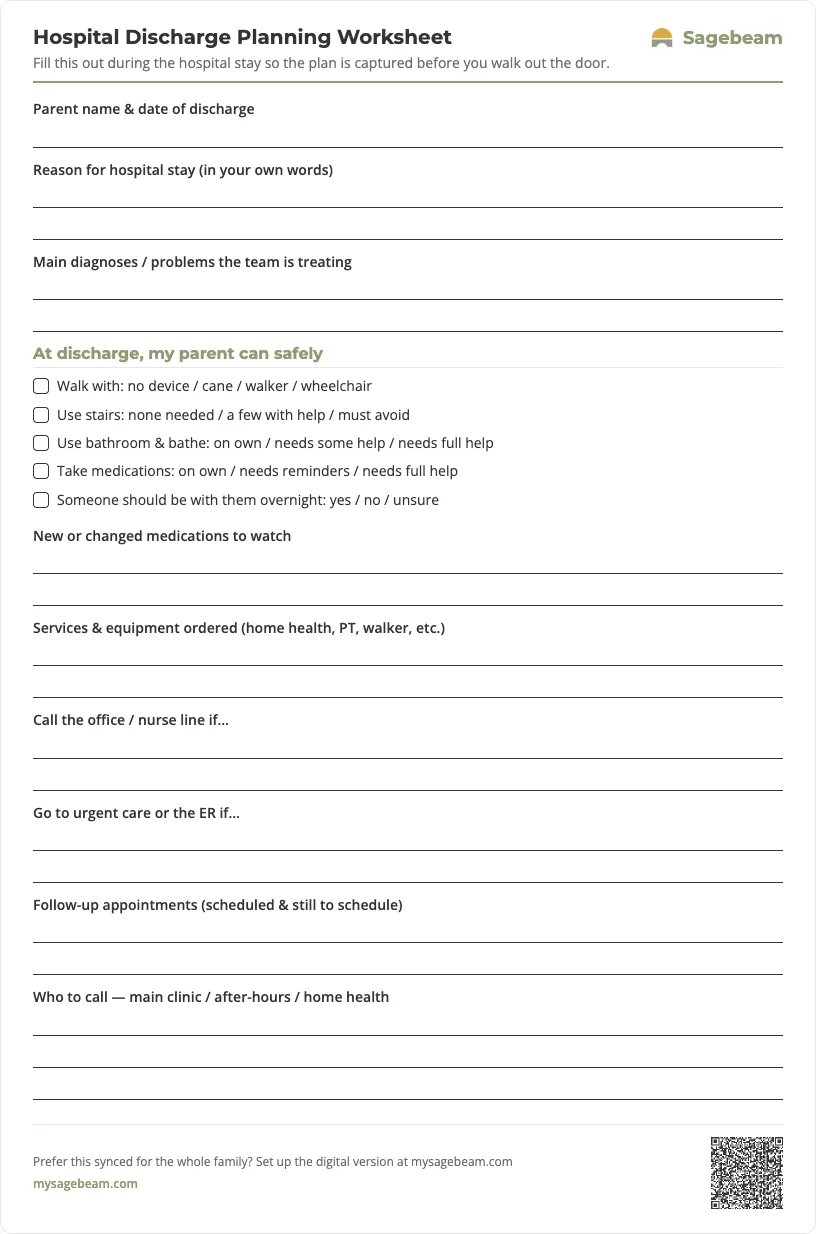
Print your hospital discharge worksheet
A ready-to-use one-page sheet to bring to rounds and the discharge meeting. Print it and fill it in by hand, or keep the same worksheet digitally so the whole family sees the plan.
 Sagebeam
- What to do after a mini stroke (TIA): a family follow-up worksheet
- Blood thinner tracker after a hospital stay (printable log for families)
- Surgical drain output log template for families (JP drain log sheet)
- Post-surgery pain medication log for families (printable tracker)
Just got home from the hospital? Get a free text-message helper for the first week.
By signing up, you agree to the Terms and Privacy Policy.