Free printable caregiver observation log template (PDF)
Free printable caregiver observation log template — track symptoms, mood, mobility, and cognition changes in one place so patterns are easier to spot and share with siblings and clinicians.
Get the free printable observation log ↓No account required.By Rachel Moore, Founder, Sagebeam · Published May 2026 · How we research and review our guides
Part of: Health & safety monitoring – aging parents routine
In many families, health changes show up as little shifts long before there is a diagnosis or crisis: a parent tires more quickly, seems more forgetful, or has a few small near‑misses that are easy to shrug off. That makes it hard to tell whether something is truly getting worse, get siblings on the same page, or give doctors concrete examples instead of “I think things are a bit worse.”
This guide gives you a caregiver observation log template you can use to track health changes over time – focusing on symptoms, mood, mobility, cognition, and safety. It is designed to sit alongside your existing caregiver daily log, shift report, and incident report templates, not replace them, and to work as a simple caregiver health observation log you can actually keep up with week to week.
If you want a bigger‑picture walkthrough of which health changes to watch for and why, see How to track health changes in an aging parent. If your parent is currently in the hospital or just coming home, pair that guide with What to track during a parent’s hospital stay and How to help a parent transition home after a hospital stay. This page focuses on the observation log template itself – the practical, repeatable format you can use to record what you see once your parent is at home.
It is educational and is not medical advice. Use it to capture what you see and feel; your parent’s clinicians are still the ones who interpret those observations and decide what should happen next.
If you are already using other Sagebeam templates, this observation log pairs especially well with:
- Caregiver daily log template for families
- Home caregiver shift report template
- Caregiver incident report template
- Emergency medical information sheet template
- Doctor visit summary template for aging parents (once live)
If your parent has dementia or memory loss, the dementia daily care log template is a more tailored version of the daily log above, built specifically for tracking orientation, sleep, and sundowning.
On this page:
- Quick answer – what a caregiver health observation log should include
- How this observation log fits with your other templates
- Caregiver observation log template (copy and adapt)
- Step-by-step: using the log each week
- Tips for sharing observations with siblings and clinicians
Quick answer: what a caregiver health observation log should include
A simple caregiver observation log template – essentially a short symptom and behavior log for caregivers – usually captures:
-
When and by whom the observation was made
- Date and time window.
- Who was with your parent (family, paid caregiver, both).
-
What changed or stood out
- Short description of the symptom, behavior, or change (for example, “more short of breath walking from bedroom to kitchen,” “needed help standing up from chair,” “more confused about day of week”).
-
Where and in what context it happened
- At home, outside, during a particular task (showering, stairs, cooking, etc.).
-
How concerning it felt
- A simple scale (for example, 1–3 or “mild / moderate / urgent”) to flag which changes might need quicker attention.
-
What you did in the moment
- Any actions taken (rested, called nurse line, changed how you helped, filled out incident report, etc.).
-
Whether to raise it at the next doctor visit or sooner
- A checkbox or note such as “mention at next visit” or “call sooner if this happens again.”
The template below turns these elements into a reusable template for tracking health changes in aging parents that you can print or keep in a shared digital workspace.
How this observation log fits with your other templates
You do not need a separate form for every moment of the day. Instead:
- Use the caregiver daily log for a broad overview of each day of care.
- Use the shift report and handoff checklists to keep caregivers aligned on tasks and safety.
- Use the incident report for acute events (falls, ER visits, major behavior changes).
Use the caregiver observation log when you notice:
- A pattern (for example, increasing shortness of breath, more confusion in the evenings), or
- A new concern that is not yet an incident but makes you say, “We should watch this.”
It is especially helpful in the weeks after a hospital discharge or rehab stay, when you and your parent’s clinicians are trying to understand whether recovery is on track. Short, specific entries about pain, mobility, confusion, or near‑falls make it much easier to adjust the plan quickly if something is not going as expected. If dementia or memory loss is part of the picture, pair this log with What changes at home after a parent with dementia is discharged from hospital so you are watching for the cognitive and supervision changes that generic recovery logs often miss.
Over time, the observation log becomes:
- A pattern tracker you can skim before doctor visits, and
- A shared reference so siblings and other caregivers are reacting to the same concrete examples, not just impressions.
Caregiver observation log template (copy and adapt)
You can copy and paste this caregiver observation log template into a notebook, spreadsheet, shared note, or caregiving workspace, and adjust fields as needed. For a spreadsheet, each row would be one observation; the simplest version might just include Date, Observer, What we noticed, Concern level, and Follow‑up as columns.
CAREGIVER OBSERVATION LOG – TRACKING HEALTH CHANGES

Parent name: ________________________________

Date: ____________________   Time window (if relevant): ____________________

Observer (who noticed this): ______________________________________________
Role (family / paid caregiver / other): __________________________________

WHERE & CONTEXT

Where did this happen? (home / outside / clinic / other):
_____________________________________________________________________

What was going on at the time?
(for example: getting out of bed, walking to bathroom, making lunch)
_____________________________________________________________________
_____________________________________________________________________

WHAT CHANGED OR STOOD OUT

Describe what you noticed in plain language:
_____________________________________________________________________
_____________________________________________________________________

Check any that apply:
- [ ] Breathing changes (short of breath, breathing faster, new cough)
- [ ] Mobility changes (more unsteady, shuffling, slower, needed more help)
- [ ] Strength / stamina changes (tires more quickly, harder to stand)
- [ ] Mood / behavior changes (more withdrawn, agitated, tearful)
- [ ] Memory / thinking changes (more forgetful, confused, disoriented)
- [ ] Sleep changes (much more / less sleep, up at night)
- [ ] Appetite / weight changes (eating less / more, clothes looser / tighter)
- [ ] Pain changes (new pain, pain worse, pain pattern changed)
- [ ] Other health changes (describe): ________________________________

HOW CONCERNING DID THIS FEEL?

Circle one:
MILD (noticed, but not worrying yet)
MODERATE (we should keep an eye on this)
URGENT (we should get help or advice soon)

WHAT WE DID IN THE MOMENT

Actions taken (if any):
- Rested / changed activity: ________________________________________
- Contacted nurse line / doctor / 911: ______________________________
- Completed incident report (yes / no): _____________________________
- Other actions: ____________________________________________________

FOLLOW-UP & NOTES

Should we mention this at the next doctor visit? YES / NO
If YES, which doctor / clinic? ______________________________________

Do we need to act sooner (for example, call nurse line, schedule earlier visit)?
_____________________________________________________________________

Any other notes or patterns (for example, “This is the third time this week”):
_____________________________________________________________________
_____________________________________________________________________
You can keep one log page per notable observation or use a spreadsheet to track multiple observations over time. If this full layout feels like too much at first, start with just three pieces: date, what changed or stood out, and how concerning it felt, and add other sections later if you find them helpful.
Step-by-step: using the log each week
To make this log useful without overwhelming you:
-
Decide where it lives
- A notebook on the kitchen counter, a shared Google Doc, or a caregiving workspace like Sagebeam.
- Make sure everyone who notices changes knows where and how to add entries.
-
Capture observations soon after they happen
- Short notes in plain language are better than long narratives you never have time to write.
- Focus on what you saw and heard, not what you think it means.
If an observation ever feels urgent – for example, new chest pain, sudden trouble breathing, a fall with head injury, or sudden severe confusion – follow your clinician’s instructions or local emergency guidance first. You can come back to the log later to record what happened.
-
Review the log before doctor visits and family check‑ins
- Highlight or star entries you want to mention at the next appointment.
- Bring your observation log alongside your daily log and doctor visit summary template.
-
Look for patterns, not one‑offs
- A single rough day is less important than a growing pattern across entries.
- Use the “any other notes or patterns” section to mark when something has happened several times.
-
Adjust over time
- If certain checkboxes or sections never get used, simplify.
- If you find yourself adding the same “other” item frequently, consider adding it as its own line.
Tips for sharing observations with siblings and clinicians
To get the most value from your observation log:
-
Share specific examples, not general worries
- Instead of “Mom seems weaker,” say “In the last two weeks she has needed help standing from her chair 4 times; before that she usually stood on her own.”
-
Use the log to ground sibling conversations
- When there is disagreement about how your parent is doing, look at concrete entries together rather than debating feelings.
-
Bring key entries to appointments
- Hand your doctor a short list of recent observations at the start of the visit.
- Ask if any of them change how they think about diagnoses, medications, or safety recommendations.
-
Store your logs with your other health templates
- Keep observation logs with your medical history summary, emergency information sheet, and doctor visit summaries so you have a complete picture in one place.
-
Use a shared space like Sagebeam to keep everything together
- In Sagebeam, you can keep these caregiver health observations next to daily logs, doctor visit summaries, and benefit‑related templates, so it is easy to pull a short list of recent, concerning changes before appointments or family meetings.
-
If you're managing wound-care logistics specifically
- Visits, supplies, and reorder dates for a parent's home wound care are logistics, not health observations — keep those on the wound care home-health visit and supply tracker instead, and use this log for general health changes.
The goal is not to turn you into a clinician. It is to make sure that the real changes you see at home are easy to remember, share, and act on – before they turn into bigger crises.
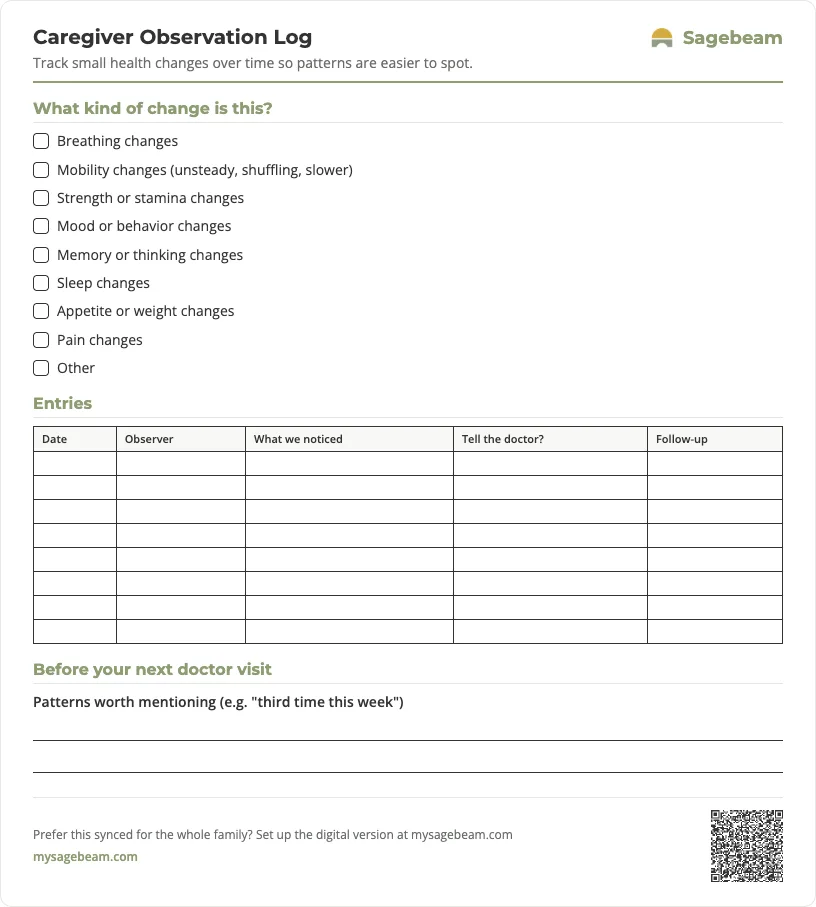
Print your observation log
A ready-to-use one-page sheet. Print it and jot down changes as you notice them, or keep the same log digitally so the whole family sees the same pattern.
 Sagebeam
| Date | Observer | What we noticed | Tell the doctor? | Follow-up |
|---|---|---|---|---|
- Daily schedule template for a person with dementia
- Dementia behavior and sundowning tracker template
- Dementia daily care log template for families
- Post-hospital symptom and red flag tracker template
You don't need more tabs. You need one place to run your parent's care.
By signing up, you agree to the Terms and Privacy Policy.