Legal documents checklist after a parent's dementia diagnosis
After a dementia diagnosis, there is a narrow window to get key legal and financial documents in place while your parent still has legal capacity to sign them. This printable checklist covers every document to execute or review — organized by urgency and what each one actually requires.
Get the free printable legal documents checklist ↓No account required.By Rachel Moore, Founder, Sagebeam · Published June 2026 · How we research and review our guides
Part of: Medical transitions for aging parents – before/after plan
A dementia diagnosis creates a narrow window that most families don't expect: there are legal documents that can only be executed while your parent still has the legal capacity to sign them, and that window can close faster than anticipated. The goal of this checklist isn't to add pressure — it's to give you a clear picture of what needs to happen, in what order, and who needs to be involved, so your family can move forward thoughtfully rather than reactively. For anything involving document drafting or capacity assessment, an elder law attorney is the right partner; many items on this list, though, are things families can work through on their own.
This article is educational and is not legal, financial, or benefits advice. Rules for programs like Medicaid and long-term care insurance vary by state and by plan and change over time. For your parent's specific situation, check with the program directly or a qualified professional — an elder-law attorney, a benefits counselor, or your state's Medicaid office.
Section 1: Documents to execute (time-sensitive — requires legal capacity)
These documents require your parent to have legal capacity at the time of signing — meaning they understand what they're signing and what it means. Because capacity can decline unpredictably with Alzheimer's or dementia, these are the highest-priority items on this list. An elder law attorney should be involved in drafting and executing all of them.
-
Durable power of attorney — financial. Authorizes a trusted person (the "agent") to manage your parent's finances — bank accounts, bills, taxes, property — when your parent can no longer do so. "Durable" means it remains valid even if your parent loses capacity. Without this, accessing accounts or managing assets may require court-supervised conservatorship.
-
Durable power of attorney — healthcare (healthcare proxy). Names a person to make medical decisions on your parent's behalf when they are unable to. Also called a healthcare power of attorney or medical POA depending on the state. This is separate from a living will — it names who decides, not what they decide.
-
Living will / advance directive. Documents your parent's own wishes about end-of-life care: resuscitation preferences, mechanical ventilation, artificial nutrition, and similar decisions. Having this in writing helps the healthcare proxy carry out your parent's actual wishes rather than guessing.
-
POLST or MOLST (if applicable). A Physician Orders for Life-Sustaining Treatment (POLST) or Medical Orders for Life-Sustaining Treatment (MOLST) is a medical order — not just a planning document — that travels with your parent and tells emergency responders and care facilities exactly what treatments to administer or withhold. Typically completed with the primary care physician or a specialist; most relevant if your parent has serious health conditions beyond the dementia diagnosis.
-
Will (if not current). If your parent's will is outdated — doesn't reflect current assets, beneficiaries, or wishes — now is the time to update it. Requires capacity and should be done with an attorney.
-
Trust (if applicable). A revocable living trust can simplify asset transfer, avoid probate, and provide more control over how assets are managed if your parent loses capacity. Not necessary for every family, but worth discussing with an elder law attorney, especially if there is real estate or significant assets involved.
Section 2: Financial accounts to review
These items don't require your parent's legal capacity in the same way — but they do require access, information, and in some cases your parent's cooperation to update. Work through these alongside the legal documents.
-
Bank accounts. Identify all accounts. Review beneficiary designations and whether any accounts have a "payable on death" designation. Consider whether adding a trusted family member as a joint account holder is appropriate. Note: adding someone to an account has legal and tax implications — discuss with an attorney or financial advisor.
-
Investment and retirement accounts (IRAs, 401(k)s, brokerage). Confirm beneficiary designations are current. Outdated beneficiaries on retirement accounts can create significant complications and can't always be corrected after death.
-
Real estate. Locate the deed(s) for any property. Understand the ownership structure — sole ownership, joint tenancy, tenancy in common. Review whether the property is held in a trust or needs to be. An attorney can help evaluate whether any changes to ownership structure make sense given the care plan and estate goals.
-
Insurance policies — life insurance. Locate all life insurance policies. Confirm beneficiaries are current. Note the insurer, policy number, and coverage amount.
-
Insurance policies — long-term care insurance. If your parent has a long-term care policy, locate it now and read it carefully. Understand what triggers benefits (typically an inability to perform two or more activities of daily living, or a cognitive impairment diagnosis), what the elimination period is, and what the daily or monthly benefit cap is. Claims processes can be slow — knowing the policy now means you're not scrambling later.
-
Debts and recurring obligations. Note any outstanding debts (mortgage, home equity line, auto loans, credit cards). Identify recurring automatic payments and where they're being pulled from. This becomes important if the financial POA needs to step in.
Section 3: Records to locate and organize
These documents don't require legal action — they just need to be found and kept somewhere accessible to the people who will be helping with care. A caregiver binder or a shared digital folder works well.
- Social Security card and benefit information (monthly amount, direct deposit account)
- Medicare card and Medicare Advantage or supplemental plan information
- Medicaid information (if applicable — enrollment, plan, ID number)
- All insurance cards (Medicare, supplemental, prescription drug plan, long-term care)
- Insurance policy documents (full copies, not just cards)
- Tax returns — past 3 years (useful for financial planning, Medicaid eligibility assessment, and benefit applications)
- Birth certificate
- Marriage certificate (if applicable)
- Divorce decree (if applicable)
- Military discharge papers (DD-214) — if your parent is a veteran, VA benefits may be available and this document is required to access them
- Passport
- Any existing estate planning documents (prior wills, trusts, beneficiary forms)
What requires an attorney vs. what families can handle
Requires an elder law attorney:
- Drafting and executing a durable power of attorney (financial or healthcare)
- Drafting or updating a will
- Setting up or amending a trust
- Assessing and documenting legal capacity at the time of signing
- Evaluating Medicaid planning strategies if long-term care costs are a concern
Requires the physician (or care team):
- Completing a POLST or MOLST form (this is a medical order, not a family document)
Families can typically handle on their own:
- Locating and organizing records
- Reviewing account beneficiary designations (and flagging what needs updating)
- Reading and understanding a long-term care insurance policy
- Gathering tax returns, property records, and insurance documents
Where to start
Most families find it least overwhelming to begin with the durable power of attorney for healthcare and the financial POA — not because the other documents don't matter, but because those two have the hardest capacity requirement and the clearest urgency. Once those are in place, the rest of the list can be worked through more methodically, with or without an attorney depending on the complexity involved.
If your family doesn't already have an elder law attorney, the National Academy of Elder Law Attorneys (NAELA) maintains a searchable directory at naela.org/findlawyer, and many attorneys offer an initial consultation to help you understand what your parent's situation requires. The goal isn't to get everything perfect in the first week — it's to get the time-sensitive documents executed before the window closes, and to have a clear picture of where everything else stands.
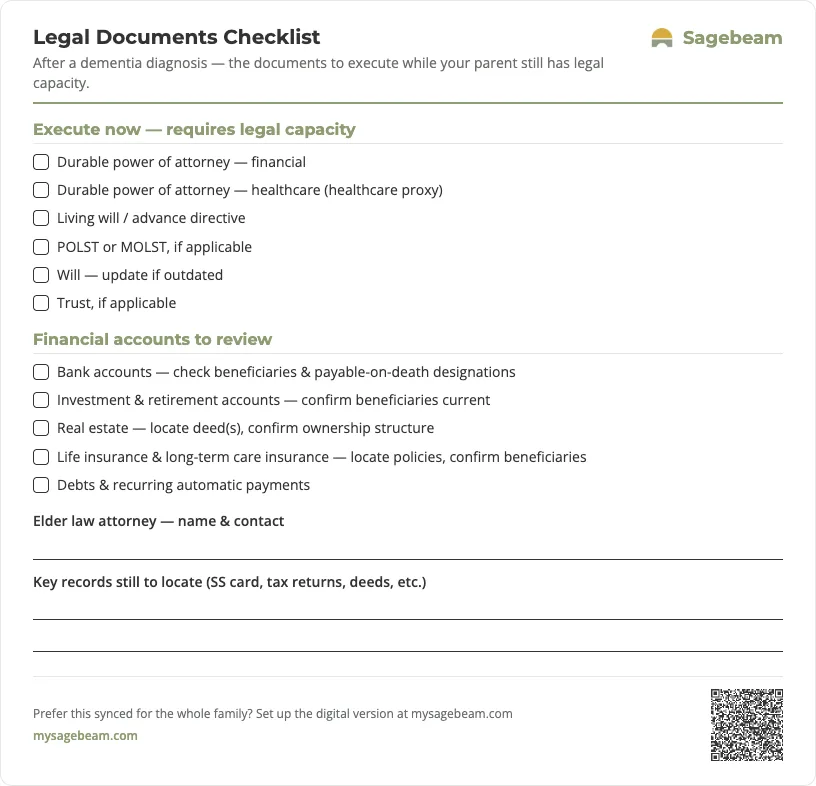
Print your legal documents checklist
A ready-to-use one-page checklist to track and prioritize. Print it and check items off by hand, or keep it synced so siblings can see progress too.
 Sagebeam
Just got home from the hospital? Get a free text-message helper for the first week.
By signing up, you agree to the Terms and Privacy Policy.
Related Planning Steps
- Legal and financial steps after a dementia diagnosis — the how and why behind each document on this checklist.
- The first 30 days after a parent's dementia diagnosis — where these documents fall among the other early priorities.
- New dementia diagnosis family action checklist — the broader first-steps checklist this legal work is part of.