Post-hospital dementia safety assessment checklist
A practical checklist for families deciding whether home is safe after a parent with dementia leaves the hospital, covering supervision, wandering, medications, mobility, falls, kitchen safety, bathrooms, nighttime risk, and caregiver capacity.
Get the free printable dementia safety checklist ↓No account required.By Rachel Moore, Founder, Sagebeam · Published June 2026 · How we research and review our guides
Part of: Medical transitions for aging parents – before/after plan
A parent with dementia may be medically ready to leave the hospital before the home is ready for them. That is the gap this checklist is designed to catch.
General discharge checklists often focus on medications, follow-up appointments, equipment, and transportation. Those matter. But dementia adds another set of safety questions: Can your parent remember not to get up alone? Can they find the bathroom at night? Can they manage the stove? Can they take new medications correctly? Can the family actually provide the supervision the plan assumes?
This checklist is educational and is not medical or legal advice. Use it to prepare a better conversation with the discharge team, home health agency, therapists, and family members. Always follow clinical guidance.
The Alzheimer's Association has a practical home safety guide for dementia caregiving. This checklist adapts that kind of safety thinking to the immediate post-hospital period.
How to use this checklist
Use it in three moments:
- Before discharge, while the case manager and therapy team are still involved.
- On the first day home, before the first night.
- During the first week, after you see what is actually happening.
Mark each item:
- Green: handled or not a concern right now.
- Yellow: concern, but manageable with a plan.
- Red: unsafe or unresolved.
Any red item deserves a specific plan before home is treated as safe.
Section 1: Supervision
- Can my parent be left alone at all?
- If yes, for how long?
- Does the care team agree with that amount of alone time?
- Is someone present during high-risk times: evening, overnight, bathroom trips, meals, medication times?
- Is there a backup person if the primary caregiver cannot come?
- Does paid caregiver coverage match the actual schedule needed?
- Can my parent call for help reliably?
- Are emergency contacts posted and easy for caregivers to find?
Notes:
If the plan assumes supervision your family cannot provide, say that directly during hospital discharge planning for a parent with dementia or memory loss.
Section 2: Confusion and delirium
- Is my parent's thinking back to baseline?
- If not, does the team know what changed?
- Has the team discussed delirium?
- Do we know what changes should trigger a call?
- Is there a plan for nighttime confusion?
- Are glasses, hearing aids, and dentures available?
- Are instructions written for caregivers, not only for my parent?
Notes:
If confusion is sudden or fluctuating, use Hospital delirium in people with dementia to organize your questions.
Section 3: Medications
- New medications are identified.
- Stopped medications are removed from the usual pill area.
- Changed doses are clearly marked.
- One person is responsible for setting up medications.
- One person is responsible for confirming each dose.
- The pharmacy has reviewed interactions or confusing instructions.
- We know which medicines may affect sleep, balance, or confusion.
- We know who to call after a medication error.
Notes:
Medication management is one of the easiest places for a discharge plan to fail. If your parent managed medications before the hospital, reassess that before restarting the old routine.
Section 4: Mobility and falls
- Can my parent get in and out of bed safely?
- Can they stand from a chair?
- Can they get to the bathroom?
- Can they use the walker, cane, or wheelchair correctly?
- Do they remember to use it without reminders?
- Are stairs avoidable or supervised?
- Are loose rugs removed?
- Is the bed-to-bathroom path lit and clear?
- Are shoes or non-slip socks available?
- Is there a plan for showering and toileting?
Notes:
The CDC's STEADI caregiver resources can help families think through fall prevention, but follow the therapy team's specific recommendations after hospitalization.
Section 5: Wandering and exits
- Has my parent wandered before?
- Did they try to leave the hospital room or unit?
- Are doors and exits monitored appropriately?
- Is there a plan for nighttime wandering?
- Are car keys secured if driving is unsafe?
- Are neighbors or building staff aware only if appropriate and respectful?
- Is an ID bracelet, medical alert device, or other safety tool needed?
Notes:
Section 6: Kitchen, bathroom, and household hazards
- Stove use is supervised or restricted if needed.
- Sharp tools are safely stored.
- Cleaning supplies are secured if confusion is significant.
- Bathroom has grab bars or support as recommended.
- Shower chair or raised toilet seat is in place if ordered.
- Hot water and burn risks are considered.
- Clutter is cleared from walking paths.
- Firearms, if present, are secured or removed.
Notes:
Section 7: Caregiver capacity
- The primary caregiver can physically provide the required help.
- Transfer assistance is realistic and safe.
- The caregiver understands medication, wound, mobility, or equipment tasks.
- There is a respite plan.
- Family members agree on who covers what.
- Paid caregivers have the information they need.
- The plan does not depend on one exhausted person doing everything.
Notes:
This section is often the hardest to answer honestly. But a plan that exhausts the caregiver is not stable. Use How to create a family caregiver communication plan or Family caregiving roles and responsibilities guide if responsibilities need to be redistributed.
What to do with red items
For each red item, write:
| Concern | Who to ask | What needs to change |
|---|---|---|
Bring the table to the case manager, therapist, home health agency, or doctor. Specific concerns get better answers than general fear.
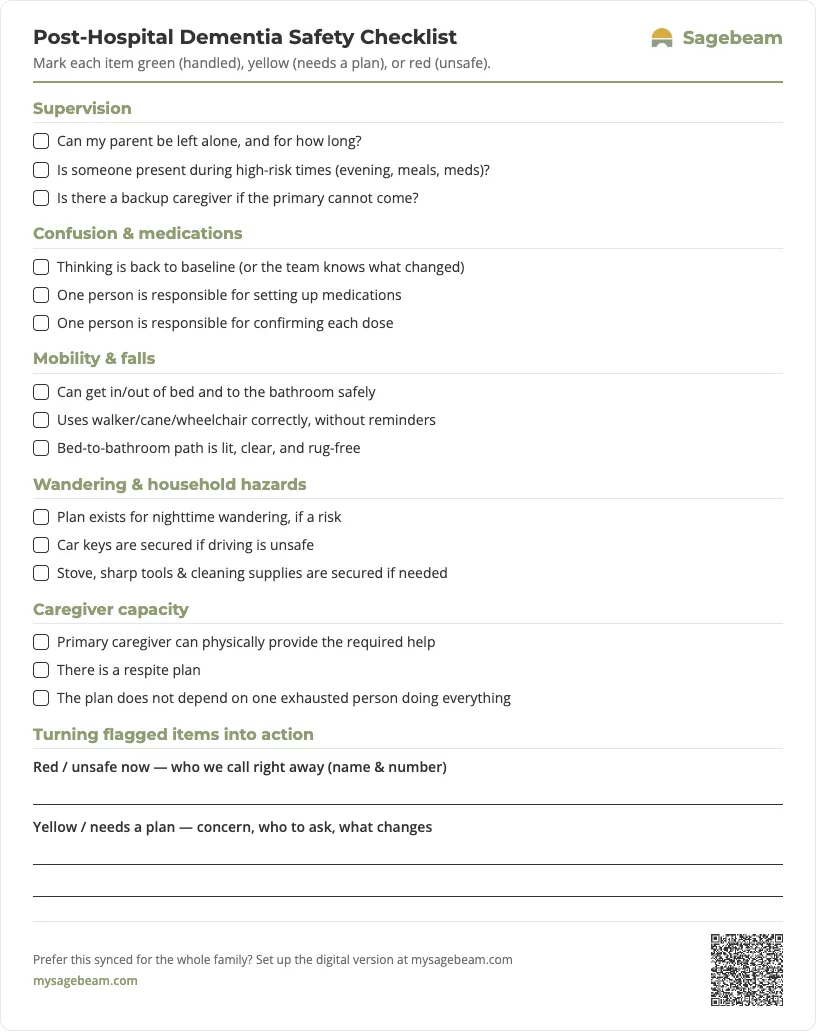
Print your dementia safety checklist
A ready-to-use one-page sheet. Print it before discharge and again during the first week home, or keep the same checklist digitally so the whole family sees the same picture.
 Sagebeam
Just got home from the hospital? Get a free text-message helper for the first week.
By signing up, you agree to the Terms and Privacy Policy.
Related planning steps
- Hospital discharge planning for a parent with dementia or memory loss - use this checklist before agreeing home is ready
- What changes at home after a parent with dementia is discharged from hospital - what to watch for once home
- Dementia patient hospital preparation checklist - what to prepare before admission when possible
- Hospital discharge checklist for an elderly parent coming home - general discharge checklist