Dementia patient hospital preparation checklist
A practical checklist for families preparing a parent with Alzheimer's or dementia for a planned hospital admission or pulling essentials together quickly during an emergency.
Get the free printable hospital checklist ↓No account required.By Rachel Moore, Founder, Sagebeam · Published June 2026 · How we research and review our guides
Part of: Medical transitions for aging parents – before/after plan
A hospital visit is harder when your parent has dementia because the hospital is not just a medical setting. It is an unfamiliar, noisy, interruptive place where routines disappear and many people ask questions your parent may not be able to answer.
Preparation helps in two ways. It gives the hospital team better information, and it gives your parent familiar anchors in an unfamiliar environment. This checklist has two versions: one for a planned admission and one for an emergency.
This article is educational and is not medical or legal advice. Always follow hospital instructions about medications, belongings, visitor policies, and documents.
If the admission is planned
Use the days before admission to reduce avoidable confusion.
Documents and information
- Photo ID.
- Insurance cards.
- Current medication list with doses and timing.
- Pharmacy name and phone number.
- Allergy list.
- Diagnoses list.
- Recent procedure or test summaries, if relevant.
- Healthcare proxy / medical power of attorney.
- Advance directive.
- POLST/MOLST/MOST, if applicable.
- Primary care doctor contact.
- Neurologist, geriatrician, or memory clinic contact.
- Family point person name and phone number.
If legal documents are not in place and there is time before a planned admission, review Legal and financial steps after a parent's Alzheimer's or dementia diagnosis. Hospitalization is not the ideal moment to discover that decision-making documents are missing.
Person-specific communication
Complete the hospital communication card for patients with dementia. Include:
- Baseline cognition.
- How your parent communicates.
- What calms them.
- What triggers distress.
- How they show pain.
- Mobility risks.
- Wandering risk.
- Important routines.
Print several copies if possible.
Comfort and orientation items
- Glasses.
- Hearing aids and batteries/charger.
- Dentures and case.
- Mobility device labeled with name.
- Comfortable clothes.
- Non-slip shoes.
- Phone charger.
- Favorite blanket or sweater.
- Small photo.
- Familiar music or headphones if useful.
- Simple clock or calendar if allowed.
Do not bring irreplaceable valuables.
Family coordination
- Name the primary family contact.
- Decide who will be present during admission.
- Decide who shares updates with siblings or relatives.
- Confirm visitor policy.
- Ask whether someone can stay during high-risk times.
- Prepare a shared note for questions and updates.
Read What to do when a parent with dementia is hospitalized before admission if you have time. It explains what to say to the team and what to document once the stay begins.
If the hospital visit is an emergency
Do not delay urgent care to pack perfectly. Bring the essentials. (The way to make this moment easy is to have packed it already — the ER go-bag checklist for an aging parent is the pack-once, check-monthly version of this list.)
Grab first
- Photo ID.
- Insurance card.
- Medication list or medication bottles if instructed/available.
- Allergy list.
- Healthcare proxy or advance directive if easy to access.
- Glasses, hearing aids, dentures.
- Phone and charger.
- Mobility device.
- One comfort item.
Say this early
Tell triage or intake:
"My parent has dementia. Their usual baseline is ____. Today they are different because ____."
Then add:
- Who knows them best.
- Whether they live alone.
- Whether they wander.
- Whether they are a fall risk.
- Whether they take blood thinners.
- Whether they can answer questions reliably.
If you cannot complete a full communication card, write three notes on paper or in your phone:
- Baseline.
- What changed.
- What calms or triggers them.
What not to do
- Do not give home medications in the hospital unless staff instructs you to.
- Do not assume your parent can accurately answer medication or symptom questions.
- Do not bring valuables that may be lost.
- Do not rely on one tired family member to remember every update.
- Do not wait until discharge day to ask whether home will be safe.
Prepare for discharge from the beginning
Even at admission, start thinking about discharge. Dementia can change the home plan, especially after illness, surgery, delirium, or a fall.
Ask early:
- "Who is the case manager or discharge planner?"
- "What would need to happen before discharge?"
- "How will dementia affect the discharge plan?"
- "Could this require skilled nursing, rehab, or more supervision at home?"
If discharge is approaching, use Hospital discharge planning for a parent with dementia or memory loss and the post-hospital dementia safety assessment checklist.
External preparation resources
The Alzheimer's Association has broader daily care resources for dementia caregivers, and UCSF's Memory and Aging Center offers hospitalization tips for people with dementia. Use those alongside your parent's clinician instructions and this practical checklist.
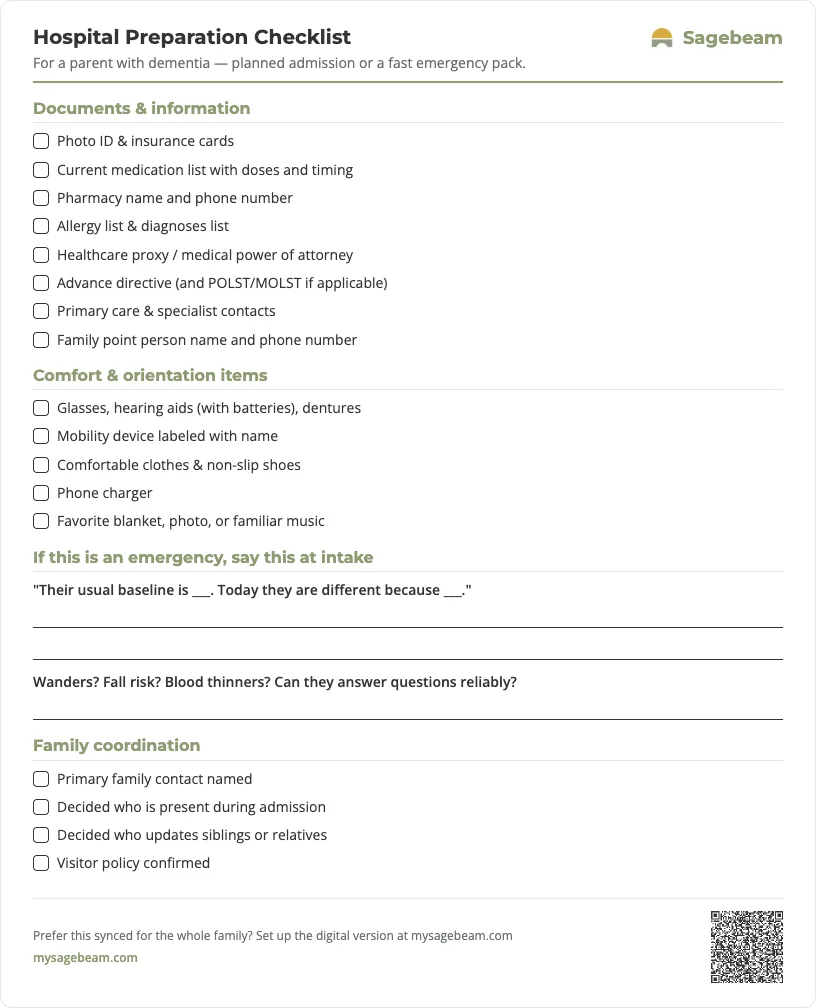
Print your hospital preparation checklist
A ready-to-use one-page sheet. Print it and check things off as you pack, or keep the same checklist digitally so the whole family knows what is covered.
 Sagebeam
Just got home from the hospital? Get a free text-message helper for the first week.
By signing up, you agree to the Terms and Privacy Policy.
Related planning steps
- Hospital communication card for patients with dementia - one-page staff handoff
- What to do when a parent with dementia is hospitalized - action guide during the stay
- Hospital delirium in people with dementia - sudden confusion during hospitalization
- Emergency medical information sheet template - broader emergency information sheet for aging parents
- Emergency room go-bag checklist for an aging parent - the general pre-packed hospital bag this checklist specializes for dementia