Family caregiving meeting agenda template (with benefits & paperwork block)
Hard to keep family caregiving conversations focused and productive? This family caregiving meeting agenda template gives you a repeatable structure for weekly or monthly check-ins – including a standing “benefits & paperwork” block for long-term care insurance, Medicaid, and other programs – so decisions, tasks, and documentation don’t fall through the cracks.
Get the free printable family meeting agenda ↓No account required.By Rachel Moore, Founder, Sagebeam · Published June 2026 · How we research and review our guides
Part of: Care coordination for aging parents – simple system
As your parent’s care gets more complex, “quick chats” in a group text or kitchen conversation stop being enough. Siblings hear different versions of what is happening, tasks get dropped, and no one is quite sure who is on point for benefits and paperwork.
A short, structured family caregiving meeting agenda can help you:
- Keep everyone aligned on how your parent is actually doing,
- Decide calmly what needs to change in the next week or month, and
- Make sure benefits, paperwork, and documentation (like LTCI claims or Medicaid reassessments) stay on track.
This guide gives you a family caregiving meeting agenda template with a built-in “benefits & paperwork” block you can copy, customize, and reuse – so your meetings feel focused and useful, not like another source of stress.
It is educational and is not legal or financial advice. Use it alongside your parent’s care plan, medical advice, and professional guidance about long-term care insurance, Medicaid, and other programs. For a general federal overview of long-term care planning, see ACL's Long-Term Care resource.
If you are actively working with benefits, you may also want:
- How to read your parent’s long-term care insurance policy in plain language
- What documentation you need before filing a long-term care insurance home-care claim
- How LTCI, Medicaid, and private pay fit together for home care
- Medicaid caregiver time and service records template
- Medicaid reassessment preparation checklist
- What to track during a parent’s hospital stay
- How to help a parent transition home after a hospital stay – so your benefits & paperwork conversations stay anchored to the real hospital‑to‑home plan.
On this page:
- Quick answer – sample family caregiving meeting agenda
- How this agenda fits with your other caregiving tools
- Family caregiving meeting agenda template (copy and adapt)
- Step-by-step: running a focused family caregiving meeting
- Tips for keeping the benefits & paperwork block productive
Jump to agenda template: Family caregiving meeting agenda
Quick answer: sample family caregiving meeting agenda
A simple family caregiving meeting agenda template might look like:
-
Check-in and ground rules (5 minutes)
- Quick emotional and logistical check-in.
- Confirm the goal and timebox for this meeting.
-
How Mom/Dad is doing right now (10–15 minutes)
- Brief updates on health, mood, safety, and daily routines.
- Any new concerns or incidents since the last meeting.
-
Care plan and schedule – what is working / not working (10–15 minutes)
- Review current care schedule (family and outside help).
- Decide on changes needed in the next week or month.
-
Benefits & paperwork block (10–15 minutes)
- Quick status check on LTCI (if applicable): policy understanding, claims, elimination period, call follow-ups.
- Quick status check on Medicaid (if applicable): hours authorized, reassessments, required documentation.
- Any other programs or paperwork (FMLA, paid leave, advance directives).
-
Decisions, owners, and follow-up (10 minutes)
- Confirm decisions made in this meeting.
- Assign owners and deadlines for each task, including documentation tasks.
- Agree on the date and time of the next meeting.
The template below turns this into a reusable agenda you can print or plug into your shared workspace.
How this agenda fits with your other caregiving tools
This agenda template is meant to sit on top of the systems you already use:
- Weekly caregiver summary templates, daily logs, shift reports, and handoff checklists capture what is happening day to day — these are the input feed for each meeting.
- Time and service records, care logs, and policy summaries keep benefits and eligibility organized.
- The family caregiving meeting is where you periodically zoom out and decide what happens next – including who will handle which pieces of documentation.
- The family caregiving roles and responsibilities guide is where you settle who owns which domain so meetings stay focused on progress, not re-litigating who does what.
You can:
- Keep one copy of the agenda in a shared drive or tool like Sagebeam and use it as a recurring meeting note.
- Link each meeting’s notes to related artifacts (for example, your latest LTCI call notes or Medicaid reassessment prep checklist).
- Use the “Decisions, owners, and follow-up” section to drive action between meetings.
Family caregiving meeting agenda template (copy and adapt)
You can copy and paste this family caregiving meeting agenda template into your own document, shared notes app, or caregiving workspace, or print it and fill it out before each meeting. Adjust sections and timing so they match your family’s style and your parent’s needs.
FAMILY CAREGIVING MEETING AGENDA

Date: _________________________
Time: _________________________
Location / call link: ______________________________________________

Participants:
- _________________________________________________________________
- _________________________________________________________________

Meeting goal (what we want to leave with today):
_____________________________________________________________________
_____________________________________________________________________

1. CHECK-IN & GROUND RULES (approx. 5 minutes)

Quick check-in:
- How is everyone arriving to this meeting today? (1–2 words each)

Ground rules for this meeting (examples):
- Focus on Mom/Dad’s needs, not old arguments.
- Listen without interrupting.
- Assume good intent; stay solution-oriented.

Notes:
_____________________________________________________________________
_____________________________________________________________________

2. HOW MOM/DAD IS DOING RIGHT NOW (approx. 10–15 minutes)

Health and safety since last meeting:
- Any new diagnoses, symptoms, falls, or hospital/ER visits?
  _________________________________________________________________

Daily life and mood:
- Energy, mood, appetite, sleep:
  _________________________________________________________________

What is going well:
_____________________________________________________________________

New or ongoing concerns:
_____________________________________________________________________

3. CARE PLAN & SCHEDULE – WHAT IS WORKING / NOT WORKING
   (approx. 10–15 minutes)

Current care schedule snapshot:
- Family / friends providing care:
  _________________________________________________________________
- Outside caregivers or agencies:
  _________________________________________________________________

What is working well in the current setup:
_____________________________________________________________________

What is not working / needs to change:
_____________________________________________________________________

Ideas to try for the next week or month:
_____________________________________________________________________

4. BENEFITS & PAPERWORK BLOCK (approx. 10–15 minutes)

LTCI (if applicable):
- Do we have an up-to-date **policy summary sheet**? YES / NO
- Any open **LTCI questions** or calls we need to make?
  _________________________________________________________________
- Status of any **claims or elimination-period tracking**:
  _________________________________________________________________

Medicaid (if applicable):
- Current program / waiver and authorized hours:
  _________________________________________________________________
- Any upcoming **reassessments** or paperwork deadlines?
  _________________________________________________________________
- Documentation we need to keep up (care logs, time & service records):
  _________________________________________________________________

Other programs / paperwork:
- FMLA / paid leave, VA benefits, disability, advance directives, etc.:
  _________________________________________________________________

Benefits & paperwork action items (who will do what, by when):
- _________________________________________________________________
- _________________________________________________________________

5. DECISIONS, OWNERS, AND FOLLOW-UP (approx. 10 minutes)

Decisions made in this meeting:
- _________________________________________________________________
- _________________________________________________________________

Tasks and owners (including documentation tasks):
- Task: __________________________  Owner: __________  By when: ______
- Task: __________________________  Owner: __________  By when: ______
- Task: __________________________  Owner: __________  By when: ______

Next meeting:
- Date / time: _____________________________________________________
- Anything we want to review at the start of the next meeting:
  _________________________________________________________________
You can shorten or expand this agenda, but keeping the benefits & paperwork block as a standing item helps ensure that LTCI, Medicaid, and other programs stay aligned with what is actually happening in your parent’s day-to-day care.
Step-by-step: running a focused family caregiving meeting
To keep these meetings helpful instead of overwhelming:
-
Set a clear goal and timebox
- For example: “Decide on the next month’s care schedule and make sure we know who is handling LTCI paperwork.”
- Aim for 45–60 minutes, especially at first.
-
Share the agenda ahead of time
- Send the template (or a link to it) so people know what to expect.
- Invite people to add topics, especially under “How Mom/Dad is doing” and “Benefits & paperwork.”
-
Follow the sections in order
- Start with how your parent is doing, then move to care logistics, then benefits and paperwork.
- Capture notes directly in the agenda so there is one source of truth.
-
Use the benefits & paperwork block to connect care and documentation
- Ask: “Given what is happening with Mom/Dad, are our LTCI / Medicaid / other programs set up correctly?”
- Confirm who will handle any calls, forms, or documentation updates.
-
End with concrete owners and dates
- Do not leave decisions vague. Assign owners and rough dates for each task.
- Confirm the next meeting time while everyone is present.
Over time, the agenda becomes familiar – and much easier to get through – as everyone learns the rhythm.
Tips for keeping the benefits & paperwork block productive
It is easy for the benefits & paperwork part of the meeting to balloon or become stressful. A few guidelines can help:
-
Keep it time-limited
- Decide in advance how many minutes you will spend here (for example, 10–15).
- If bigger questions come up, capture them and schedule a separate deep-dive with the right people.
-
Make progress visible
- Use the same section each meeting so you can see what has moved forward (claims submitted, reassessments completed, questions answered).
- Link to or attach your latest LTCI summaries, call notes, and Medicaid logs.
-
Separate “what we know” from “what we need to find out”
- Use the agenda to record:
- Facts (what the policy says, what the program letter says), and
- Questions (what you still need to confirm with an insurer, Medicaid worker, or advisor).
- Use the agenda to record:
-
Give one person point on benefits and documentation, but share visibility
- It often helps to have a primary “benefits captain,” but use the meeting so everyone understands the current status.
- That way, caregiving decisions (like adding hours or changing providers) are made with a shared view of what programs can support.
Treat this template as a starting point. The specifics of your agenda will change as your parent’s needs, benefits, and family dynamics change – but keeping a standing benefits & paperwork block in your family caregiving meetings will make it much easier to keep care, finances, and documentation moving in the same direction.
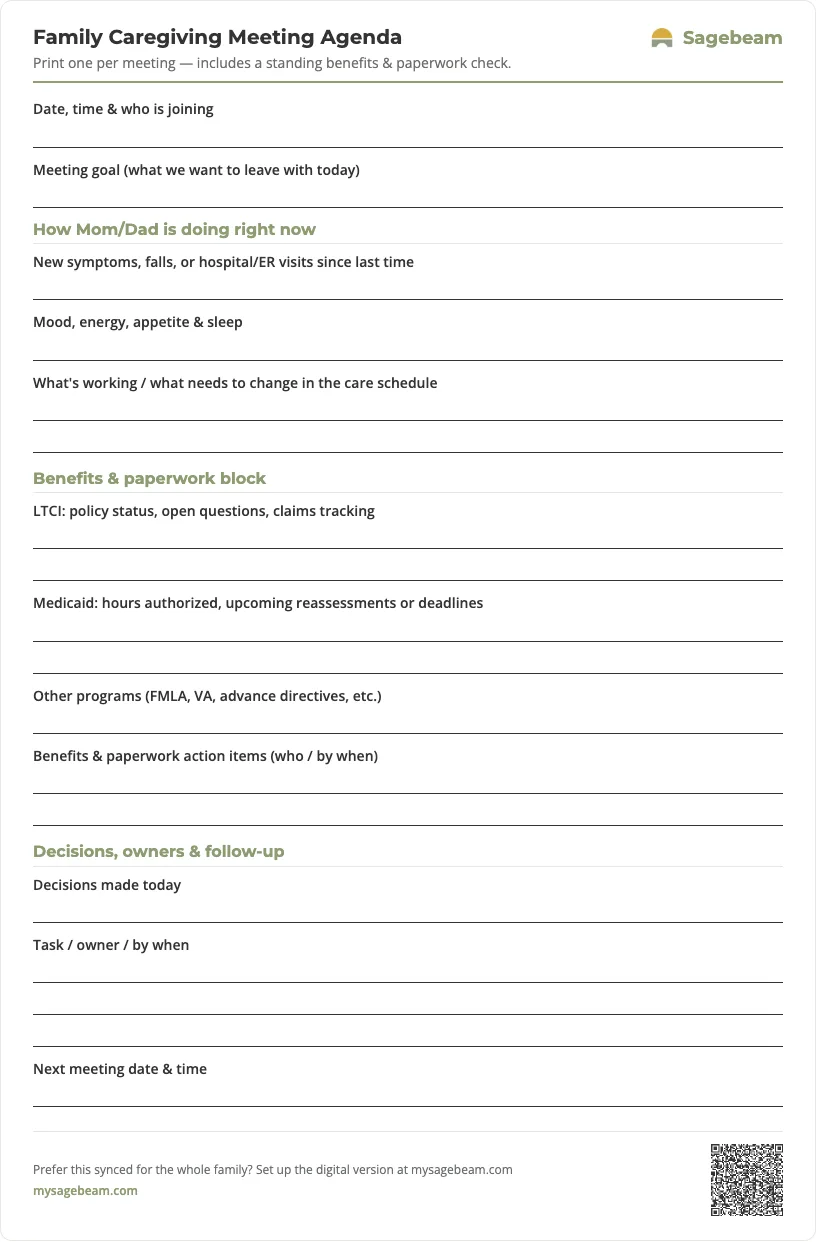
Print your family meeting agenda
A ready-to-use one-page sheet. Print it and fill it in by hand, or keep the same agenda digitally so the whole family stays in sync.
 Sagebeam
- Emergency room go-bag checklist for an aging parent
- Turning schedule template for bedbound family care (printable chart)
- Caregiver emergency backup plan template
- Radiation ride and household-coverage calendar
You don't need more tabs. You need one place to run your parent's care.
By signing up, you agree to the Terms and Privacy Policy.