Hospital communication card for patients with dementia
A one-page template families can complete and give to hospital staff when a parent with dementia is admitted, covering baseline cognition, communication, triggers, calming strategies, pain signals, mobility, and key contacts.
Get the free printable hospital communication card ↓No account required.By Rachel Moore, Founder, Sagebeam · Published June 2026 · How we research and review our guides
Part of: Medical transitions for aging parents – before/after plan
When a parent with dementia is admitted to the hospital, staff may see the diagnosis before they see the person. A communication card helps change that. It gives nurses, aides, therapists, sitters, and doctors a quick picture of who your parent is at baseline, how they communicate, what upsets them, what calms them, and what safety risks matter most.
This is different from a medication list or advance directive. It is not a legal document and it does not tell the hospital how to treat the medical condition. It helps the hospital team care for your parent as a whole person during a confusing, high-risk environment. MedlinePlus's overview of dementia is a useful plain-language reference for the baseline symptoms and behaviors this card is meant to capture.
This template is educational and is not medical or legal advice. Always follow hospital instructions and provide formal documents separately when requested.
UCSF's Memory and Aging Center emphasizes that family caregivers often know routines, preferences, and communication patterns that are not visible in the chart; their hospitalization guidance supports the core idea behind this template.
How to use this card
Complete one page. Keep it short. Hospital staff are busy, and a concise card is more likely to be read.
Use it:
- During an emergency department visit.
- At hospital admission.
- Before a planned surgery or procedure.
- When your parent is transferred to a new unit.
- When a sitter or aide is assigned.
- Before discharge planning if baseline function is being discussed.
Bring several printed copies if possible. You can also keep a digital version on your phone.
Hospital communication card template
Patient name: _______________________________
Preferred name: _______________________________
Date completed: _______________________________
Primary family contact: _______________________________
Phone: _______________________________
Relationship: _______________________________
Dementia diagnosis, if known: _______________________________
Usual living situation: _______________________________
Baseline: what is normal for them
Before this hospitalization, they usually:
- Recognize: ________________________________________________
- Know where they are: ______________________________________
- Walk with: ________________________________________________
- Need help with: ___________________________________________
- Sleep pattern: ____________________________________________
- Eating/drinking pattern: __________________________________
What is different right now:
Communication
They understand best when staff:
- Speak slowly
- Use short sentences
- Give one instruction at a time
- Approach from the front
- Use their preferred name
- Allow extra time to answer
- Make sure glasses/hearing aids are in place
Words or phrases that help:
Words or approaches to avoid:
What calms them
Helpful:
- Familiar voice
- Family photo
- Music: _______________________________
- Blanket or comfort item: _______________________________
- Quiet room
- Light on during the day
- Reassurance: "You are safe. You are in the hospital."
Other calming strategies:
Triggers and distress signs
They may become upset when:
- They are touched without warning
- They are rushed
- They are in pain
- They need the bathroom
- They are hungry or thirsty
- They cannot hear or see well
- They are awakened suddenly
- They do not recognize the room
Signs they are scared, in pain, or overwhelmed:
Pain and symptoms
They may not say "I am in pain." Their pain may look like:
- Grimacing
- Guarding one side
- Refusing to move
- Agitation
- Withdrawal
- Calling out
- New confusion
- Other: _______________________________
Known pain history or current concern:
Mobility and safety
Usual mobility:
- Walks independently
- Cane
- Walker
- Wheelchair
- Needs help transferring
- High fall risk
Important safety notes:
- May try to get up alone
- May wander
- May pull at lines/tubes
- Needs help toileting
- Gets more confused at night
- Does not remember safety instructions
Details:
Key medical and care notes
Medication sensitivities or concerns:
Allergies:
Important routines:
Documents available:
- Medication list
- Healthcare proxy / medical POA
- Advance directive
- POLST/MOLST/MOST
- Insurance cards
Where documents are kept:
What not to put on the card
Keep the card practical. Do not include:
- Long family conflict history.
- Financial details.
- Private information unrelated to care.
- Accusations about prior care.
- Detailed legal arguments.
If there are serious safety or legal issues, discuss them with the case manager, social worker, or appropriate professional separately.
How this connects to the rest of the hospital stay
This card is most useful when paired with active family communication. Use What to do when a parent with dementia is hospitalized to decide what to bring, what to document, and what to ask on rounds.
If your parent becomes suddenly more confused, use Hospital delirium in people with dementia to describe what changed. If discharge planning has started, bring the same baseline information into Hospital discharge planning for a parent with dementia or memory loss.
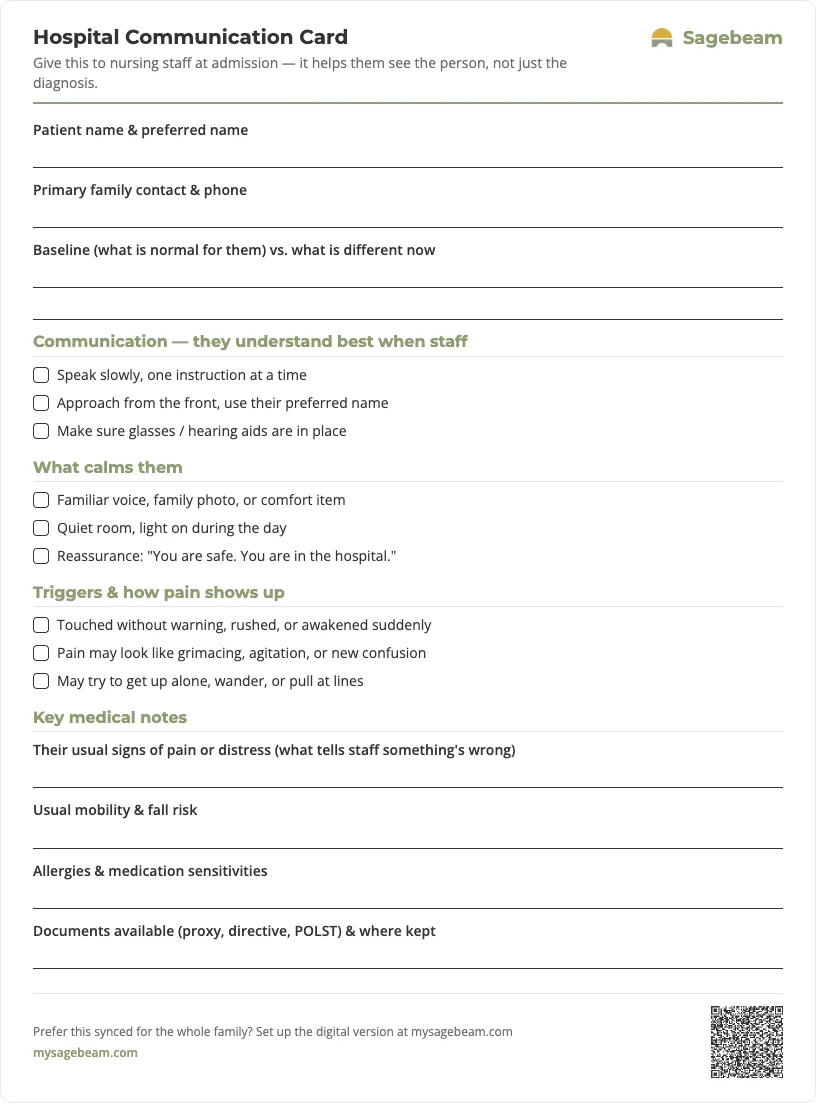
Print your hospital communication card
A ready-to-use one-page card for hospital staff. Print it for the go-bag, or keep it synced so it is always current before the next admission.
 Sagebeam
Just got home from the hospital? Get a free text-message helper for the first week.
By signing up, you agree to the Terms and Privacy Policy.
Related planning steps
- What to do when a parent with dementia is hospitalized - full hospital action guide
- Dementia patient hospital preparation checklist - what to bring for emergency or planned admissions
- Hospital delirium in people with dementia - sudden confusion and what to ask
- Caregiver handoff checklist template - broader family and caregiver handoff structure