Long-term care insurance denial appeal checklist template
When an LTCI home-care claim is delayed or denied, knowing what evidence to gather makes the difference between a weak follow-up and a successful appeal. This checklist template helps you organize the key documents, timelines, and communication records before you respond to the insurer.
Get the free printable denial & appeal evidence checklist ↓No account required.By Rachel Moore, Founder, Sagebeam · Published May 2026 · How we research and review our guides
When a long-term care insurance (LTCI) home-care claim is delayed or denied, the first response is often emotional: frustration, fear, or anger.
The next step, though, is practical: What evidence do we have, and what do we still need, before we follow up or appeal?
This article gives you a long term care insurance denial appeal evidence checklist template you can use to:
- Gather and track key documents (policy, letters, logs, doctor notes, trackers),
- Capture the insurer’s stated reasons in your own words, and
- Plan a focused, evidence-based response – whether you handle it yourself or with professional help.
It is educational and is not legal or financial advice. Only the insurer (and, in some cases, a court) can decide whether a claim or appeal meets the contract’s terms. Use this checklist to organize your side of the picture and to support clearer conversations with clinicians, advocates, or attorneys.
If you have not already done so, read:
- What documentation you need before filing a long-term care insurance home-care claim
- Common reasons long-term care insurance home-care claims get delayed or denied
- How to use care logs and doctor visits to support long-term care insurance claims
- Long-term care insurance elimination-period day tracker (template)
- Should you involve an attorney or advocate for long-term care insurance problems?
- What to track during a parent’s hospital stay
- How to help a parent transition home after a hospital stay
On this page:
- Quick answer – core sections of an LTCI denial/appeal evidence checklist
- How this checklist fits with your other LTCI tools
- LTCI denial and appeal evidence checklist template (copy and adapt)
- Step-by-step: using the checklist before you follow up or appeal
- Tips for keeping your response focused and factual
Jump to checklist template: LTCI denial and appeal evidence checklist
Quick answer: core sections of an LTCI denial/appeal evidence checklist
A practical LTCI denial appeal evidence checklist usually includes:
-
Claim and policy basics
- Policyholder name, policy number, insurer contact details.
- Claim number(s) and the type of claim (for example, “home-care activation”).
-
Insurer’s stated reasons
- Your own summary of why the insurer says the claim is delayed or denied.
- Policy sections or phrases they cite, and any deadlines they mention.
-
Policy context
- Key benefit triggers, home-care coverage rules, and elimination-period details from your policy summary sheet.
-
Clinical evidence
- Relevant physician statements, visit notes, and assessments that speak to ADLs, cognition, and safety.
-
Care logs and service records
- Daily logs, visit records, and (if relevant) elimination-period tracking for the period in question.
-
Timeline of events
- When you filed the claim, what the insurer asked for, when you responded, and any follow-up communications.
-
Gaps and next steps
- A checklist of evidence you still need to gather or clarify.
- Notes on whether you plan to self-advocate, involve an advocate, or consult an attorney.
The template below weaves these elements into a single long term care insurance denial appeal evidence checklist template you can reuse for each delay or denial.
How this checklist fits with your other LTCI tools
This denial and appeal evidence checklist is meant to sit on top of your existing documentation:
- Your LTCI policy summary sheet explains the structure of the contract.
- Your care logs, visit records, and elimination-period tracker capture what has actually been happening.
- Your call notes worksheet records what the insurer has asked for and said so far.
The checklist:
- Pulls the most relevant pieces from those sources into a single, case-focused view, and
- Helps you see, at a glance, where your documentation is strong and where you might need more clarity before following up or appealing.
You can print the checklist and fill it out by hand, or adapt it into a document or workspace like Sagebeam where you keep links to the underlying evidence.
LTCI denial and appeal evidence checklist template (copy and adapt)
You can copy and paste this long term care insurance denial follow up template into your own document or spreadsheet, or into a caregiving workspace, and customize it as needed.
LONG-TERM CARE INSURANCE (LTCI) DENIAL / APPEAL EVIDENCE CHECKLIST

SECTION 1 – CLAIM & POLICY SNAPSHOT

Parent / policyholder name: __________________________________________
Policy number: ______________________________________________________

Insurer name: _______________________________________________________
Claim number(s): ____________________________________________________

Type of claim (for example: home-care activation, ongoing benefits):
_____________________________________________________________________

Key policy points from summary sheet
(benefit triggers, home-care coverage, elimination-period basics):
_____________________________________________________________________
_____________________________________________________________________

SECTION 2 – INSURER’S STATED REASONS

In my own words, the insurer says the claim is delayed / denied because:
_____________________________________________________________________
_____________________________________________________________________

Policy sections / phrases they cite:
_____________________________________________________________________
_____________________________________________________________________

Deadlines mentioned (for more information, appeal, etc.):
_____________________________________________________________________

SECTION 3 – CLINICAL EVIDENCE

Relevant physician statements / forms we already have:
- _________________________________________________________________
- _________________________________________________________________

Recent visit notes or summaries that describe ADLs, cognition, or safety:
- Date: __________  Clinician: ___________________________
  Key points: ___________________________________________
- Date: __________  Clinician: ___________________________
  Key points: ___________________________________________

Clinical evidence we still need to gather or clarify:
- _________________________________________________________________
- _________________________________________________________________

SECTION 4 – CARE LOGS, SERVICE RECORDS & ELIMINATION-PERIOD TRACKING

Care logs / daily notes included in this packet:
(dates covered, location of files)
_____________________________________________________________________

Visit records / timesheets included:
_____________________________________________________________________

Elimination-period day tracker:
- Elimination period length: __________ days
- Days we believe meet criteria (summary, e.g., “Days 1–65”):
  _________________________________________________________________

Any gaps or inconsistencies we have noticed in our own records:
_____________________________________________________________________
_____________________________________________________________________

SECTION 5 – TIMELINE OF EVENTS

Key dates:
- Claim filed: ______________________
- Insurer requested more information on: _____________________________
- Our responses sent on: ____________________________________________
- Denial or latest letter dated: ____________________________________

Other important events (hospitalizations, major changes in care, etc.):
_____________________________________________________________________
_____________________________________________________________________

SECTION 6 – GAPS & NEXT STEPS

Evidence we still need to gather (check as we complete each one):
- [ ] Updated physician statement / clearer note on ADLs
- [ ] Recent visit summaries reflecting current needs
- [ ] More structured care logs for the period in question
- [ ] Updated elimination-period tracking
- [ ] Other: ________________________________________

Our planned next step:
- [ ] Strengthen documentation and send a focused follow-up
- [ ] Consult a non-legal advocate
- [ ] Consult an attorney
- [ ] Other: ________________________________________

Notes on why we chose this path:
_____________________________________________________________________
_____________________________________________________________________

SECTION 7 – QUESTIONS FOR INSURER / ADVOCATE / ATTORNEY

Questions for the insurer:
- _________________________________________________________________
- _________________________________________________________________

Questions for a non-legal advocate (if any):
- _________________________________________________________________
- _________________________________________________________________

Questions for an attorney (if we choose to consult one):
- _________________________________________________________________
- _________________________________________________________________
You can also convert this into a checklist-style form where each bullet becomes a checkbox with links to the underlying files.
Step-by-step: using the checklist before you follow up or appeal
To use this checklist effectively:
-
Fill in Sections 1 and 2 first
- Capture the basics (policy, claim, contact info).
- Restate the insurer’s reasons and any cited policy sections in your own words.
-
Map your existing evidence into Sections 3 and 4
- List what clinical documentation and care logs you already have.
- Note any obvious gaps or inconsistencies you see.
-
Build out the timeline in Section 5
- Record when you filed, when you heard back, and how you responded.
- Include major health events that might contextualize changes.
-
Use Section 6 to decide what to do next
- Check off evidence you still need to gather.
- Mark whether you plan to handle the next step yourself or involve an advocate or attorney.
-
Draft questions in Section 7
- Prepare what you want to ask the insurer or any professional you contact, so conversations stay focused.
After you have filled out the checklist, you will have a clearer view of:
- Where your case is strong,
- Where documentation could be improved, and
- What kind of help (if any) might be useful.
Tips for keeping your response focused and factual
When you are ready to respond to a delay or denial:
-
Lead with the insurer’s stated reasons
- Structure your response around the points in their letter, not everything you are worried about at once.
-
Point to specific evidence, not just feelings
- For each concern, reference where in your documentation it is addressed (for example, “See Dr. Lee’s note dated…,” “See care logs for weeks of…”).
-
Keep tone calm and concrete
- Anger is understandable, but clarity usually moves things further than confrontation.
-
Update the checklist as you go
- Mark evidence you have sent, note new letters or deadlines, and adjust your “next step” if the situation changes.
This checklist cannot guarantee a particular outcome, but it can make your side of the process more organized, less overwhelming, and easier to explain to insurers and professionals who may help you.
When you are ready to consider outside help, your state's SHIP (State Health Insurance Assistance Program) provides free, unbiased insurance counseling — a good first call before deciding whether you need an attorney. If the situation does call for legal advice, the National Academy of Elder Law Attorneys (NAELA) offers a searchable directory of attorneys with elder law and LTCI experience.
Always rely on the actual policy language and qualified legal or financial advice when deciding how to use this evidence in formal appeals or legal processes.
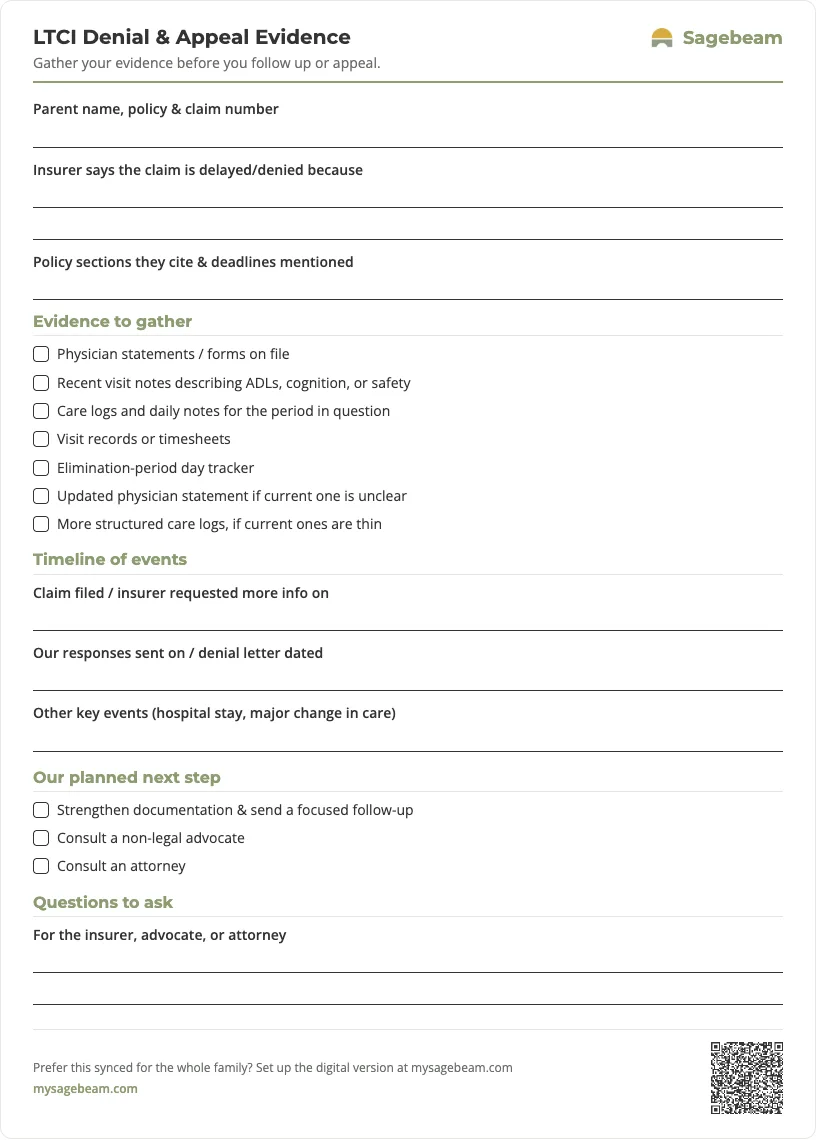
Print your denial & appeal evidence checklist
A ready-to-use one-page sheet for organizing your response to a delay or denial. Print it and fill it in by hand, or keep the same checklist digitally so the whole family can see where things stand.
 Sagebeam
- How LTCI, Medicaid, and private pay fit together for home care
- How to read your parent’s long-term care insurance policy in plain language
- Long-term care insurance policy and benefits summary sheet (template)
- What documentation you need before filing a long-term care insurance home-care claim
You don't need more tabs. You need one place to run your parent's care.
By signing up, you agree to the Terms and Privacy Policy.