Medicaid care log template for paid family caregivers – show what care really takes
If you’re a paid family caregiver through Medicaid, your EVV app or timesheet shows when you were there. This care log template shows what you actually did, how hard it was, and how long it took – the details that matter most for reassessments and appeals.
Get the free printable Medicaid care log ↓No account required.By Rachel Moore, Founder, Sagebeam · Published April 2026 · How we research and review our guides
Part of: Getting paid as a family caregiver through Medicaid – full guide
When you’re a paid family caregiver through Medicaid, your EVV app or timesheet may show that you worked 9am–1pm, but it doesn’t show:
- How long bathing actually took,
- Whether your parent could stand safely or needed full support, or
- How many times they needed help to the bathroom or redirects for safety.
Those details are what reassessments and appeals depend on. Without them, it’s easy for a care plan to underestimate what your parent really needs.
This Medicaid care log template gives you:
- A quick checklist for what a Medicaid care log should capture,
- A copy‑and‑adapt care log template you can use on paper or in a shared workspace, and
- Simple habits to keep logs going without turning them into a second job.
If you’re still learning how the whole system works, pair this with:
- Getting paid as a family caregiver through Medicaid – hub for how programs work day to day.
- Medicaid caregiver time and service records template – the timesheet side of the picture.
On this page:
- Quick answer – what a Medicaid care log should include
- How this fits with timesheets, daily logs, and shift reports
- Medicaid care log template (copy and adapt)
- Step‑by‑step: using this care log without burning out
- How this log supports reassessments and appeals
Jump to template: Medicaid care log template
This article is educational and is not legal, financial, or benefits advice. Rules for programs like Medicaid and long-term care insurance vary by state and by plan and change over time. For your parent's specific situation, check with the program directly or a qualified professional — an elder-law attorney, a benefits counselor, or your state's Medicaid office.
Quick answer: what a Medicaid care log should include
Every state and program is different, but a strong Medicaid care log template for paid family caregivers usually includes:
- Header
- Date.
- Visit or shift time (start and end).
- Caregiver name.
- Today’s overall picture
- 2–3 bullets on how the day or visit compared to a typical day.
- Help with everyday activities
- Short notes on help with bathing, dressing, eating, toileting, mobility, and getting in and out of bed or chairs.
- Supervision and safety
- Times you needed to stay nearby for safety, near‑falls, wandering, or other risks.
- How long key tasks took and how hard they were
- Simple time estimates and phrases like “needed full support,” “needed hands‑on help,” or “needed close supervision.”
- Notes for reassessment
- 1–3 examples you may want to bring up at your next reassessment or appeal.
You do not need paragraphs of narrative. The goal is short, specific examples that show what care actually looks like, in the language assessors use.
How this fits with timesheets, daily logs, and shift reports
If you’re already using:
- A Medicaid caregiver timesheet or EVV app to record hours, and
- A family caregiver daily log to keep siblings in the loop,
you might wonder whether a separate Medicaid care log is overkill.
Here’s how they fit together:
-
Medicaid caregiver timesheet / time and service records – “When was I there, for how long, and which covered services did I provide?”
See: Medicaid caregiver time and service records template. -
Caregiver daily log template for families – “What happened in the day overall, and what do siblings or doctors need to know?”
See: Caregiver daily log template for families. -
Medicaid care log (this article) – “What did today’s care really take in terms of help and supervision, in a way that lines up with how hours are decided?”
You can combine them:
- Use the Medicaid care log as a more detailed “service” layer for days when you are the paid caregiver.
- Summarize pieces of the care log into your family’s daily log or weekly summary when you’re updating siblings.
Medicaid care log template (copy and adapt)
You can copy and paste this template into a notebook, a shared caregiving workspace, or a simple document in your Sagebeam workspace. Adjust headings to match your program and your parent.
MEDICAID CARE LOG – PAID FAMILY CAREGIVER

Date: ______________________
Visit / shift time: ________________ to ________________

Caregiver name: ______________________________
Relationship to parent: ______________________

1. Today’s overall picture
- Compared to a typical day, today was:
  - [ ] Easier than usual
  - [ ] About the same
  - [ ] Harder than usual
- 2–3 key points about how today went:
  - ________________________________________________________________
  - ________________________________________________________________

2. Help with everyday activities (what care looked like)
For each area you helped with, add short notes about what you did and how much help was needed.

- Bathing / showering:
  - Help provided and level of help (reminders, hands‑on support, full assist):
    ________________________________________________________________
- Dressing (upper and lower body):
  - Help provided and level of help:
    ________________________________________________________________
- Toileting / bathroom:
  - Help provided and level of help:
    ________________________________________________________________
- Eating / meals:
  - Help provided and level of help:
    ________________________________________________________________
- Getting in and out of bed / chairs:
  - Help provided and level of help:
    ________________________________________________________________

3. Time and effort for key tasks
Use simple estimates; exact minutes are less important than the pattern.

- About how long total did hands‑on care take this visit (not counting breaks)?
  ________________________________________________________________
- Were any tasks much slower or harder than usual today? Which ones?
  ________________________________________________________________

4. Supervision and safety
- Times you needed to stay close for safety (falls risk, confusion, wandering, stove, doors, etc.):
  ________________________________________________________________
- Any falls, near‑falls, or safety scares today?
  ________________________________________________________________

5. Health, mood, or thinking changes you noticed
- Changes in energy, pain, breathing, or other symptoms:
  ________________________________________________________________
- Changes in mood or behavior (more anxious, withdrawn, agitated, etc.):
  ________________________________________________________________
- Changes in memory or thinking (repeating questions, getting lost in home, etc.):
  ________________________________________________________________

6. Notes for reassessment or doctor
Short, concrete examples you may want to bring up at reassessment or appointments.

- Example 1:
  ________________________________________________________________
- Example 2:
  ________________________________________________________________
- Example 3 (optional):
  ________________________________________________________________
You can simplify sections if some areas do not apply (for example, if your parent no longer bathes in a shower) or add notes where you see recurring issues.
Step‑by‑step: using this care log without burning out
The log only helps if it fits into your real life. To keep it sustainable:
-
Pick your rhythm.
- For short visits: one quick entry per visit, focusing on the most intense or risky tasks.
- For longer days: one entry at the end of the day that summarizes the main care blocks.
-
Limit yourself to 5–10 minutes.
- Use bullets, not paragraphs.
- Prioritize changes and hard tasks over “everything that happened.”
-
Keep it in one place.
- A section in your existing caregiver binder.
- A single digital note or folder named “Medicaid care logs.”
For example, you might:
- Keep a printed stack of care log pages in your parent’s home.
- After each visit, check a few boxes, jot 3–5 short bullets, and circle “easier/about the same/harder.”
- Once a week, skim the logs to pull 2–3 patterns into your reassessment prep notes or doctor question list.
How this log supports reassessments and appeals
When assessors and caseworkers decide how many hours your parent should have, they often ask questions like:
- “Can your parent bathe independently?”
- “Do they need help getting dressed?”
- “Do they need supervision to be safe at home?”
Without examples, it’s easy to answer “yes” or “no” in a way that glosses over nuance. With a Medicaid care log, you can instead say:
- “They can wash their upper body if I set everything up, but they need hands‑on help stepping in and out of the shower and washing their lower body because of falls risk,” or
- “They can pull on a shirt, but I have to lay out clothes, help with buttons, and it takes 20–30 minutes each morning.”
Those are the kinds of specifics reassessments and appeals need.
When you combine:
- This Medicaid care log template,
- Your Medicaid caregiver time and service records, and
- A Medicaid reassessment preparation checklist,
you’re in a much stronger position to accurately represent reality so your parent’s care plan matches what their days actually require.
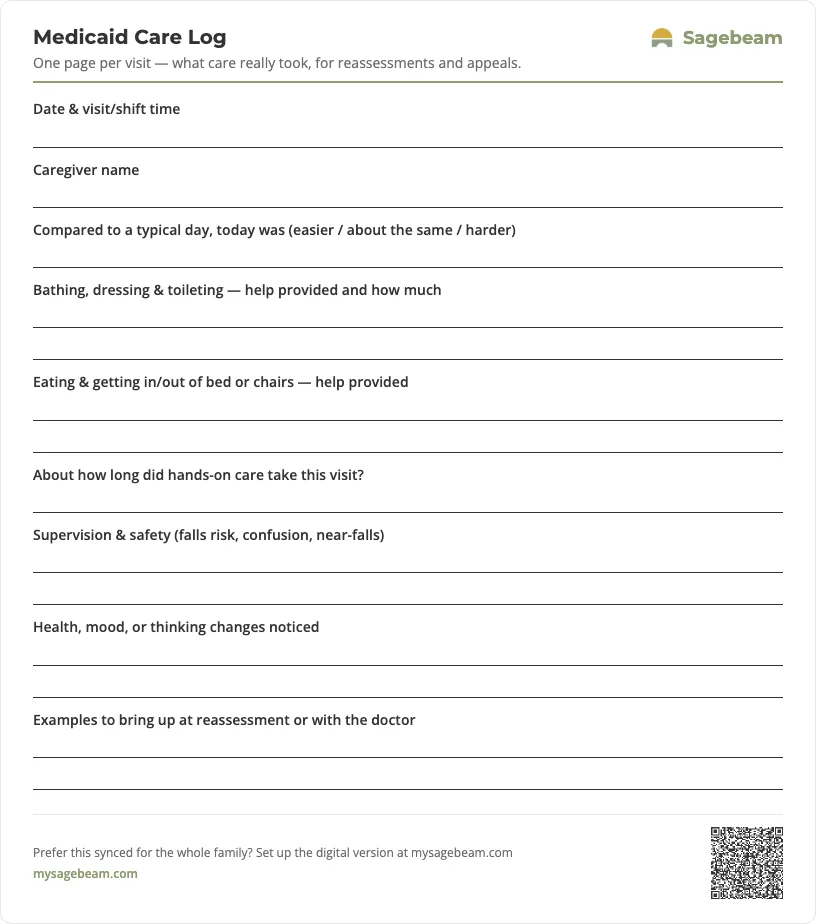
Print your Medicaid care log
A ready-to-use one-page sheet. Print a stack and fill one in per visit, or keep the same log digitally so the whole family stays in sync.
 Sagebeam
- Can I get paid to be my parent’s caregiver through Medicaid? Eligibility checklist
- Medicaid caregiver time and service records template – compliance-first timesheet
- Medicaid reassessment preparation checklist – show what your parent really needs
You don't need more tabs. You need one place to run your parent's care.
By signing up, you agree to the Terms and Privacy Policy.
Sources and further reading
- Paying family caregivers: self-direction in Medicaid personal care (PubMed Central) – research overview of self-directed Medicaid personal care and the role of family caregivers.
- Self-Directed Services (Medicaid.gov) – explains the core features of self-directed Medicaid services that many paid family caregiver programs use.