Free printable caregiver daily log sheet template (PDF)
Free printable caregiver daily log sheet — a one-page template for meds, mood, and safety notes that family and home health caregivers can share, print, or keep digital.
Get the Free daily log — print or fill out online ↓No account required.By Rachel Moore, Founder, Sagebeam · Published March 2026 · How we research and review our guides
Part of: Care coordination for aging parents – simple system
When you’re coordinating care for an aging parent, a lot happens in a day: meals, medications, visitors, naps, small health changes, mood shifts, and the odd scare or near-miss. Without a system, those details live in your head, in text threads, or in quick comments at the door between caregivers.
A caregiver daily log gives families one simple place to capture what actually happened each day, so you can:
- See patterns in health, mood, and safety over time.
- Keep siblings and helpers aligned without endless back-and-forth.
- Walk into appointments with concrete examples instead of guesswork.
This guide gives you a copy-and-adapt daily log template you can use on paper or in a shared digital workspace. You can copy the sections below directly into a notebook or shared document and tweak them for your family. It fits into the broader system in our care coordination hub and pairs well with How to track health changes in an aging parent and How to create a family caregiver communication plan. For a general overview of the caregiving role this log supports, see the National Institute on Aging's guide to caregiving.
If you are also a paid family caregiver through Medicaid, this family log can sit alongside your program-specific records. For Medicaid-focused documentation, see the Medicaid caregiver time and service records template and the Medicaid care log template for paid family caregivers. And if your parent has dementia or memory loss, a memory-care version of this log — with dedicated space for orientation, sleep, and sundowning — may fit better; see the dementia daily care log template.
Recording what happened? You're in the right place. If you're instead trying to plan the day ahead — time blocks, who's covering what, and what's flexible — use the caregiver daily schedule template instead. The two work together: the schedule plans the day, this log records how it actually went.
This article is educational and reflects general caregiving experience, not professional advice for your family's specific situation. For medical, legal, or financial questions, follow the guidance of your parent's care team and the qualified professionals who know their situation.
Quick answer: a simple daily log layout
A simple caregiver daily log template for families includes:
- Header
- Date
- Time period covered (e.g. “8am–4pm”)
- Who provided care (family, paid caregiver, both)
- Today’s overview
- 2–3 bullets on how the day went overall
- Health and mood
- Energy, mood, pain, confusion, or other changes
- Meals, medications, and hydration
- What they ate and drank; any missed or changed medications
- Mobility and safety
- Walking, transfers, falls or near-falls, home safety concerns
- Tasks and activities
- Key tasks completed (bathing, laundry, appointments, exercises)
- Notes for tomorrow / next caregiver
- Follow-ups, questions for family or doctors, anything to watch tomorrow
The rest of this article walks through how to use this template without turning it into a second job.
Step 1: Decide when and how the log gets filled out
A daily log only works if it fits into people’s real days. Start by deciding:
- When entries get written
- At the end of each shift or visit.
- Or once in the evening, summarizing the full day.
- Where the log lives
- A notebook in a consistent spot at home, and/or
- A shared digital note or caregiving workspace for siblings.
- Who is responsible for making sure it happens
- One “log owner” who checks that entries are being made, even if others do the writing.
For example:
- A local daughter might fill out the log each evening, with hired caregivers leaving brief notes in the same notebook.
- Siblings who live in different cities might use a shared note; anyone who visits or calls adds a few lines about what they saw.
The aim is not a perfect record; it’s a light, dependable rhythm that gives everyone a shared picture of each day.
Step 2: Use a consistent header
Start each entry with the same small set of facts. This makes the log much easier to scan later.
Your header might include:
- Date
- Time period covered
- “Morning visit 9–11am” or “Full day 8am–8pm”
- Caregivers present
- Names and roles (e.g. “Maria – home health aide; Alex – daughter, 6–8pm”)
Example:
- Date: Mar 18
Time: 8am–4pm
Caregivers: Sandra (aide), Zoe (daughter, 3–4pm)
This tiny bit of structure helps you later connect specific notes to who was there and when.
Step 3: Capture a short “today’s overview”
Next, add 2–3 bullets that answer, “How was today overall?”
For example:
- “Morning was calm; more tired after lunch than usual.”
- “Seemed brighter after neighbor’s visit; laughed more.”
- “Rough day—complained of more back pain; needed extra help getting up.”
This section should feel like the short summary you’d give a sibling on the phone, not a full narrative. It gives context for the more detailed sections that follow.
Step 4: Log health and mood changes
In this section, include anything you’d want a doctor—or your future self—to know about how your parent was doing physically and emotionally:
- Energy and stamina
- “Needed to sit and rest halfway through walk to mailbox.”
- Pain or discomfort
- “Back pain 6/10 most of the day; eased a bit after heat pack.”
- Mood and behavior
- “More withdrawn than usual; didn’t want to take usual afternoon call.”
- Memory and thinking
- “Asked the same question about tomorrow’s appointment three times.”
You don’t need to cover every category every day. Focus on what changed compared to their usual.
For more detail on what kinds of cognitive changes to jot down here, see Early signs of cognitive decline in aging parents.
Step 5: Note meals, medications, and hydration
This part doesn’t have to be precise like a medical chart. The goal is to catch patterns, not count every sip.
You might track:
- Meals
- “Ate ~75% of breakfast, skipped lunch, small dinner snack.”
- Hydration
- “Two glasses of water with meds + one tea; encourage more fluids tomorrow.”
- Medications
- “All morning meds taken on time; evening pill taken an hour late but not missed.”
- “Started new blood pressure medication today; noted some lightheadedness.”
If a separate medication-tracking system already exists, use this section to flag any deviations or side effects rather than rewriting the full schedule. For a more detailed approach, see How to track an aging parent’s medications and appointments.
Step 6: Record mobility and safety incidents
Mobility and safety are areas where patterns really matter. In this section, note:
- Walking and transfers
- “Needed more support getting out of bed and up from chair.”
- Falls and near-falls
- “No falls; one near-slip in bathroom when stepping out of shower.”
- Home safety
- “Rug by front door bunched up again; moved it, but might need non-slip mat.”
- Driving (if applicable)
- “Drove to grocery store and back; seemed more hesitant at left turns.”
Even brief notes here feed directly into decisions about home changes, support levels, and driving safety. They also support separate guides like How to evaluate if a parent’s home is still safe and Signs an aging parent should stop driving.
If this log is being used after a hospital stay for a parent with dementia or memory loss, add extra detail about nighttime confusion, wandering, medication supervision, and near-falls. The post-hospital dementia safety assessment checklist gives you a more focused way to decide whether the home setup and supervision plan are still realistic.
If your parent is bedbound and the care team has prescribed a repositioning routine, keep the turning schedule chart at the bedside and roll its daily summary ("turns 10/12, see chart") into this log rather than duplicating every entry here.
Step 7: List key tasks and activities completed
This section helps everyone see what’s getting done regularly and what may need more backup.
Examples:
- “Laundry (1 load), changed bed linens.”
- “Shower and hair wash; needed moderate assistance.”
- “PT exercises: completed 2 of 3 sets.”
- “Telehealth with primary care; notes added to care log.”
You don’t need to list every minor action. Focus on:
- Personal care (bathing, dressing).
- Household tasks tied to health or safety (laundry, cleaning high-risk areas).
- Medical or therapy visits and exercises.
Step 8: Add notes for tomorrow and the next caregiver
Finish each entry with brief guidance for what happens next. This is where the daily log becomes a true handoff tool.
You might include:
- Follow-ups
- “Call clinic tomorrow about increased dizziness.”
- “Refill prescription before Friday.”
- What to watch tomorrow
- “Check if back pain is better or worse than today.”
- “Notice if she’s still skipping lunch.”
- Questions for family or doctors
- “Ask Dr. Lee if the new medication could be causing extra fatigue.”
When the next person arrives—whether that’s you, a sibling, or a paid caregiver—they can quickly skim yesterday’s notes and know what matters most for today.
Keeping the log sustainable
A caregiver daily log is only helpful if people actually use it. To keep it sustainable:
- Lower the bar.
- A few short bullets are enough; an empty entry is worse than an imperfect one.
- Share the responsibility.
- Invite paid caregivers and nearby relatives to add a line or two at the end of their time with your parent.
- Avoid turning it into a critique.
- Treat the log as shared information, not a way to grade anyone’s care.
If you already have a coordination system from the care coordination hub, the daily log can live inside it alongside tasks, appointments, and contact information rather than as yet another separate document.
How the daily log fits into your larger care system
The daily log is one piece of a bigger structure:
- It feeds health tracking by giving you concrete examples for How to track health changes in an aging parent.
- It supports sibling alignment by giving everyone the same raw information before you talk about roles and responsibilities.
- It strengthens communication with hired caregivers by making expectations clear and giving them a simple way to report back.
When you need to answer questions like:
- “Is this just a bad week, or are things really changing?”
- “What should we tell the doctor about what’s been happening at home?”
- “Do we need more help, or different routines?”
—the daily log becomes your memory and your evidence, not just another piece of paperwork.
Using this log for home health care shifts
This same daily log works well for families who bring in paid home health aides, whether that's a few hours a week or coverage across multiple shifts a day. The template doesn't change — you're still capturing the header, overview, health and mood, meals and medications, mobility, tasks, and notes for next time. What changes is who's writing in it.
In a home health care setup, the log usually lives in one consistent place — a notebook by the door, or a shared digital note — and every caregiver who works a shift adds their own entry before they leave. That gives the family (and the agency, if there is one) a continuous record across aides, rather than separate impressions from each person. It also means a family member who wasn't there can read the last few entries and know exactly how the day or week has been going.
A few things that help this work smoothly with paid caregivers:
- Agree on the basics up front — where the log lives, when entries get written, and how much detail is expected.
- Keep it factual, not evaluative. The log records what happened, not a judgment of how well someone did their job.
- Use it to brief the next shift, not just to look back later — a quick read of yesterday's notes helps a new or returning aide pick up where the last one left off.
If your family is coordinating shift-to-shift handoffs between multiple paid caregivers — especially when shifts change daily or several agencies are involved — a dedicated handoff form can work better than a general daily log for that specific moment. See the home caregiver shift report template for a format built specifically for passing information from one caregiver to the next at a shift change. This daily log and that shift report template are meant to work together: this log is the ongoing daily record; the shift report is the focused handoff note between shifts.
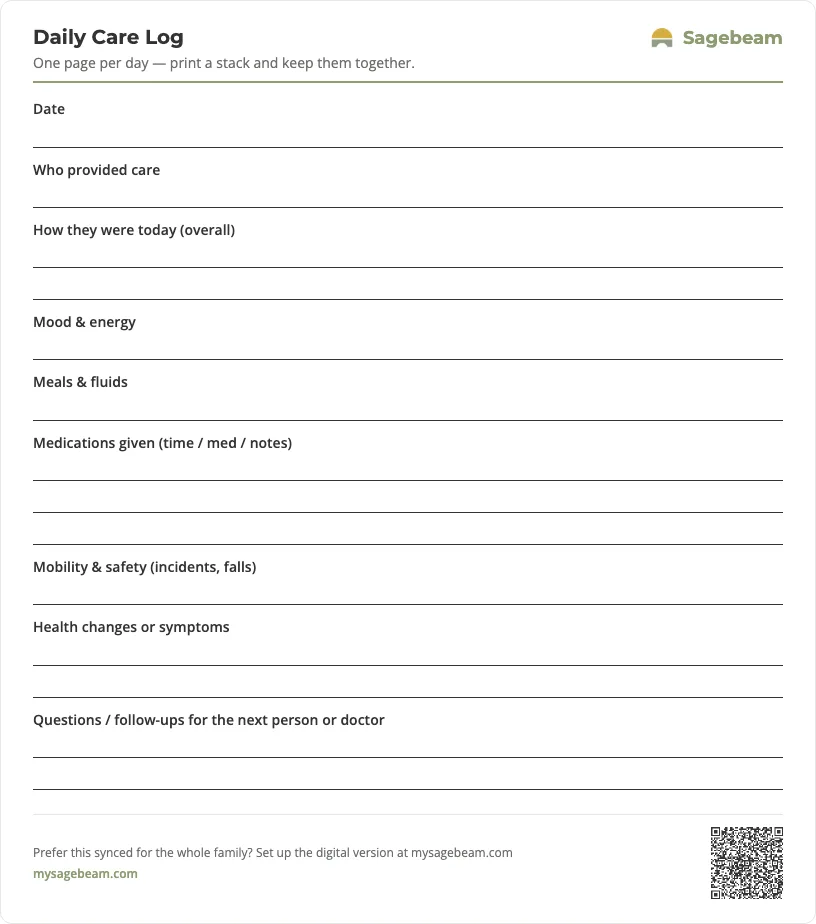
Your daily log — print it, or fill it out right here
 Sagebeam
- Emergency room go-bag checklist for an aging parent
- Turning schedule template for bedbound family care (printable chart)
- Caregiver emergency backup plan template
- Radiation ride and household-coverage calendar
You don't need more tabs. You need one place to run your parent's care.
By signing up, you agree to the Terms and Privacy Policy.
Where to go next
If you’ve been relying on quick texts and your own memory, starting a caregiver daily log can feel like “one more thing.” In practice, most families find that a simple, reusable template reduces the mental load: you write a few lines, and the system holds the details for you.
From here, you might:
- Use the care coordination hub to decide where your daily log lives alongside other care information.
- Turn raw daily notes into a weekly overview with the Weekly caregiver summary template for families so siblings and doctors can see the big picture without reading every entry.
- Use the Caregiver incident report template when there’s a fall, sudden change, or other one-off event so those stand out clearly from routine days.
- Pair this template with How to track health changes in an aging parent so your daily notes feed into a longer-term health log.
- Revisit How to create a family caregiver communication plan to decide who sees the log, how often you share summaries, and how you’ll use it to make decisions together.
You don’t need a complex form to get started. Print the ready-made template below, or keep the same log digitally so the whole family stays in sync—then just a few minutes at the end of each day, and a commitment to write down what you’re already noticing.
Frequently Asked Questions
What is a caregiver daily log and why do families need one?
A caregiver daily log is a simple record of what happened during a day of care—how your parent was doing, what was done, any changes, and what needs follow-up. For families, it turns scattered impressions and texts into one shared view, so you can spot patterns, brief siblings, and give doctors clearer information without relying on memory.
What should be included in a caregiver daily log?
A practical daily log usually includes the date and who provided care, a brief summary of the day, notes on mood and energy, meals and medications, mobility and safety incidents, health changes or symptoms, and any follow-ups or questions for the next person. You don't need long narratives—short, specific bullets are enough.
Who should fill out the daily log—family or paid caregivers?
Ideally, everyone who provides hands-on care contributes. One person can "own" the log, but family members, hired caregivers, and other helpers can each add brief notes at the end of their time with your parent. The format should be simple enough that no one dreads using it.
Is it better to keep the caregiver daily log on paper or digitally?
The best format is the one you'll consistently use. A notebook on the kitchen counter can work well when multiple in-home caregivers rotate; a shared digital note or caregiving workspace is often better when siblings live in different places. You can also combine them—paper for in-home notes, with key points summarized into a shared digital log.
How do you keep track of caregiver hours with a daily log?
Add a start and end time to the header of each entry—for example, "8am–4pm" or "Morning visit, 9–11am." Over a week or month, those time-stamped entries add up to a simple record of who was there and when, which is useful for coordinating schedules or for paid caregivers who also track hours separately for payroll or Medicaid documentation.
What does an example of a filled-out caregiver daily log look like?
A typical entry might read: "Date: Mar 18. Time: 8am–4pm. Caregivers: Sandra (aide), Zoe (daughter, 3–4pm). Overview: calm morning, more tired after lunch. Meals: ate most of breakfast, skipped lunch. Medications: morning meds on time. Mobility: no falls, one near-slip in bathroom. Notes for tomorrow: watch appetite, call clinic if it continues." Short, specific bullets like these are more useful than a long narrative.
What should a daily care sheet include at minimum?
At minimum, a daily care sheet should capture the date and who provided care, a brief overview of how the day went, any health or mood changes, meals and medications, mobility or safety concerns, and a note for the next person. You can always add more detail—but these core fields are what make the sheet worth filling out consistently.
Related templates
- Post-cardiac surgery daily monitoring log template for families – a condition-specific version of this log for a parent recovering from heart surgery.
- CHF symptom tracker template for family caregivers – a heart-failure daily tracker for weight, swelling, and breathing changes.
- Hip replacement recovery daily log template for families – a version tailored to hip replacement recovery.