Skilled nursing facility visit log template for families
Regular family visits during a skilled nursing facility (nursing home) stay are one of the strongest predictors of good care — but observations are easy to forget. This skilled nursing facility visit log template helps families track what they see, questions they asked, and staff responses so nothing gets lost before the care conference.
Get the free printable SNF visit log ↓No account required.By Rachel Moore, Founder, Sagebeam · Published June 2026 · How we research and review our guides
Part of: Care coordination for aging parents – simple system
Regular family visits during a skilled nursing facility stay — what many families call a nursing home or rehab facility — are one of the strongest predictors of good care. When staff know a patient's family visits frequently and notices things, the care tends to be more attentive. The National Council on Aging and long-term care advocates consistently point to family presence as a meaningful quality signal in care facilities. But visits without a record are hard to use. You notice something on Tuesday, mention it on Thursday, and can't quite remember the specifics by the care conference the following week.
A SNF visit log — a simple running record of what you see, what you ask, and what you're told — closes that gap. It gives you:
- A way to track changes over time that might be invisible in any single visit
- A record of what you reported to staff and what they said, so concerns don't disappear into the air
- Concrete observations to bring to the 14-day and 30-day care conferences
- Documentation if concerns escalate and you need to involve the ombudsman
This guide gives you a SNF visit log template you can use throughout your parent's stay. It is educational and is not a substitute for the formal care records kept by the facility.
Related resources:
- SNF care conference questions template — prepared questions for the 14-day, 30-day, and quarterly care plan meetings
- How to choose a skilled nursing facility for a parent — evaluating the facility before and during the stay
- What is a skilled nursing facility? A guide for families — understanding what SNF care looks like
- Caregiver observation log template for tracking health changes — broader health-change tracking once your parent is home
On this page:
- What a SNF visit log should capture (and what it doesn't)
- How this log fits with other SNF documentation
- SNF visit log template (copy and adapt)
- Step-by-step: using the log effectively
- What to do with your notes at the care conference
Jump to template: SNF visit log template
What a SNF visit log should capture (and what it doesn't)
A practical visit log is not a medical chart. You are capturing what you observe as a family member — not making clinical assessments. The value is in the pattern: one visit's notes may not mean much; ten visits' notes, showing that confusion has gradually worsened or that pain scores have trended upward, tell a useful story.
What to capture:
- Date, time, and who visited
- Overall impression of how your parent seems (energy, mood, demeanor, compared to the last visit)
- Specific observations: mobility, appetite, pain level (as your parent reports it), wound appearance (if visible), confusion or clarity compared to baseline
- What your parent said — including complaints, questions they wanted to raise, or things they mentioned not wanting to forget
- Whether therapy happened that day, and your parent's report of how it went
- Staff interactions observed: who was there, whether your parent's needs were attended to, call light response time
- Questions you raised with staff and exactly what they told you
- Any documentation given to you (updated medication list, new instructions, etc.)
What to leave out:
Your personal assessments of clinical severity — "this seems like an infection" — belong in a conversation with the nurse, not in the log. The log records what you saw and were told; the clinical team assesses what it means.
How this log fits with other SNF documentation
- Use this log for your own records throughout the stay.
- At the 14-day and 30-day care conferences, bring relevant entries to supplement the clinical team's perspective with yours. The SNF care conference questions template is designed to work alongside this log.
- If concerns escalate and you need to contact the state long-term care ombudsman, the log becomes part of the picture you share about what you observed and reported.
- After discharge, this log is useful context for the first home health visits and physician follow-up. What the family observed in the SNF is valuable clinical history.
SNF visit log template (copy and adapt)
You can copy and paste this template into a document, a shared note, or a caregiving workspace. Add a new entry for each visit. Cross out sections that consistently don't apply to your parent's situation.
SNF VISIT LOG – FAMILY RECORD

Parent name: ________________________________
Facility name: ______________________________
Date of admission: ___________________________

---
VISIT ENTRY

Date: _________________  Time: ___________  Length of visit: ______________
Who visited: _____________________________________________________________

SECTION 1 – OVERALL IMPRESSION

How does your parent seem compared to your last visit?
(circle or note: much better / slightly better / about the same / slightly worse /
much worse)

One sentence on the biggest thing you noticed:
_______________________________________________________________________

SECTION 2 – SPECIFIC OBSERVATIONS

Mobility (walking, transfers, using equipment):
_______________________________________________________________________

Pain level (as your parent reports it – use their words):
_______________________________________________________________________

Appetite (did they eat? Are they hungry or uninterested?):
_______________________________________________________________________

Hydration (are they drinking enough? Any IV fluids still?):
_______________________________________________________________________

Confusion or clarity (compared to their baseline):
_______________________________________________________________________

Mood and demeanor (anxious, engaged, withdrawn, tearful, calm, irritable):
_______________________________________________________________________

Wound or surgical site (if visible – redness, swelling, drainage, odor):
_______________________________________________________________________

Sleep (are they rested? Did they mention poor sleep?):
_______________________________________________________________________

Room/environment (clean, appropriate temperature, call light in reach):
_______________________________________________________________________

Other observations:
_______________________________________________________________________

SECTION 3 – THERAPY

Did therapy happen today, to your parent's knowledge? [ ] Yes  [ ] No  [ ] Unknown
Type of therapy (PT, OT, speech): _________________________________________
Your parent's report of how it went:
_______________________________________________________________________

Any concerns about therapy frequency or quality to follow up on:
_______________________________________________________________________

SECTION 4 – STAFF INTERACTION

Staff members you interacted with during this visit:
(Name and role, if known): ________________________________________________

Call light: Did you observe how quickly call lights were answered?
_______________________________________________________________________

Observed concerns about staffing or responsiveness (or no concerns):
_______________________________________________________________________

SECTION 5 – WHAT YOUR PARENT SAID OR REQUESTED

Things your parent mentioned wanting to raise with the team:
_______________________________________________________________________

Complaints or concerns your parent expressed:
_______________________________________________________________________

Things your parent wanted you to bring next visit:
_______________________________________________________________________

SECTION 6 – QUESTIONS YOU RAISED AND RESPONSES

Question/concern you raised with staff:
_______________________________________________________________________

Who you spoke with: ___________________________  Role: ___________________

What they told you:
_______________________________________________________________________

Follow-up needed? [ ] Yes  [ ] No
If yes, what: _____________________________________________________________

(Repeat for additional questions)

SECTION 7 – DOCUMENTATION AND UPDATES

Did staff provide any new information or documentation during this visit?
(medication changes, therapy progress updates, discharge timeline, etc.)
_______________________________________________________________________
_______________________________________________________________________

Next visit planned: Date ________________  Who: __________________________

Priority questions to ask at next visit or at care conference:
_______________________________________________________________________
_______________________________________________________________________
---
END OF ENTRY
Step-by-step: using the log effectively
At the start of each visit: Greet your parent and take a moment to observe before filling anything in. A first impression — "she seems more tired today" or "he was in a different chair and seemed more alert" — captures something that a structured checklist might miss.
During the visit: Keep notes brief and factual. You don't need to record everything; focus on what's different from the last visit and anything your parent tells you.
Before you leave: Speak with nursing staff about any observation you're concerned about. Write down what you asked and exactly what they said. A vague "I mentioned it" is less useful than "I told the charge nurse that his wound looked redder than yesterday and she said she'd check it during evening care."
At home after the visit: If anything struck you as significant, add a brief note while it's fresh. The longer you wait, the less specific your memory will be.
Use it between visits too. If you're calling to check in by phone, add a brief phone log entry. What the nurse tells you on a Tuesday afternoon call is part of the record.
What to do with your notes at the care conference
The formal care conferences at 14 days, 30 days, and quarterly are the structured moment to share what you've observed. Before the meeting, review the last several log entries and identify:
- Any patterns you've noticed (gradual improvement or gradual decline)
- Questions that went unanswered or responses that seemed inadequate
- Things your parent requested or mentioned that the care team may not know about
- Your parent's goals for the meeting (if they can participate)
Open the care conference by sharing the most important thing you've observed since the last meeting. "Based on my last several visits, I've noticed that she seems more confused in the evenings than she was in the first week — I wanted to flag that and understand whether the team has noticed the same thing."
The SNF care conference questions template is designed to work alongside this log — your observations inform the questions you ask at the meeting.
After the conference, add a log entry noting what was discussed, what commitments were made, and any follow-up the team said they'd provide.
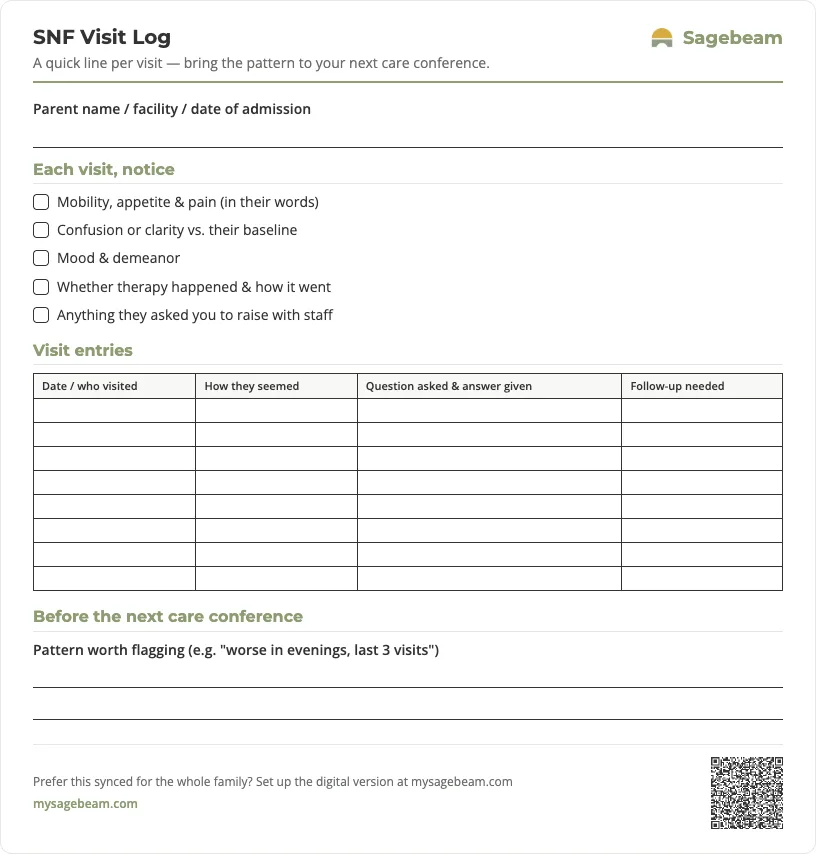
Print your SNF visit log
A ready-to-use one-page sheet. Print it and jot a line after each visit, or keep the same log digitally so the whole family sees the pattern.
 Sagebeam
| Date / who visited | How they seemed | Question asked & answer given | Follow-up needed |
|---|---|---|---|
- Caregiver emergency backup plan template
- Radiation ride and household-coverage calendar
- Chemotherapy infusion-cycle family coverage calendar
- Dialysis treatment and ride coordination calendar for families
You don't need more tabs. You need one place to run your parent's care.
By signing up, you agree to the Terms and Privacy Policy.