Caregiver incident report template (printable falls & sudden changes form)
Use this caregiver incident report template to record falls, sudden changes, and other incidents in clear, factual detail you can share with family, agencies, a…
Get the free printable incident report ↓No account required.By Rachel Moore, Founder, Sagebeam · Published April 2026 · How we research and review our guides
Part of: Care coordination for aging parents – simple system
Most days in caregiving are routine: meals, medications, small mood shifts, and check‑ins that fit neatly into a daily log or weekly summary.
Then there are the incident days:
- A fall getting out of bed.
- A sudden episode of confusion or behavior change.
- A missed or double‑dosed medication.
- A wandering or “almost wandered” moment.
In the moment, you’re focused on keeping your parent safe. Later, the details blur: What exactly happened? Who was there? When did we call the doctor? A caregiver incident report gives you one clear place to write down what happened so you’re not relying on memory or scattered texts.
This guide gives you:
- Who this is for: family caregivers and home caregivers (including paid aides) who want a simple, consistent way to document incidents.
- A caregiver incident report template you can print or copy into a shared workspace.
- Guidance on when to use it (and when a daily log entry is enough).
- Examples of how to write a clear, factual report doctors and agencies can understand.
- Tips on where to keep incident reports and how they connect to your binder and weekly summaries.
It fits alongside:
- Caregiver daily log template for families – routine day‑to‑day notes.
- Weekly caregiver summary template for families – the story of the week.
- Creating a caregiver binder for elderly parents – where incident reports can live.
- How to evaluate if a parent’s home is still safe – what to review after repeated incidents.
This article focuses specifically on one‑time events and near‑misses – not everyday care.
Note: This template does not replace any forms required by an employer, agency, or regulator. Always follow existing policies where you work and use this as a supplement for your own records and family coordination.
Quick answer: what a caregiver incident report template should include
A practical caregiver incident report template or caregiver incident report form includes:
- Header
- Date and exact or approximate time of incident
- Location (room, home, facility)
- Name of the person receiving care
- Name and role of the person completing the report
- Type of incident
- Fall, near‑fall, sudden behavior or confusion, medication issue, wandering / elopement, safety issue, other
- What happened (factual description)
- Brief, time‑ordered summary of what was observed before, during, and after
- Injuries or symptoms
- Visible injuries, pain, new symptoms, or “no injury observed”
- Immediate actions taken
- First aid, checks completed, changes made in the moment
- Who was notified and when
- Family members, on‑call nurse, doctor, agency supervisor, 911, others
- Follow‑up plan
- What to monitor, changes to the care plan or home setup, upcoming appointments
You can keep most incident reports to one page. The goal is clear, factual documentation – not assigning blame or writing a long narrative.
Step 1: When to use a caregiver incident report (vs a daily log)
Not every bump or odd moment needs a formal report. Use a caregiver incident report template when:
- Something unexpected and safety‑relevant happens, such as:
- A fall or near‑fall.
- A sudden change in behavior, confusion, or consciousness.
- A medication error (missed dose, double dose, wrong medication).
- A wandering or “went missing for a short period” episode.
- A new or rapidly worsening symptom (sudden chest pain, shortness of breath, slurred speech, etc.).
- You or another caregiver take urgent action:
- Call 911, an on‑call nurse, or a doctor.
- Change how transfers, mobility, or supervision are handled.
- Make a safety‑related adjustment in the home (e.g., blocking stairs, removing rugs).
- An agency, facility, or insurance provider asks for written documentation.
For everyday variation (a slightly better or worse day, minor mood shifts, a small bruise with a clear explanation), a note in the daily log is usually enough. If you notice the same type of issue repeating, that’s a sign to start using incident reports so you can see patterns over time.
Public health data underline why this matters: the CDC notes that more than one in four adults 65 and older falls each year, and falls are a leading cause of emergency visits and hospitalizations for older adults (CDC – Facts About Falls).
If the incident involves a parent with dementia who fell, may have a hip injury, or became much more confused afterward, read When a parent with dementia has a fall or hip fracture after urgent safety needs are handled. That guide explains what baseline details to give the hospital team and how dementia changes the recovery and discharge conversation.
When you’re unsure whether something is an emergency, follow your local emergency guidance or your doctor’s advice first – use this template to record what happened, not to decide what medical care to seek.
Step 2: Decide who completes incident reports and where they live
Before your next incident, decide:
- Who fills these out?
- The primary family caregiver?
- Any caregiver on duty when the incident happens?
- A supervisor at an agency?
- Where do finished reports live?
- In a clearly labeled section of your caregiver binder.
- In a secure, shared digital folder for siblings.
- In any official system your agency or facility requires.
Write this policy in simple language at the front of your template:
“Any fall, near‑fall, or sudden change in behavior gets an incident report. The caregiver on duty completes it within 24 hours and keeps a copy in the binder’s ‘Incidents’ section. The primary caregiver reviews and adds notes if needed.”
If you work with an agency or facility, ask:
- “When are we expected to file an incident report?”
- “Do you have your own form we should use?”
- “Can we keep a copy in our family binder as well?”
Your goal is not to create duplicate busywork, but to make sure the family has a clear record alongside any official paperwork. Keep the family report factual, brief, and easy for a doctor, therapist, or agency supervisor to scan later.
Step 3: Caregiver incident report template (copy and adapt)
You can copy and paste this home caregiver incident report template into your own document, caregiving workspace, or print it for your binder. Adjust fields and examples to match your parent’s situation and any local requirements.
CAREGIVER INCIDENT REPORT

Date of incident: ______________________
Approximate time: ______________________
Location (room / place): _______________

Person receiving care: __________________
Primary diagnosis / key conditions: ____________________________________

Person completing report: ______________
Role (family, home caregiver, nurse, etc.): ____________________________
Date written: __________________________

1. Type of incident
(check or circle all that apply)
- [ ] Fall
- [ ] Near‑fall
- [ ] Sudden behavior or confusion change
- [ ] Medication issue (missed / double dose / wrong medication)
- [ ] Wandering / elopement / leaving home unsafely
- [ ] Safety issue (stove, driving, equipment, etc.)
- [ ] Other: ____________________________

2. What happened (factual description)
- What was happening just before the incident?
  ________________________________________________________________
- What did you see or hear during the incident?
  ________________________________________________________________
- What happened immediately after?
  ________________________________________________________________

3. Injuries or symptoms observed
- Visible injuries (if any):
  ________________________________________________________________
- Pain, dizziness, shortness of breath, confusion, or other symptoms:
  ________________________________________________________________
- If no injury was observed, write “No injury observed at this time.”

4. Immediate actions taken
- Checks or first aid provided:
  ________________________________________________________________
- Changes made right away (e.g., moved to a chair, supported walking, removed hazard):
  ________________________________________________________________

5. Who was notified and when
- Family member(s) notified:
  ________________________________________________________________
  Time / method (call, text, in person): __________________________
- Medical provider / nurse / on‑call line:
  ________________________________________________________________
  Time / method: _________________________________________________
- 911 or emergency services (if applicable):
  ________________________________________________________________

6. Follow‑up plan
- What needs to be watched over the next few days:
  ________________________________________________________________
- Changes to the care plan or home setup:
  ________________________________________________________________
- Appointments scheduled or to be scheduled:
  ________________________________________________________________

7. Additional notes (optional)
Use this space for anything that would help someone understand what happened
without guessing or assigning blame.
________________________________________________________________
________________________________________________________________
Aim for short, specific sentences – enough detail that another caregiver or doctor could understand what happened without being there.
Step 4: Examples of clear incident reports (good vs. vague)
Vague reports like:
“Dad fell in the living room. He seems fine now.”
don’t give future you – or a doctor – much to work with.
Example: clearer fall incident report
A clearer version using the template might say:
“At 7:30pm, Dad stood up from the couch and tripped over the rug edge while walking toward the bathroom. He landed on his left side. No loss of consciousness. He reported soreness in his left hip and knee but could bear weight with support. Checked for visible bruising and reviewed his medications; no dose was missed or doubled today. I removed the rug from the walking path and notified Jane (primary caregiver) by phone at 8:00pm. We agreed to monitor for increased pain or difficulty walking and call the doctor in the morning if needed.”
You don’t have to write that much every time, but:
- Include what led up to the incident.
- Stick to what you saw, heard, and did, not guesses about causes.
- Note injuries or “no injury observed”, not just “seems okay.”
- Record who was notified and how.
Example: sudden confusion incident report
For a sudden confusion episode, a clear entry might be:
“At 3pm, Mom became disoriented while we were in the kitchen. She repeatedly asked where she was and why we were ‘in the store,’ though we were at home. This lasted about 10–15 minutes, then she returned to her usual level of confusion. No slurred speech or facial drooping observed. Blood pressure and blood sugar were within her usual range. I texted both siblings at 3:30pm and called the on‑call nurse at 4pm, who advised watching for repeat episodes or stroke signs and going to ER if symptoms return or worsen.”
These kinds of examples help doctors and future caregivers see patterns and make safer decisions.
Step 5: How incident reports work with logs, summaries, and doctors
Incident reports don’t stand alone – they plug into your broader system:
- Daily log: Log the incident briefly in the daily log and reference “see incident report dated [date].”
- Weekly summary: In your weekly caregiver summary, mention key incidents (“Two near‑falls getting out of bed this week; see incident reports for 4/29 and 5/1.”).
- Caregiver binder: Keep reports filed in date order in the binder’s “Incidents” section so you can:
- Review them before appointments.
- Bring copies to new providers or therapists.
- Revisit them when deciding about home safety changes.
Before a medical appointment, quickly scan recent incident reports and highlight:
- How often similar incidents are happening.
- What you tried and whether it helped.
- Any patterns in time of day, location, or triggers.
Then, instead of saying:
“He’s been falling more lately.”
You can say:
“He’s had three documented near‑falls getting out of bed in the last month, all in the morning when he first stands up. We removed loose rugs and added a bed rail, but he still needs hands‑on help. What else should we be doing?”
That level of detail is much easier for doctors and therapists to act on. Articles like How to track health changes in an aging parent can help you turn what you’ve logged into patterns for your care team.
Printable fall log for an elderly parent (a running falls and near-falls diary)
The incident report above is built for a single event in full detail. But falls have a second documentation need the one-off report doesn't cover: the pattern across events. When a parent has more than the occasional fall or near-fall, what doctors and physical therapists most want to see is the sequence – how often, what time of day, where in the home, and what was happening just before.
That's what a fall log for an elderly parent (some families call it a fall diary) is for: one line per fall or near-fall, kept in date order, so the pattern is visible at a glance. Keep writing a full incident report for any fall that's serious or unusual; the log is the running index that sits on top of those reports.
Copy this table into a document or print it for the binder's "Incidents" section:
FALL & NEAR-FALL LOG — [Parent's name]
Started: ______________

Date | Time | Location        | What they were doing   | Footwear      | Injury? | Near-fall? | Incident
     |      | (room/place)    | just before            | (or barefoot) | (Y/N)   | (Y/N)      | report? (Y/N)
_____|______|_________________|________________________|_______________|_________|____________|_________
_____|______|_________________|________________________|_______________|_________|____________|_________
_____|______|_________________|________________________|_______________|_________|____________|_________
_____|______|_________________|________________________|_______________|_________|____________|_________
_____|______|_________________|________________________|_______________|_________|____________|_________
_____|______|_________________|________________________|_______________|_________|____________|_________
Log near-falls too – the caught-themselves-on-the-dresser moments. They're easy to forget – and they're exactly the entries that make the pattern visible early.
Pattern-spotting prompts. Before each appointment – or whenever the log has gained a few new lines – read down the columns and ask:
- Time of day: are entries clustering in the morning (first standing), after meals, or at night on the way to the bathroom?
- Location: is one room, doorway, or stretch of hallway showing up repeatedly?
- Activity just before: standing up from sitting? Turning? Reaching? Carrying something?
- Footwear: do socks or slippers appear in more entries than shoes?
- Anything that changed around when entries started or picked up – a new medication, new glasses, a rearranged room? Note it; don't interpret it.
What to do with the pattern. The log's job is to make the conversation with the care team concrete – not to grade the situation at home. Share the log with your parent's doctor and ask what they make of the pattern, and whether a physical therapy evaluation, a medication review, or a home-safety assessment makes sense. "Four entries in six weeks, three of them in the hallway at night, mostly in socks" is a report a clinician can act on; the decision about what it means and what happens next is theirs. Bring the log (or a photo of it) to the next appointment, or call sooner if what you're seeing worries you – and if a fall ever involves a head strike, serious pain, or your parent can't get up, treat it as the emergency it may be and call 911 or their doctor rather than just logging it.
If the pattern conversation leads to home changes, How to evaluate if a parent's home is still safe walks through the room-by-room review.
Common mistakes with caregiver incident reports
As you start using incident reports, watch out for these pitfalls:
-
Writing like you’re assigning blame.
Incident reports work best when they’re factual (“what happened,” “what we did next”) rather than emotional or accusatory. Focus on events and actions, not who “should have” done what. -
Leaving out context.
Small details – time of day, what your parent was trying to do, new medications – can matter a lot. One extra sentence can make the difference between “random fall” and “falls when standing quickly after sitting for a long time.” -
Skipping “no injury observed.”
If there was no obvious injury, write that down. Otherwise, future readers may assume nothing was checked. -
Only documenting major crises.
Near‑misses (like catching a parent before they fully fall, or turning off an unattended stove) are useful to record, especially if they repeat. They point to adjustments that could prevent a more serious incident later. -
Hiding incident reports from the rest of the care team.
If you’re the only one who sees them, patterns may be missed. Share summaries of what you’re seeing with siblings and, when appropriate, with the care team.
Frequently Asked Questions
Do I need a caregiver incident report for every small bump or misstep?
No. Use a caregiver incident report template when something is safety‑relevant, unusual, or repeating – a fall, near‑fall, sudden confusion, medication error, wandering episode, or new worrying symptom. For small, expected variations (like a slightly more tired day with a clear cause), a note in the daily log is usually enough unless your agency requires more formal reporting.
Are caregiver incident reports legally required?
Requirements vary by country, state, and care setting. Home care agencies, facilities, and licensed professionals often have their own incident report forms and rules. This template is designed to help families and home caregivers stay organized, not to replace any required forms. If you work for an agency or facility, follow their policies first, and use this template for your own records and family coordination.
Should my parent see their incident reports?
It depends on your parent’s preferences and cognitive state. Some people find it reassuring to know incidents are being tracked so their doctors can help; others may feel anxious or blamed. You might summarize the key points in plain language (“We’re writing down when you feel dizzy so we can talk to the doctor about it”) rather than sharing every detail verbatim. When in doubt, focus on safety and respect – the goal is to support your parent, not make them feel watched.
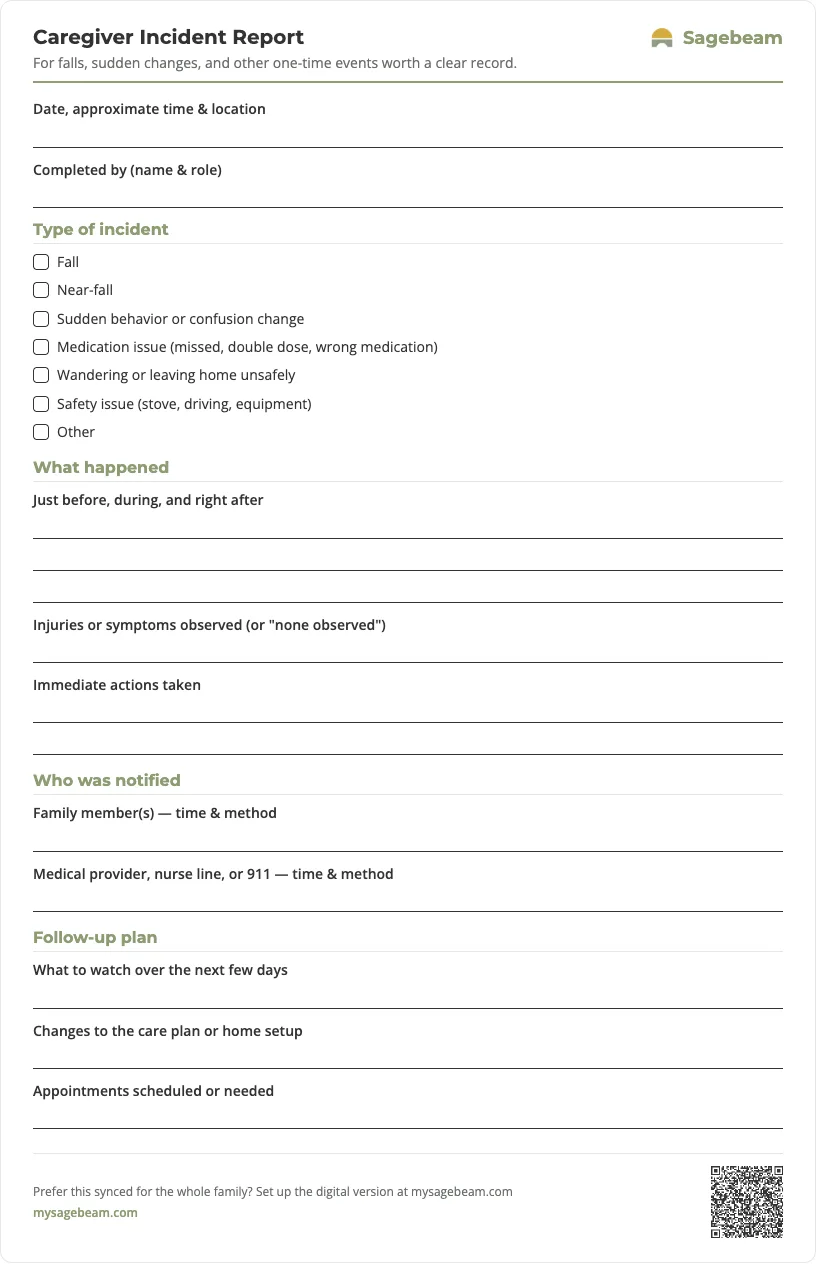
Print your incident report
A ready-to-use one-page sheet. Print it and fill it in right after something happens, or keep the same report digitally so the whole family sees the same facts.
 Sagebeam
- Tube feeding log sheet for families (printable G-tube and PEG record)
- Foley catheter output log and supply tracker (printable for families)
- Bowel movement and toileting log for elderly care (printable chart)
- Non-weight-bearing recovery support roster for families
You don't need more tabs. You need one place to run your parent's care.
By signing up, you agree to the Terms and Privacy Policy.
Related templates
- Caregiver daily log template for families – your running record of each day, where you can reference incident reports.
- Emergency medical information sheet template – a one‑page emergency snapshot to hand to paramedics or ER staff.
- Weekly caregiver summary template for families – a weekly recap that pulls in key incidents and patterns.