Emergency medical information sheet template for aging parents (printable one-page form)
Use this emergency medical information sheet template to create a one-page summary of your parent's conditions, medications, allergies, and contacts that first…
Get the free printable emergency medical information sheet ↓No account required.By Rachel Moore, Founder, Sagebeam · Published April 2026 · How we research and review our guides
Part of: Care coordination for aging parents – simple system
Free tool · no sign-up
Prefer to fill it in on your screen?
Type your parent's allergies, medications, conditions, and contacts and print a wallet card and a full sheet. Everything stays on your device — nothing is sent anywhere.
When something goes wrong with an aging parent, the first minutes are often chaotic:
- Paramedics arrive at home and start asking rapid‑fire questions.
- An ER nurse tries to understand your parent’s conditions and medications.
- You’re juggling logistics, siblings, and your parent’s fear in real time.
In those moments, it’s hard to remember everything clearly – especially if you’re not the one who usually handles the details, or you’re not there in person. A one‑page emergency medical information sheet gives first responders and ER staff what they need at a glance.
At a glance: what you’ll get
- Who this is for: families caring for aging parents at home, in assisted living, or between settings.
- A printable emergency medical information sheet template you can copy and adapt.
- Guidance on what to include (and what to leave out) so it fits on one page.
- Ideas for where to keep it and who should keep it up to date.
- Tips on how it connects to your caregiver binder, daily logs, and incident reports.
In your binder, you may already have a “Safety, emergencies, and what to bring” section. This article focuses on the single, front‑of‑the‑packet page – the emergency medical information form you can hand to EMTs or ER staff without shuffling through multiple sections.
Note: This template is for organizing information, not for making medical decisions. Follow local emergency guidance and your doctor’s instructions when deciding whether to call 911 or go to the ER.
Don’t want to fill this in by hand? Use the free Emergency Info Card builder to get a printable wallet card and a full one-page sheet with your parent’s allergies, medications, conditions, and emergency contacts already laid out — no signup, and nothing you type leaves your device.
Quick answer: what an emergency medical information sheet should include
A practical emergency information sheet for elderly parents – the kind first responders can actually use – includes:
- Header
- Full name, date of birth, and preferred name
- Current address and primary phone
- Date the sheet was last updated
- Emergency contacts
- Primary contact (name, relationship, phone, backup phone)
- Secondary contact(s) if primary is unreachable
- Key medical conditions and history
- Short list of major diagnoses (e.g., heart failure, diabetes, dementia)
- Past surgeries or major events that matter in emergencies
- Current medications and allergies (summary)
- High‑level list of current medications (or “see attached med list”)
- Allergies and adverse reactions (including drug, food, and latex)
- Doctors and pharmacy
- Primary care doctor and main specialists with phone numbers
- Usual hospital or health system, if relevant
- Pharmacy name and phone
- Insurance and ID
- Insurance plan name and member ID
- Medicare/Medicaid and secondary insurance, if any
- Care needs, safety notes, and communication
- How your parent moves (uses walker, needs help to stand, high fall risk)
- Cognitive status (dementia, hearing/vision notes, communication preferences)
- Advance care planning (where to find documents)
- Whether there is a health care proxy / power of attorney
- Where to find advance directive or POLST/MOLST forms
- Who to contact about these decisions
These are the details emergency teams usually ask for in the first few minutes. If they can read them in one place, you spend less time answering questions and more time focusing on your parent.
You can keep all of this on one page by using short phrases and grouping related items. Detailed information (full medication list, visit notes, binder sections) can live behind it.
Step 1: Decide who this sheet is for and where it lives
Before you build anything, get clear on who will use this sheet and where they’ll find it.
Common patterns:
- At home
- One copy on the refrigerator in a clear sleeve.
- One copy in the front of the caregiver binder.
- Optional small card version in your parent’s wallet or purse.
- In assisted living or senior housing
- One copy in your parent’s room, near the door or bed (if allowed).
- One copy with family, in case staff call during an emergency.
- For long‑distance or rotating caregivers
- A PDF copy in a shared digital folder or caregiving workspace.
- Printed copies in any caregiver “go bag” for appointments.
Write a simple note for your family:
“If there’s an emergency, hand this one‑page emergency medical information sheet to paramedics or ER staff. The full binder with details comes with us, but this is the front page.”
Also decide:
- Who “owns” keeping it up to date (usually one primary caregiver).
- How often it’s reviewed (e.g., after med changes or every 3–6 months).
Step 2: Emergency medical information sheet template (copy and adapt)
Prefer a filled-in printable? Use the Emergency Info Card builder instead of copying this by hand.
You can copy and paste this medical emergency information card template into your own document, adjust it, and print it in large, readable text. Aim to keep it to one side of a page.
EMERGENCY MEDICAL INFORMATION – AGING PARENT

Last updated: ______________________

PERSON INFORMATION
- Full name: ________________________________
- Preferred name: ___________________________
- Date of birth: ____________________________
- Home address: _____________________________
  __________________________________________
- Primary phone: ____________________________

EMERGENCY CONTACTS
- Primary contact (name / relationship): __________________________
  Mobile: ____________________  Other: ___________________________
- Secondary contact (optional): _________________________________
  Mobile: ____________________  Other: ___________________________

KEY MEDICAL CONDITIONS & HISTORY
(brief list – most important diagnoses only)
- ________________________________________________________________
- ________________________________________________________________
- ________________________________________________________________

MEDICATIONS & ALLERGIES
- Current medications (summary or “See attached list in binder”):
  ________________________________________________________________
- Allergies / adverse reactions (drug, food, latex, other):
  ________________________________________________________________

DOCTORS, HOSPITAL, & PHARMACY
- Primary care doctor: ____________________  Phone: ______________
- Key specialist(s): ______________________  Phone: ______________
                      ______________________  Phone: ______________
- Usual hospital / health system (if any): _______________________
- Pharmacy: _______________________________  Phone: ______________

INSURANCE
- Primary insurance: _______________________  Member ID: _________
- Medicare / Medicaid (if applicable): ___________________________
- Secondary insurance (if any): __________________________________

CARE NEEDS, SAFETY, & COMMUNICATION
- Mobility / safety (walker, wheelchair, high fall risk, etc.):
  ________________________________________________________________
- Vision / hearing / communication notes:
  ________________________________________________________________
- Cognitive status (memory, dementia, confusion at baseline, etc.):
  ________________________________________________________________

ADVANCE CARE PLANNING (WHERE TO FIND DOCUMENTS)
- Health care proxy / medical decision-maker:
  Name: _________________________  Phone: ________________________
- Advance directive / POLST / MOLST:
  - [ ] In caregiver binder (location: __________________________)
  - [ ] On file with doctor / hospital
  - [ ] Other: _________________________________________________

Additional notes (optional – keep brief):
_______________________________________________________________
_______________________________________________________________
Print this emergency medical information form in large, clear font. If you need more space for medications, you can:
- Keep a full med list as a separate page behind this sheet, and
- Write “See full medication list attached” under “Medications & allergies.”
- If the sheet runs longer than one page in large print, prioritize the top sections (person information, contacts, key conditions, allergies) and move some doctor or insurance detail to the binder pages behind it.
Step 3: Keep the sheet current without making it a second job
An emergency sheet only helps if it’s accurate enough. It doesn’t need to be perfect, but it shouldn’t be years out of date either.
To keep it manageable:
- Update the “Last updated” date any time you:
- Change a major medication or dose.
- Add or remove a key diagnosis.
- Change primary doctor, pharmacy, or insurance.
- Use phrases instead of full lists where possible:
- “See med list in binder” instead of rewriting every med on the front sheet.
- “Severe penicillin allergy” instead of listing every drug in that family.
- Set a simple review cadence, like:
- Every 3–6 months during a quiet period.
- At the same time you review the caregiver binder.
If you’re worried about forgetting a change, jot it in your daily log or on a sticky note in the binder, then update the sheet the next time you sit down to do paperwork.
Step 4: Adapting the template to different situations
You can use the same emergency medical information form in several contexts, with small tweaks.
If your parent lives at home
Focus on making the sheet easy for paramedics and ER staff to find and read:
- Put a copy on the refrigerator in a clear sleeve.
- Keep another copy in a visible spot near the front door or bedside.
- Tell family and neighbors where it is.
You might add a brief line like:
“Caregiver binder with full details is in the kitchen on the counter.”
If your parent is in assisted living or senior housing
Facilities often have their own paperwork, but staff may still call family in a crisis. In that case:
- Keep your own sheet for family use, even if the facility has theirs.
- Add a line noting the facility and unit, since your parent may be transferred between floors or buildings.
- Make sure the “Health care proxy / decision‑maker” section is clear.
You can also share a copy with staff if they welcome it and it aligns with their policies.
If your parent has frequent ER visits or complex conditions
For parents with recurring hospital visits, it's worth going one step beyond the sheet and pre-packing a full emergency room go-bag — the sheet rides in its documents envelope alongside chargers, hearing-aid batteries, and the other things a long ER visit actually requires.
For parents with recurring hospital visits or complicated histories:
- Add a line under “Key medical conditions” for:
- “Most recent hospitalization (month/year, hospital).”
- “Reason for most recent hospitalization (1 line).”
- Clarify under “Usual hospital / health system” where you prefer care, if there is a choice.
- Consider keeping a short “medication changes last 3 months” note on the back if meds change often.
If your parent has dementia or memory loss, keep a separate hospital communication card for patients with dementia with this emergency sheet. The emergency sheet tells staff the medical basics; the communication card tells them your parent's baseline, what calms them, how they show pain, and what safety risks to watch for.
The goal is not to capture everything, but to give emergency staff a fast map of what they’re walking into. The FDA recommends keeping a current medication list and having a copy ready to share with a doctor, pharmacist, caregiver, or emergency team (FDA medication-list guidance).
Step 5: How the emergency sheet fits with your binder, logs, and incident reports
The emergency sheet is the front door to your parent’s information – not the whole house.
Here’s how it fits with other tools:
- Caregiver binder: The binder holds full med lists, visit notes, advance care planning documents, and safety and “what to bring” checklists. The emergency sheet sits at the front or in a sleeve on the cover.
- Daily log: Use your daily log to track how your parent is doing day‑to‑day. That log can help you explain to doctors what led up to this emergency.
- Incident reports: For falls, sudden confusion, or other events that trigger an emergency, complete a caregiver incident report and bring a copy with you. The sheet tells staff who your parent is and what their baseline looks like; incident reports explain what just happened.
- Weekly summary: Your weekly caregiver summary can help doctors understand how this emergency fits into the bigger picture of the last few weeks.
- Medical history summary: A medical history summary for aging parents gives new doctors and facilities a fuller backstory once the immediate emergency has passed.
When you arrive at an ER or urgent care, you can hand over:
- The emergency medical information sheet on top.
- Your binder (or a slim folder) with the incident report and recent summaries behind it.
That combination does far more than trying to recall everything from memory while you’re stressed.
Common mistakes with emergency medical information sheets
As you build and use your sheet, watch out for these pitfalls:
-
Trying to fit the entire binder onto one page.
This sheet should be a summary, not a full chart. If you’re squeezing in paragraphs, pull details into the binder instead. -
Leaving off the “Last updated” date.
Without a date, staff won’t know whether to trust what they’re seeing. A clearly labeled date is enough to signal recency. -
Letting the sheet drift years out of date.
An imperfect but recent list is better than an old, inaccurate one. If your sheet is more than a year old, review it. -
Assuming staff will search your phone for information.
Many emergency teams cannot or will not unlock devices. A printed, obvious one‑pager is much more reliable in a crisis. -
Not matching what’s in the binder or med list.
Big mismatches between the front sheet and the detailed list confuse everyone. When you change something important, update both places during the same session.
Frequently Asked Questions
Where should I keep my parent’s emergency medical information sheet?
For home setups, the best spot is usually on the refrigerator in a clear sleeve, with another copy at the front of the caregiver binder. You can keep a small, folded version in your parent’s wallet or a caregiver “go bag” as backup. The key is that everyone – family, neighbors, and caregivers – knows exactly where to grab it in an emergency.
Should the sheet include the full medication list?
It’s usually better to keep the emergency medical information sheet to high‑level highlights (“on insulin,” “blood thinner,” “severe penicillin allergy”) and point to a separate, detailed caregiver medication list in your binder. That keeps the sheet readable in seconds while still giving staff access to precise dosages and schedules when they have a moment to look.
Is this emergency information sheet legally binding for DNR or advance directives?
No. This sheet points to your parent’s official documents; it does not replace them. DNR orders, POLST/MOLST forms, and advance directives must follow your state or country’s rules to be legally recognized. Use this sheet to show that those documents exist, where they’re kept, and who to talk to – then make sure the official forms are completed and stored where emergency staff can find them.
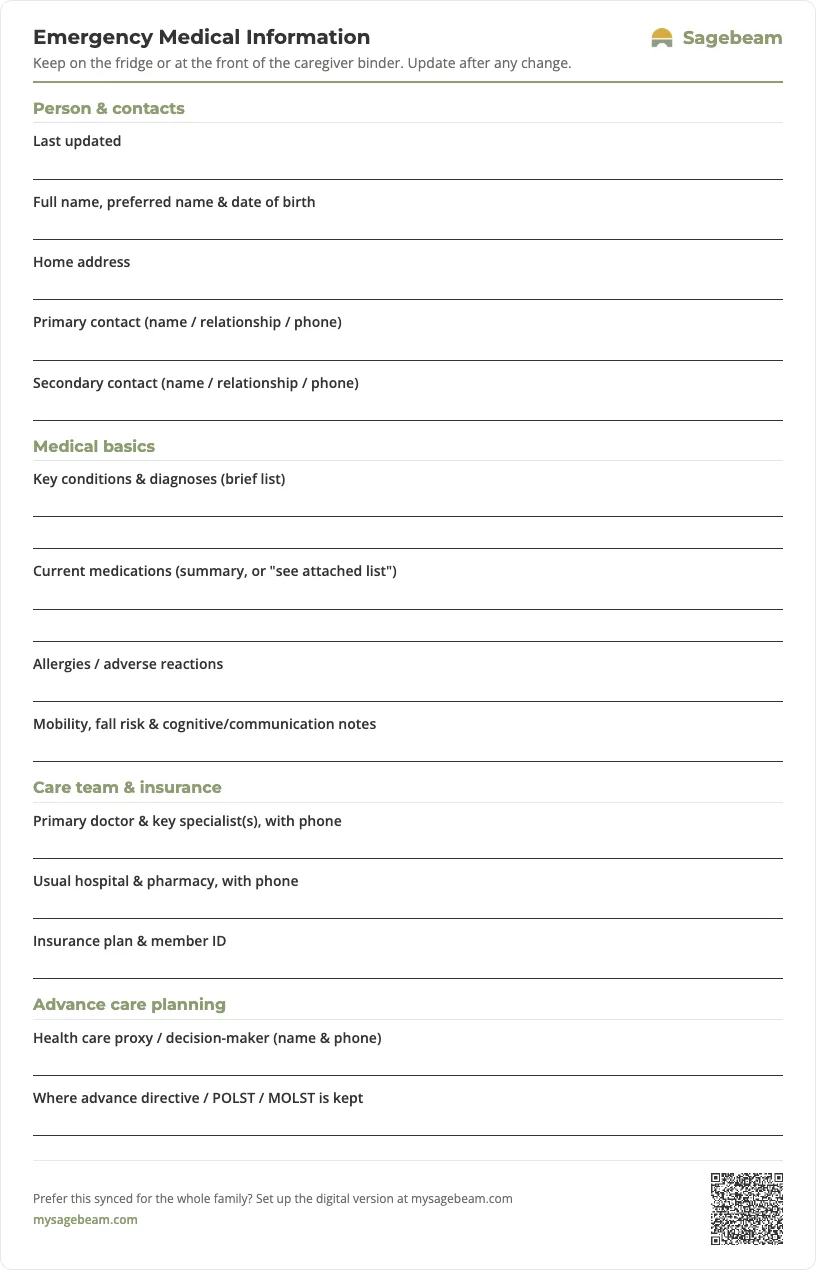
Print your emergency medical information sheet
A ready-to-use one-page sheet for paramedics and ER staff. Print it and fill it in by hand, or keep it digitally so it stays current for the whole family.
 Sagebeam
- Tube feeding log sheet for families (printable G-tube and PEG record)
- Foley catheter output log and supply tracker (printable for families)
- Bowel movement and toileting log for elderly care (printable chart)
- Non-weight-bearing recovery support roster for families
You don't need more tabs. You need one place to run your parent's care.
By signing up, you agree to the Terms and Privacy Policy.
Related templates
- Caregiver incident report template – a detailed record of the fall or sudden change that led to the emergency.
- Weekly caregiver summary template for families – a recap of how the last few weeks have gone leading up to the crisis.
- Medical history summary template for aging parents – a shareable overview you can give new doctors and facilities once your parent is stable.
- Caregiver medication list template for families – the detailed current-medication page to keep behind this emergency sheet.