Post-hospital follow-up appointment prep checklist for families (template)
Post-hospital follow-up appointment checklist for families: gather medications, discharge notes, symptoms, and questions before an aging parent's first doctor visit after a hospital stay.
Get the free printable appointment prep sheet ↓No account required.By Rachel Moore, Founder, Sagebeam · Published June 2026 · How we research and review our guides
Part of: Medical transitions for aging parents – before/after plan
The first follow-up appointment after a hospital stay carries a lot of weight:
- It is often when the team decides whether recovery is on track or needs a course correction.
- Medications, therapy plans, and home services may be adjusted.
- Questions about "what's next"—including rehab, home care, or benefits like long-term care insurance or Medicaid—may surface.
But if you show up with only a vague sense that "things are a little better" or "something seems off," it is hard for clinicians to act. The key details—how symptoms have changed, what has been hard at home, which instructions were confusing—live in your head, scattered notes, or different people's memories. This doctor appointment checklist gives those details a place to land. The Family Caregiver Alliance's post-discharge checklist tells caregivers to confirm follow-up visits, compare medication lists, ask questions, and know what support is expected at home.
You do not need a thick binder to fix this. You need a simple post-hospital follow-up appointment prep checklist that helps you:
- Gather the right documents and logs in one place,
- Summarize patterns since discharge, and
- Articulate your top questions and goals for the visit.
This guide is educational and is not medical or legal advice. Always follow your parent's discharge instructions and clinician guidance. The goal here is to help you prepare so those clinicians can do their best work with clear information.
Related resources:
- Hospital discharge planning worksheet for families (template) – the original plan and red-flag guidance.
- Post-hospital symptom and red-flag tracker template for families – short-term symptom tracking.
- Doctor visit summary template for aging parents – to capture what happens during the visit.
- Hospital discharge planning for a parent with dementia or memory loss – if your parent's follow-up involves dementia or cognitive changes.
- Caregiver medication list template for families – keep the current list and recent changes ready to share.
- Pneumonia recovery log for an elderly parent – if your parent's follow-up is for pneumonia, a discharge-instruction block plus a 14-day daily log.
- Knee replacement recovery daily log template – if your parent's follow-up is for knee replacement, a daily log for PT completion and incision observations.
- After a mini stroke (TIA): a family follow-up worksheet – if your parent's follow-up is after a TIA, a tracker for each test and appointment the care team ordered — booked, done, and reviewed with you.
Your before, during, and after doctor-visit kit
- Before: Use this medical appointment checklist to gather records, changes you have noticed, and the questions that matter most.
- During: Open the doctor visit summary template and write down decisions, medication changes, tests, and referrals.
- After: Share the summary, assign each follow-up, and update the family calendar and medication list.
If family notes are scattered across several people, Sagebeam can turn those notes into an appointment prep brief. The family can review the brief together, choose the top questions, and bring one clear page into the room.
On this page:
- Quick answer – what to have ready before a post-hospital follow-up
- How this checklist fits with your other templates
- Questions to bring when a parent has dementia or memory loss after a hospital stay
- Post-hospital follow-up appointment prep checklist template (copy and adapt)
- Step-by-step: using the checklist the week and night before the visit
- Tips for making the most of the visit once you are there
Jump to template: Post-hospital follow-up appointment prep checklist
Quick answer: what to have ready before a post-hospital follow-up
For the first follow-up appointment after hospital discharge, you will usually want:
-
Core documents
- Discharge summary and discharge instructions (including red-flag list).
- Hospital discharge planning worksheet (if you have one).
- A current medication list (with new, changed, and stopped meds clearly marked).
-
Symptom and function snapshot since discharge
- A brief summary of how breathing, pain, mobility/falls, confusion, mood, sleep, appetite, and daily activities have changed.
- Highlights from your post-hospital symptom tracker or observation log.
-
Fall, near-fall, and safety events
- A short list of any falls, near-falls, or safety scares (for example, wandering, medication errors, or bathroom incidents).
-
Services and support picture
- Which services actually started (home health, PT/OT, aides) and how they are going.
- How much help family is realistically providing vs. what was assumed at discharge.
-
Top questions and decisions for this visit
- 3–5 priority questions (for example, about symptoms, meds, therapy, safety, or future steps).
- Any decisions you hope to make (for example, more/less services, equipment, referrals).
-
A simple way to capture what's decided
- Your doctor visit summary template or a place to write: "What changed today, and what happens next?"
The template below pulls these pieces into a one-page checklist you can print or keep in a shared space.
How this checklist fits with your other templates
You do not need a separate tool for every part of the process. Think of your documentation around a follow-up visit as:
- Before the visit – this post-hospital follow-up prep checklist plus your logs and discharge worksheet.
- During and after the visit – your doctor visit summary template, updated medication schedule, and any new orders or referrals.
In practice:
- Use your post-hospital symptom tracker and observation log to capture changes day to day.
- A week before the visit, use this prep checklist to pull out patterns and questions.
- At the visit, use the doctor visit summary template to record what was decided and update your other templates afterward.
The goal is a small, coordinated toolkit rather than a stack of unrelated forms.
Questions to bring when a parent has dementia or memory loss after a hospital stay
If your parent's thinking, memory, or behavior has changed since the hospital stay, write down concrete examples and when they happened. Questions to ask the doctor about a parent with dementia may include:
- Which changes since discharge do you want us to track or report?
- What does the care team consider my parent's usual baseline now?
- Who should we call if confusion, sleep, behavior, or daily function changes?
- Does the home support plan still match the level of help my parent needs?
- Are there medication instructions or follow-ups the family should supervise more closely?
Bring observations, not a diagnosis. Let the clinician assess what they mean.
Post-hospital follow-up appointment prep checklist template for families (copy and adapt)
You can copy and paste this post-hospital follow-up appointment prep checklist template into a document, spreadsheet, shared note, or caregiving workspace, and adjust sections to match your parent's situation. Use the printable version if you want a doctor visit checklist PDF for the folder you take to the appointment.
POST-HOSPITAL FOLLOW-UP APPOINTMENT PREP CHECKLIST – FOR FAMILIES

Parent name: ________________________________   Date of discharge: ____________

Follow-up visit with: ________________________   Date/time: ___________________
Clinic / location: ____________________________________________________________

1. CORE DOCUMENTS

[ ] Discharge summary from hospital
[ ] Discharge instructions (including red-flag symptom list)
[ ] Hospital discharge planning worksheet (if completed)
[ ] Most recent medication list from hospital or clinic
[ ] Our current medication schedule / pill organizer reflects this list

Notes about any uncertainty (for example, meds we are unsure about, differences
between bottles and the list):
_____________________________________________________________________
_____________________________________________________________________

2. SYMPTOM & FUNCTION SNAPSHOT SINCE DISCHARGE

Using our post-hospital symptom tracker or observation log, our overall
impression over the last 1–4 weeks is:

Breathing / chest symptoms:
_____________________________________________________________________

Pain & comfort:
_____________________________________________________________________

Mobility, balance, and falls / near-falls:
_____________________________________________________________________

Thinking, mood, and behavior:
_____________________________________________________________________

Sleep, appetite, and fluids:
_____________________________________________________________________

Daily activities (bathing, dressing, toileting, meals, meds) and need for help:
_____________________________________________________________________

Other diagnosis-specific issues (for example, blood sugar, weight, swelling):
_____________________________________________________________________

3. SAFETY EVENTS & NEAR-MISSES

Since discharge, notable events include (falls, near-falls, wandering,
medication errors, bathroom incidents, ER/urgent care visits):

Date: ___________   Event: _________________________________________________
What led up to it? ________________________________________________________
What changed afterward? _________________________________________________

Date: ___________   Event: _________________________________________________
What led up to it? ________________________________________________________
What changed afterward? _________________________________________________

4. SERVICES & SUPPORT PICTURE

Services we were told to expect after discharge:
- Home health nursing:    [ ] ordered   [ ] started   [ ] not started
- PT/OT at home:          [ ] ordered   [ ] started   [ ] not started
- Home care aides:        [ ] planned   [ ] in place  [ ] not in place
- Other: ________________________________________________________________

How services are going (what is helping, what feels missing):
_____________________________________________________________________
_____________________________________________________________________

Family / friend help at home (who is doing what, how often):
_____________________________________________________________________
_____________________________________________________________________

Does current help match what the discharge plan assumed?
[ ] yes    [ ] partly    [ ] no – we are doing more than expected
Details:
_____________________________________________________________________

5. TOP QUESTIONS & GOALS FOR THIS VISIT

Our top questions (3–5, in priority order):
1) ___________________________________________________________________
2) ___________________________________________________________________
3) ___________________________________________________________________
4) ___________________________________________________________________
5) ___________________________________________________________________

Decisions we hope to make or get guidance on (for example, meds, therapy,
services, equipment, driving, living situation):
_____________________________________________________________________
_____________________________________________________________________

6. HOW WE WILL CAPTURE WHAT HAPPENS AT THE VISIT

[ ] We have a doctor visit summary template or notebook ready.
[ ] We know who will write down key points during or right after the visit.
[ ] We have a plan to update our medication list, logs, and calendars
    immediately after we get home.
If this full checklist feels like too much to start, begin with:
- Core documents (discharge summary, instructions, medication list).
- A short symptom/function snapshot and list of any falls or near-misses.
- Your top 3 questions and a simple place to write down what changes.
You can add more sections over time as you find them helpful.
Step-by-step: using the checklist the week and night before the visit
To make this prep checklist useful without overwhelming you:
-
A week before the visit
- Confirm the date, time, and location of the appointment.
- Review your discharge worksheet and logs for the last 1–3 weeks.
- Fill out the "Core documents," "Symptom & function snapshot," and "Services & support picture" sections based on recent entries.
-
Gather and reconcile documents
- Make sure your discharge summary, instructions, and medication list all match what you are actually doing at home.
- Note any discrepancies or questions under "Core documents."
-
Ask others for input on questions
- Invite siblings or other caregivers to add questions to the checklist (in a shared note or app if possible).
- Together, pick the top 3–5 to prioritize at the visit.
-
The night before the visit
- Quickly review:
- Your symptom snapshot,
- Any recent safety events, and
- Your final list of questions and goals.
- Place the checklist, logs, and doctor visit summary template in a folder or bag so you do not forget them.
- Quickly review:
-
Assign roles
- Decide who will:
- Do most of the talking at the visit,
- Take notes (using the visit summary template), and
- Update medication lists and calendars afterward.
- Decide who will:
Tips for making the most of the visit once you are there
Once you are in the visit:
-
Lead with patterns, not everything
- Start with 2–3 key patterns from your logs ("We've noticed…"), then move to your top questions.
-
Use your checklist as a guide, not a script
- Let the clinician lead on diagnosis and treatment; use your checklist to make sure the most important questions and concerns are covered.
-
Clarify next steps before leaving
- Use your doctor visit summary template to confirm:
- Any changes to medications, services, activity limits, or safety recommendations.
- Which follow-ups are scheduled or need scheduling.
- Who to call if certain symptoms or problems show up.
- Use your doctor visit summary template to confirm:
-
Update your documentation soon after
- Within a day of the visit, update:
- Your medication schedule and pill organizer,
- Your logs (with any new patterns to watch for), and
- Your calendars (for visits, tests, and services).
- Within a day of the visit, update:
Whether you use paper or an app like Sagebeam, the aim of a post-hospital follow-up appointment prep checklist is simple: walk into the visit with a clear picture of how things have really been going at home—and walk out with an equally clear picture of what changed and what happens next. That clarity is one of the most powerful tools families have for keeping recoveries on track and reducing avoidable setbacks after a hospital stay.
For the bigger picture around these visits, build your parent's discharge plan with the free Post-Discharge Schedule Builder — a condition-informed 30-day task list that keeps follow-ups, medications, and daily checks in one plan.
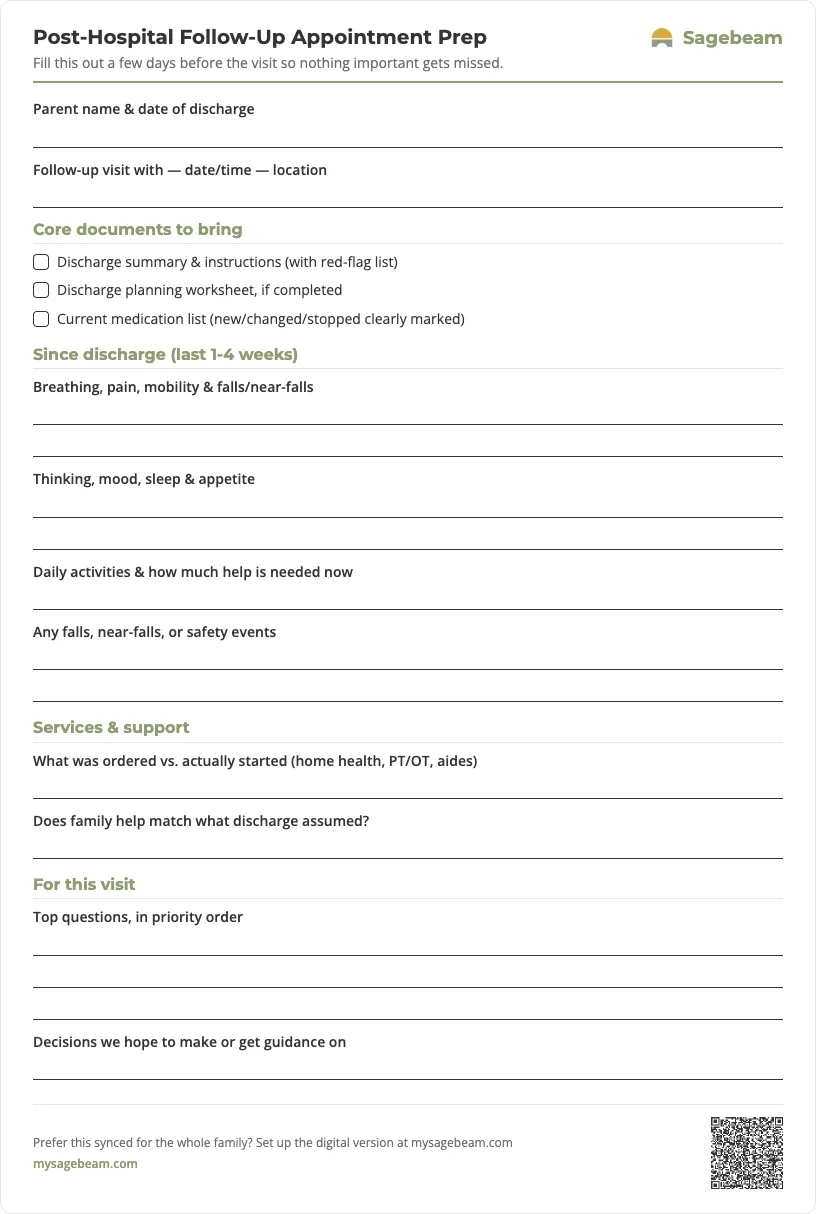
Print your follow-up appointment prep sheet
A ready-to-use one-page sheet. Print it and fill it in before the visit, or keep the same prep sheet digitally so everyone can add questions ahead of time.
 Sagebeam
- What to do after a mini stroke (TIA): a family follow-up worksheet
- Blood thinner tracker after a hospital stay (printable log for families)
- Surgical drain output log template for families (JP drain log sheet)
- Post-surgery pain medication log for families (printable tracker)
Just got home from the hospital? Get a free text-message helper for the first week.
By signing up, you agree to the Terms and Privacy Policy.