Post-hospital symptom and red flag tracker template
The first weeks after a hospital stay are when subtle changes and red-flag symptoms matter most—but they are also easy to miss. This post-hospital symptom and red-flag tracker template gives families a focused way to track pain, mobility, wound status, confusion, appetite, and red-flag symptoms defined by the medical team, so patterns are easier to spot, act on, and share—and shows you how to track symptoms after hospital discharge without creating an unmanageable amount of paperwork.
Get the free printable symptom & red-flag tracker ↓No account required.By Rachel Moore, Founder, Sagebeam · Published June 2026 · How we research and review our guides
Part of: Health & safety monitoring – aging parents routine
In the first weeks after a hospital stay, small changes can make a big difference:
- Breathing is a little more labored walking to the bathroom.
- A wound looks a bit more red or warm than it did yesterday.
- Your parent seems more confused or unsteady in the evenings.
- Appetite or energy drops off over a few days.
At the same time, family members, home health nurses, therapists, and home care aides may only see parts of the picture. Without a simple way to pull those observations together, it is hard to know:
- Whether symptoms are getting better, worse, or staying the same,
- When it is time to call the team about a red-flag symptom, and
- How to give doctors clear examples instead of “they just seem off.”
This guide gives you a post-hospital symptom and red-flag tracker template you can use in the first few weeks after discharge to:
- Focus on the specific symptoms and red-flags your parent’s team defined,
- Capture those symptoms in plain language, and
- Make it easier to decide what to mention at home health visits and follow-up appointments.
It is educational and is not medical advice. Always follow the instructions you receive from your parent’s clinicians and discharge team—especially their red-flag guidance. Use this tracker to record what you see, not to decide on your own when to seek urgent care.
For a complete hospital-to-home toolkit, you can also use:
- What to track during a parent’s hospital stay – what to write down in the hospital.
- Hospital discharge planning worksheet for families (template) – one-page summary of diagnoses, meds, services, and red-flags.
- Hospital discharge checklist for an elderly parent coming home – tasks for the day of discharge.
- First 72 hours after hospital discharge – simple game plan for family caregivers – day 0/1/2 focus.
- Caregiver observation log template for tracking health changes – broader health-change tracking once things stabilize.
- Caregiver incident report template – for acute events like falls or ER visits.
- Doctor visit summary template for aging parents – to capture what is decided at follow-ups.
- What to watch for in the first 30 days after hospital discharge – week-by-week patterns to monitor as recovery unfolds.
- Post-hospital follow-up appointment prep checklist (template) – how to use your tracker data to prepare for the first follow-up visit.
- Preventing avoidable hospital readmissions as a family caregiver – how to turn what you track into early questions for the medical team.
This post-hospital symptom tracker is designed to sit between your hospital notes and the longer-term observation log—focused on the crucial weeks right after discharge.
On this page:
- Quick answer – what a post-hospital symptom and red-flag tracker should include
- How this tracker fits with your other logs and templates
- Post-hospital symptom and red-flag tracker template (copy and adapt)
- Step-by-step: using the tracker in the first few weeks
- Tips for sharing the tracker with clinicians and siblings
Quick answer: what a post-hospital symptom and red-flag tracker should include
A focused post-hospital symptom and red-flag tracker template usually captures:
-
Basic visit context
- Date, time (or time of day), and who is filling it out.
- How far out from discharge you are (for example, “Day 3,” “Week 2”).
-
Key symptom areas the team cares about
- For example: pain, breathing, mobility/balance, wound status, confusion or memory, mood, sleep, appetite/fluids, and any diagnosis-specific items (like blood sugar or weight).
-
Plain-language descriptions of what you see
- Short notes like “breathing harder climbing stairs than yesterday,” “needed help standing from chair,” or “ate half of dinner.”
-
Red-flag symptom checklist defined by your team
- A list of red-flag symptoms copied from your discharge instructions with checkboxes for “Seen today? Y/N” and space to note what you did (called clinic, went to ER, etc.).
-
Daily or twice-daily snapshot, not minute-by-minute tracking
- A simple scale or checkboxes for key items (for example, pain level, mobility, wound appearance) so you can see trends.
-
Action and follow-up section
- Space to record:
- Whether you called the office, nurse line, or went to urgent care/ER, and what you were told.
- Questions to bring to the next home health visit or clinic appointment.
- Space to record:
The template below turns these elements into a single, reusable symptom and red-flag tracker for families that you can print or keep in a shared digital workspace.
How this tracker fits with your other logs and templates
You do not need a separate form for everything. Think of your documentation tools like this:
- Use “What to track during a parent’s hospital stay” to log hospital details and questions.
- Use the hospital discharge planning worksheet to capture the plan, meds, services, and red-flags at discharge.
- Use the post-hospital symptom and red-flag tracker (this page) to focus on the first few weeks after discharge.
- Use the caregiver observation log once you are out of the immediate post-hospital window and want a broader, ongoing health-change log.
- Use the incident report template for specific acute events like falls, emergency visits, or major behavior changes.
- If your parent's hospital stay was for a stroke, use the stroke-specific post-stroke symptom and red-flag tracker instead — it adds a B.E. F.A.S.T. emergency card for spotting a possible second stroke and the subtler post-stroke changes (swallowing, speech, mood) worth watching.
In practice:
- In the first 1–3 weeks after discharge, you might use this post-hospital tracker once or twice a day.
- After that, you may switch to:
- A weekly or as-needed pattern for this tracker, and
- The broader observation log for longer-term trends.
The post-hospital tracker is meant to be intensive but short-term, zooming in on the “watch closely” period without duplicating everything you already capture elsewhere. Tracking symptoms and red-flags in this window is one of the five core steps the Family Caregiver Alliance recommends for a safe hospital-to-home transition.
Post-hospital symptom and red-flag tracker template for families after hospital discharge (copy and adapt)
You can copy and paste this post-hospital symptom and red-flag tracker template into a document, spreadsheet, shared note, or caregiving workspace, and adjust sections and symptom categories based on your parent’s discharge instructions.
POST-HOSPITAL SYMPTOM & RED-FLAG TRACKER – FOR FAMILIES

Parent name: ________________________________   Date of discharge: ____________

Today’s date: ___________________   Time (or time of day): _____________________

Day since discharge (for example, Day 3, Day 10, Week 2): ____________________

Person completing this entry (name & role): __________________________________

KEY SYMPTOMS WE ARE TRACKING
(adapt these to match your discharge instructions)

Pain (0–10 or mild / moderate / severe):
_____________________________________________________________________

Breathing (for example, shortness of breath, new cough, breathing faster):
_____________________________________________________________________

Mobility & balance (walking, transfers, stairs, near-falls):
_____________________________________________________________________

Wound or incision (redness, warmth, drainage, odor) – if applicable:
_____________________________________________________________________

Confusion or memory (more confused, disoriented, new or worse agitation):
_____________________________________________________________________

Mood & behavior (more withdrawn, tearful, agitated, or “not themselves”):
_____________________________________________________________________

Sleep (much more / less than usual, up a lot at night):
_____________________________________________________________________

Appetite & fluids (eating and drinking more / less than usual):
_____________________________________________________________________

Other diagnosis-specific symptom we are watching (for example, blood sugar,
weight, swelling, pain in a specific area):
_____________________________________________________________________
_____________________________________________________________________

RED-FLAG SYMPTOMS DEFINED BY THE TEAM
(copy these from your discharge instructions; check if seen today)

Today we saw (check any that apply):
- [ ] New or sudden chest pain or pressure
- [ ] Trouble breathing at rest
- [ ] Sudden new or much worse confusion
- [ ] Fever above _______°F / _______°C
- [ ] Wound looks much more red, warm, or draining
- [ ] New or much worse weakness on one side
- [ ] Fall with possible head injury or loss of consciousness
- [ ] Other red-flag symptom listed by our team: ______________________

If any red-flag symptom occurred:

What we did (for example, called clinic / nurse line, went to ER/urgent care):
_____________________________________________________________________
_____________________________________________________________________

What we were told (in our own words):
_____________________________________________________________________
_____________________________________________________________________

DAILY SNAPSHOT (OPTIONAL QUICK CHECKBOXES)

Today compared with yesterday:
- Pain:   [ ] better   [ ] same   [ ] worse
- Breathing:   [ ] better   [ ] same   [ ] worse
- Mobility/balance:   [ ] better   [ ] same   [ ] worse
- Wound/incision (if applicable):   [ ] better   [ ] same   [ ] worse
- Confusion/memory:   [ ] better   [ ] same   [ ] worse
- Mood:   [ ] better   [ ] same   [ ] worse
- Sleep:   [ ] better   [ ] same   [ ] worse
- Appetite/fluids:   [ ] better   [ ] same   [ ] worse

FOLLOW-UP & QUESTIONS

Do we need to contact someone based on today’s entry?
- [ ] No – continue to monitor
- [ ] Yes – call clinic / nurse line
- [ ] Yes – mention at next home health / PT/OT visit
- [ ] Yes – mention at next doctor visit

Who we plan to contact (if any) and by when:
_____________________________________________________________________

Questions for home health / PT/OT:
_____________________________________________________________________
_____________________________________________________________________

Questions for the doctor / clinic at next visit:
_____________________________________________________________________
_____________________________________________________________________
If this feels like too much to start, you can begin with just:
- Today’s date and “Day since discharge,”
- Short notes under a few key symptoms (for example, pain, breathing, mobility, confusion), and
- The red-flag section, filled in with your team’s own wording.
You can add more sections later if you find them helpful.
Step-by-step: using the tracker in the first few weeks
To make this tracker helpful without overwhelming you:
-
Decide when you will use it each day
- Many families pick once or twice a day, such as:
- Morning (to see how the night went), and
- Evening (to compare to the previous day).
- On days with home health or PT/OT visits, you might fill it out just before the visit so you can share recent changes.
- Many families pick once or twice a day, such as:
-
Adapt the symptom list to your parent’s situation
- Use your discharge instructions and hospital notes to decide:
- Which symptom categories matter most (for example, breathing and wound, or confusion and mobility).
- Any diagnosis-specific items to add (for example, blood sugar, weight, or swelling).
- Cross out sections that truly do not apply so the form feels lighter.
- Use your discharge instructions and hospital notes to decide:
-
Copy red-flags directly from your discharge instructions
- Under “RED-FLAG SYMPTOMS DEFINED BY THE TEAM,” write:
- The team’s exact wording, and
- What they said to do (call vs. urgent care vs. ER).
- This keeps your tracker aligned with their guidance.
- Under “RED-FLAG SYMPTOMS DEFINED BY THE TEAM,” write:
-
Keep entries short and honest
- A few bullet points per entry are enough:
- “Breathing harder walking to bathroom than yesterday.”
- “More confused about time after dinner.”
- “Wound looks same as yesterday; dressing dry.”
- You are not grading your caregiving—you are giving the team a clear picture of what is happening at home.
- A few bullet points per entry are enough:
-
Reset or taper as things improve
- After the first couple of weeks:
- If symptoms are clearly improving, you might reduce entries to every few days or only when you notice a change.
- If things are getting worse or you are using the red-flag section often, that is a sign to talk with the team about the overall plan.
- After the first couple of weeks:
Tips for sharing the tracker with clinicians and siblings
To get the most value from this post-hospital symptom and red-flag tracker:
-
Bring it to visits and home health appointments
- At the start of a visit, you can say:
- “Here are the main changes we’ve seen since discharge,”
- “These are the red-flag symptoms we’ve tracked,” and
- “Here are our top questions based on the last week.”
- At the start of a visit, you can say:
-
Use it to ground sibling conversations
- When siblings disagree about how your parent is doing after a hospital stay, look at the tracker together:
- “In the last week, we’ve written down three near-falls and more confusion in the evenings.”
- “Given this, does the current plan (home vs. rehab vs. more help) still feel realistic?”
- When siblings disagree about how your parent is doing after a hospital stay, look at the tracker together:
-
Store it with your other care templates
- Keep completed trackers with:
- Your discharge planning worksheet,
- Your observation logs, and
- Your doctor visit summaries.
- This makes it easier to pull a concise story together if you:
- File a long-term care insurance claim, or
- Apply for Medicaid home services.
- Keep completed trackers with:
-
Use a shared space so everyone sees the same information
- Whether you keep the tracker in a paper folder or an app like Sagebeam, the goal is that family, home health, and other helpers are reacting to the same observations, not competing memories.
The aim is not to create more paperwork for its own sake. It is to make sure that the real symptom changes and red-flags you see at home after a hospital stay are easy to share, act on, and—when needed—use to support benefits that help your parent stay as safe and supported as possible.
To pair this tracker with a day-by-day plan for the same window, build your parent's discharge plan with the free Post-Discharge Schedule Builder — it generates the 30-day task list this tracker rides alongside.
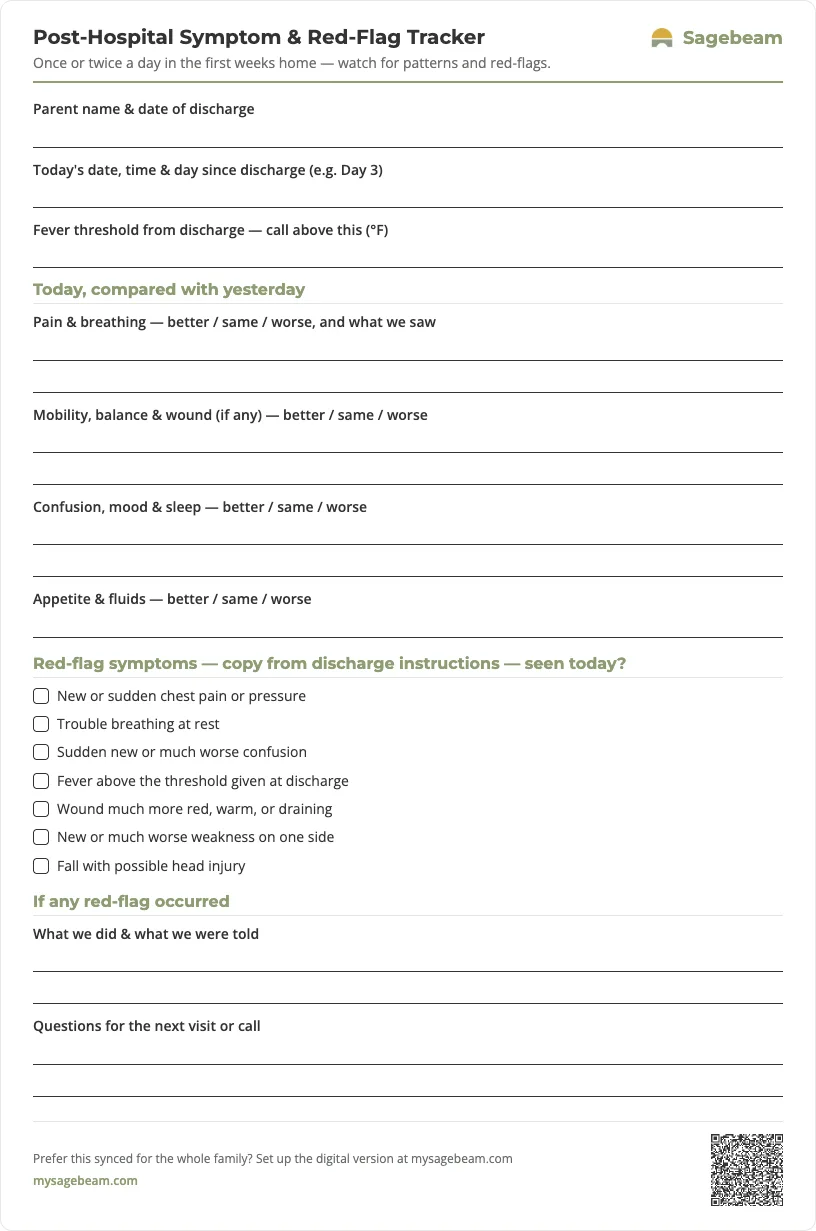
Print your symptom & red-flag tracker
A ready-to-use one-page sheet. Print a stack for the first few weeks home, or keep the same tracker digitally so home health, siblings, and family see the same picture.
 Sagebeam
- Daily schedule template for a person with dementia
- Dementia behavior and sundowning tracker template
- Dementia daily care log template for families
- Doctor visit summary template for family caregivers
You don't need more tabs. You need one place to run your parent's care.
By signing up, you agree to the Terms and Privacy Policy.