Medical history summary template for aging parents (share with new doctors)
Use this medical history summary template to create a one-page overview of your parent's diagnoses, medications, surgeries, and care team you can share with new…
Get the free printable medical history summary ↓No account required.By Rachel Moore, Founder, Sagebeam · Published April 2026 · How we research and review our guides
Part of: Care coordination for aging parents – simple system
Any time your parent sees a new doctor or specialist, you end up answering the same questions:
- “What conditions have they been diagnosed with?”
- “What surgeries have they had, and when?”
- “What medications are they on right now?”
- “Who else is on their care team?”
In the moment, it’s easy to forget dates, miss a medication, or leave out a key piece of history – especially if there have been multiple hospitalizations over the years. A medical history summary gives you a single, portable overview you can share ahead of time or hand over at check‑in.
This template is meant to complement, not replace, your caregiver binder and emergency medical information sheet. Think of it as the shareable “about this patient” page you send to new providers and care facilities.
Note: This template is for organizing information, not for giving medical advice. Always follow your parent’s doctors’ guidance on diagnoses, medications, and treatment plans.
At a glance: what you’ll get
- A printable medical history summary template for aging parents you can copy and adapt.
- Clarity on what belongs on a one‑page summary vs in the full binder.
- Ideas for when and how to share it with new doctors, specialists, or facilities.
- Tips on keeping it up to date without turning it into a full‑time job.
- How it fits with your binder, emergency sheet, daily logs, and incident reports.
Quick answer: what a medical history summary template should include
A practical medical history summary form for elderly parents includes:
- Header
- Full name, date of birth, and preferred name
- “Prepared by” name and relationship, with contact info
- Date the summary was last updated
- Key diagnoses and conditions
- Brief list of major diagnoses (with year diagnosed, if known)
- Any important baseline notes (e.g., “mild dementia,” “baseline shortness of breath,” “high fall risk”)
- Surgical and hospitalization history (high level)
- Past surgeries, procedures, and major hospitalizations with year and reason
- Current medications and allergies (summary)
- High‑level medication list or “See attached medication list”
- Allergies and adverse reactions (drug, food, latex)
- Care team and usual hospital
- Primary care doctor and key specialists, with phone numbers
- Usual hospital or health system
- Functional and support needs
- Mobility, personal care needs, and cognitive status at baseline
- Advance care planning (where to find documents)
- Health care proxy / decision‑maker
- Where to find advance directive or POLST/MOLST
You can usually keep this on one or two pages if you stick to short phrases and focus on what a new doctor or facility truly needs to understand your parent’s overall picture.
Step 1: Decide who this summary is for
Start by clarifying when and where you’ll use this medical history summary template – especially how you’ll use this medical history summary for a new doctor:
- New primary care doctor or specialist
- To reduce time spent retelling the same history.
- To give context before a first appointment, especially if your parent has complex needs.
- New care facility (rehab, skilled nursing, assisted living, memory care)
- To summarize your parent’s medical background and baseline function.
- Hospital teams during or after a stay
- To help new providers understand your parent’s long‑term picture, not just the current crisis.
You might create:
- One standard version you share with any new doctor, and
- A slightly more detailed version for facilities that includes more functional and support details.
Write a short note at the top of your own copy:
“This medical history summary is maintained by the family for sharing with new doctors and care facilities. For full details, see the caregiver binder and medication list.”
Step 2: Medical history summary template (copy and adapt)
You can copy and paste this printable medical history summary template into your own document or health portal message. Adjust headings and space to fit your parent’s situation.
MEDICAL HISTORY SUMMARY – AGING PARENT

Last updated: ______________________

PERSON & CONTACT INFORMATION
- Full name: ________________________________
- Preferred name: ___________________________
- Date of birth: ____________________________

Prepared by (name / relationship): ______________________________
Phone: _______________________  Email: __________________________

KEY DIAGNOSES & CONDITIONS
(brief list – most important only, with year if known)
- ____________________________________  (diagnosed ________)
- ____________________________________  (diagnosed ________)
- ____________________________________  (diagnosed ________)

SURGICAL & HOSPITALIZATION HISTORY (HIGH LEVEL)
- Surgery / hospitalization: ________________________________
  Year: ________  Hospital: ________________________________
  Reason / notes (1 line): _________________________________
- Surgery / hospitalization: ________________________________
  Year: ________  Hospital: ________________________________
  Reason / notes (1 line): _________________________________

CURRENT MEDICATIONS & ALLERGIES
- Current medications:
  - [ ] Listed below
  - [ ] See attached medication list in caregiver binder
- If listing here, include name and main purpose (dose optional):
  - ____________________________________ (for ______________)
  - ____________________________________ (for ______________)
- Allergies / adverse reactions (drug, food, latex, other):
  __________________________________________________________

CARE TEAM & USUAL HOSPITAL
- Primary care doctor: ____________________  Phone: _________
- Key specialist(s) (cardiology, neurology, etc.):
  - ______________________________  Phone: _________________
  - ______________________________  Phone: _________________
- Usual hospital / health system (if any): _________________

FUNCTIONAL & SUPPORT NEEDS (BASELINE)
- Mobility (walks independently, uses cane/walker/wheelchair, high fall risk, etc.):
  __________________________________________________________
- Personal care (bathing, dressing, toileting, eating):
  __________________________________________________________
- Cognitive status (memory, dementia type/stage if known, confusion at baseline, etc.):
  __________________________________________________________

ADVANCE CARE PLANNING (WHERE TO FIND DOCUMENTS)
- Health care proxy / medical decision-maker:
  Name: __________________________  Phone: _________________
- Advance directive / POLST / MOLST:
  - [ ] In caregiver binder (location: ____________________)
  - [ ] On file with doctor / hospital
  - [ ] Other: ___________________________________________

Additional notes for new providers (optional – keep brief):
__________________________________________________________
__________________________________________________________
Aim for short, specific phrases. If you run out of space, prioritize diagnoses, medications/allergies, and functional status; you can always attach a fuller med list or additional pages from your binder. If your parent has a long history, it’s fine for the printable medical history summary template to run to a second page — as long as the most important information sits in the top half of page one.
Step 3: How to fill it out without getting overwhelmed
Filling in years of medical history can feel daunting. A few shortcuts help:
- Start with what you know cold.
- Fill in current diagnoses, current meds (or “see medication list”), and main doctors first.
- Use approximate years where needed.
- “Around 2015” is better than leaving things blank.
- If you truly don’t know a date, leave it empty; doctors care more about patterns than exact years.
- Pull from what you already have.
- Use discharge summaries, after‑visit summaries, or your caregiver binder to jog your memory.
- Keep surgeries and hospitalizations high level.
- Focus on events that changed the course of care (e.g., hip replacement, major cardiac event, stroke), not every urgent care visit.
You don’t have to finish this in one sitting. It’s fine to write a “good enough for now” version and improve it over time.
Articles like How to organize medical information for aging parents and How to track an aging parent’s medications and appointments can help you gather what you need without starting from scratch. Research focused on older adults’ personal health information management, such as an AHRQ‑funded project on addressing personal health information management needs of older adults, also points to the importance of simple, reusable summaries like this one.
Step 4: When and how to share your medical history summary
Once you have a workable summary, decide how it travels with your parent’s care.
With new doctors and specialists
Before a first appointment:
- Upload the summary through the patient portal, or
- Fax/mail it to the office if they accept paperwork ahead of time, or
- Bring a printed copy and hand it to staff at check‑in.
You can say:
“This is a one‑page medical history summary we keep updated as a family. It may be easier to scan than reading through years of notes.”
With hospitals and rehab facilities
During a hospitalization or rehab stay:
- Bring the summary (and your binder) on admission.
- Offer a copy to the admitting nurse or case manager.
- Keep one copy in your parent’s room so rotating staff can see the big picture.
For longer stays, update the “Last updated” date if major diagnoses or meds change.
With assisted living or long‑term care
Facilities have their own intake processes, but your summary can:
- Help staff understand your parent’s baseline.
- Highlight key risks (falls, swallowing issues, wandering) in one place.
- Clarify who the health care proxy is and how to reach them.
Always follow the facility’s policies about what documents they keep on file.
If you’re preparing for a first visit with a new specialist, you can also pair this with guidance from Questions to ask when a parent starts seeing new specialists so you walk in with both your questions and their story ready.
Step 5: How the summary fits with your binder, emergency sheet, and logs
The medical history summary is one piece of a larger system:
- Caregiver binder: Holds full medication lists, visit notes, test results, and condition‑specific information. The summary can sit near the front as a quick reference for anyone new.
- Emergency medical information sheet: Your emergency sheet is designed for first responders and ER staff in the first minutes of a crisis. The medical history summary is designed for new ongoing providers who need more context than an emergency team.
- Daily log and weekly summary: Your daily log and weekly caregiver summary show how your parent is doing now and how things are changing. The history summary shows how you got here.
- Incident reports: If specific events (falls, medication issues, sudden changes) are especially important, you can reference relevant incident reports from the binder.
Over time, you’ll likely only need to tweak a few lines as meds change or new diagnoses are added. Most of the summary will stay stable, even as the day‑to‑day details evolve.
Common mistakes with medical history summaries
As you create and use your summary, watch out for:
-
Trying to capture every detail.
This is a summary, not a full chart. If a detail won’t change how a new doctor thinks about your parent’s care, it probably belongs in the binder, not on this page. -
Over‑explaining in paragraphs.
Long narratives are hard to scan. Short phrases (“heart failure, 2018,” “left hip replacement, 2019”) are easier for busy clinicians to work with. -
Letting the summary become outdated.
If your parent’s conditions or medications have changed significantly since you wrote it, block off 20–30 minutes to refresh it. An outdated summary can be more confusing than helpful. -
Not aligning with what’s in the chart.
Doctors will still rely on their own records, but they may look to your summary for quick orientation. If there’s a big discrepancy, clarify it in person (“The chart still shows X, but that med was stopped in 2024 – we noted it here.”). Think of this summary as a way to speed orientation, not replace the official chart.
Frequently Asked Questions
Is this different from the emergency medical information sheet?
Yes. The emergency medical information sheet is built for first responders and ER staff in the first few minutes of a crisis. This medical history summary template is designed for new doctors and care facilities who need a bigger‑picture view of your parent’s health over time. Many families use both: the emergency sheet on the fridge, and the history summary in the front of the binder and in patient portals.
What if I don’t know exact dates for surgeries or diagnoses?
Use approximate years or ranges (“around 2015,” “early 2020s”) and focus on the sequence of major events. Doctors generally care more about which came first and what changed afterward than the exact day or month. If you’re unsure, you can leave a date blank and let the provider know you’re happy for their team to fill it in from the chart.
Should I include sensitive information like mental health or substance use history?
If a condition is actively relevant to current care (for example, depression, anxiety, substance use disorder, or past suicide attempt), it’s usually better for new providers to know. That said, you can keep descriptions brief and factual, and you can limit how widely you share the summary. When in doubt, you might create a slightly more detailed version to share only with certain providers, and a more general version for facilities that don’t need every detail.
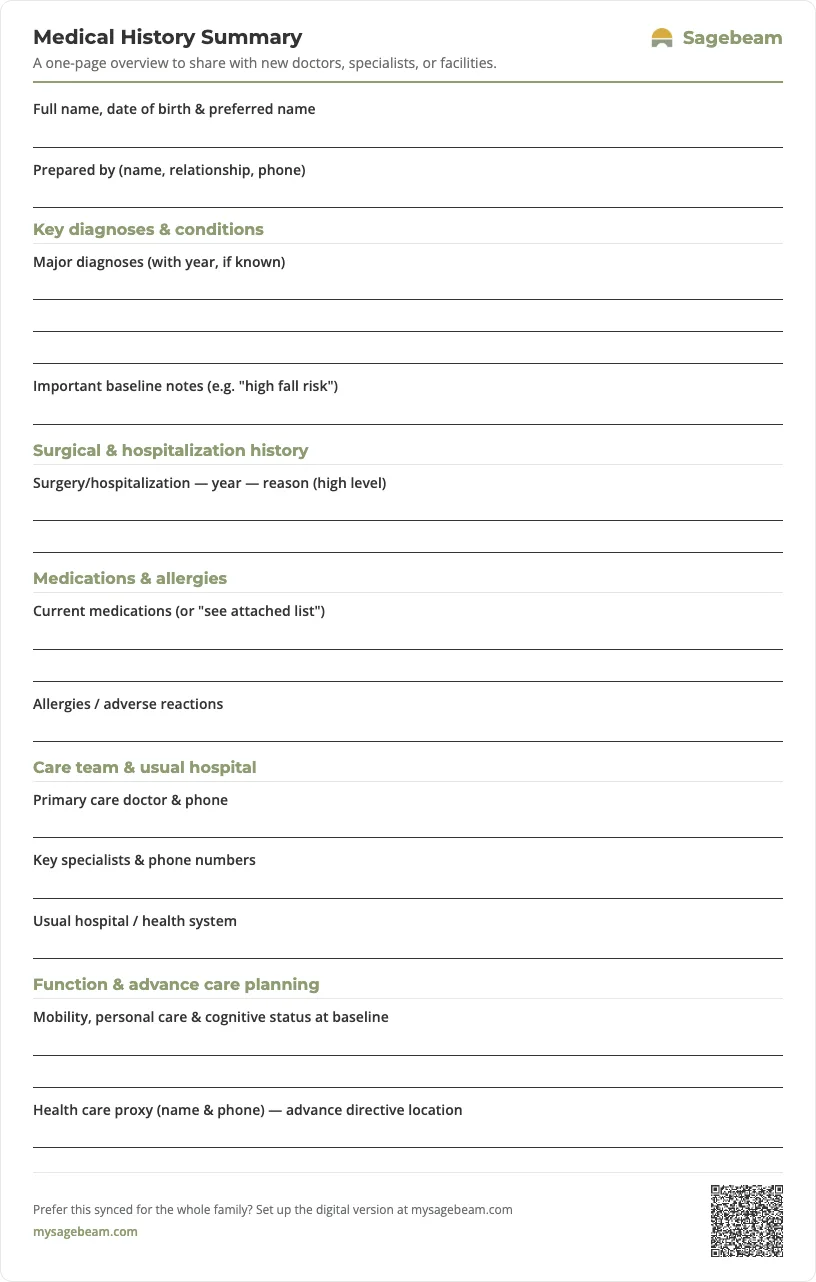
Print your medical history summary
A ready-to-use one-page sheet. Print it and fill it in by hand, or keep the same summary digitally so it stays current and easy to share.
 Sagebeam
- Tube feeding log sheet for families (printable G-tube and PEG record)
- Foley catheter output log and supply tracker (printable for families)
- Bowel movement and toileting log for elderly care (printable chart)
- Non-weight-bearing recovery support roster for families
You don't need more tabs. You need one place to run your parent's care.
By signing up, you agree to the Terms and Privacy Policy.
Related templates
- Emergency medical information sheet template – a one‑page emergency snapshot for first responders and ER staff.
- Weekly caregiver summary template for families – a weekly recap that shows how things have been going recently.
- Caregiver daily log template for families – day‑to‑day notes you can mine when filling in the history summary.